© Wikimedia Commons contributors · CC BY-SA 4.0 · Commons
Ricinus
Toxic🐾Ricinus communis · (Ricinus communis)
Spurge family (Euphorbiaceae)
Description
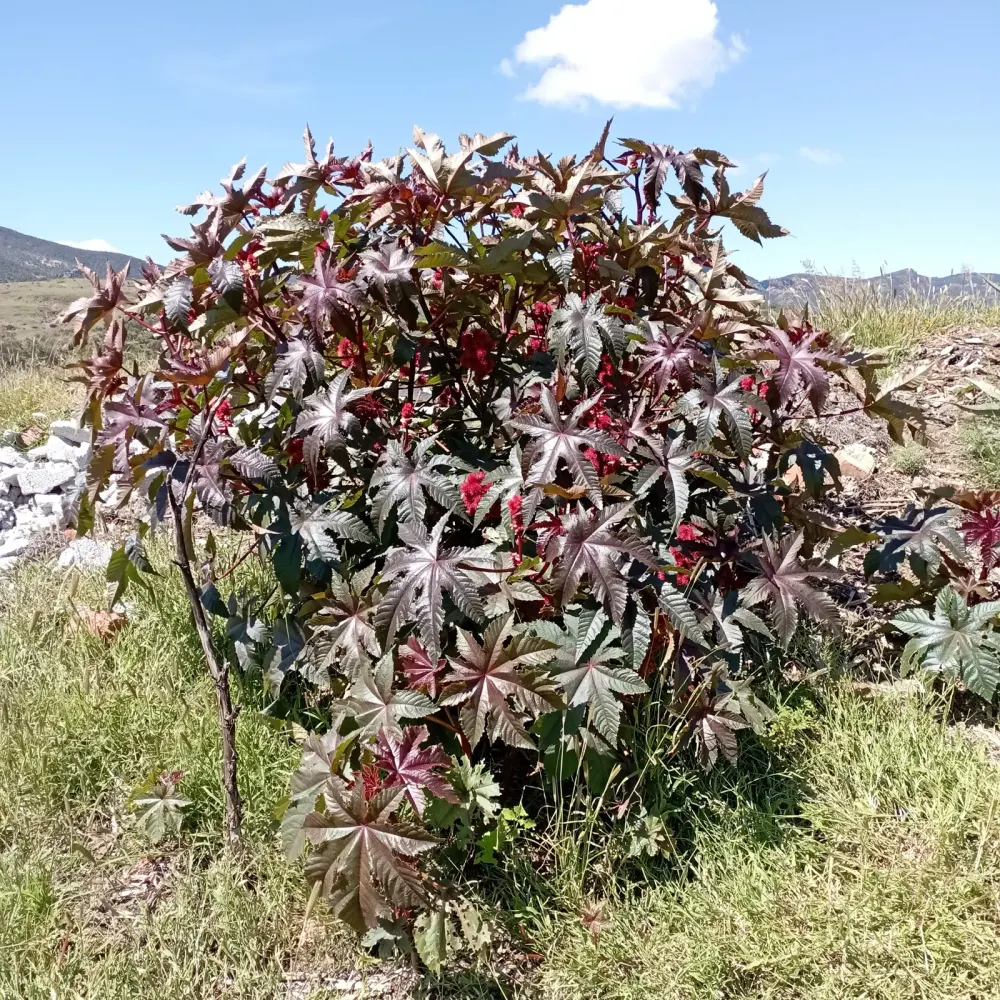
Ricinus communis, the castor bean or castor oil plant, is a species of perennial flowering plant in the spurge family, Euphorbiaceae. It is the sole species in the monotypic genus, Ricinus, and subtribe, Ricininae.
CONTRAINDICATED during pregnancy
Whole castor seeds are strictly forbidden during pregnancy — ricin poisoning and severe volume loss through diarrhoea endanger mother and child. Pure castor oil as a laxative is also only to be used under medical supervision during pregnancy (e.g. for term labour induction by midwife/obstetrician), not for self-medication, as it can trigger uterine contractions.
CONTRAINDICATED during breastfeeding
Whole seeds and plant material are strictly contraindicated during lactation. Small amounts of pure, pharmaceutical-grade castor oil are considered compatible with lactation but should be used only on medical indication due to the risk of diarrhoea in the infant.
CONTRAINDICATED for children
Castor seeds are the most common cause of severe plant poisoning in children in the Mediterranean region — the colourfully patterned, bean-like seeds are visually attractive and as few as 1–2 chewed seeds can be lethal. In suspected seed ingestion: IMMEDIATELY call emergency services and poison control. Castor oil as a laxative is no longer used in paediatrics due to its unpleasant effect and risk of cramping; gentler alternatives (macrogol, lactulose) are standard.
Critical drug interactions with:
Andere Laxanzien (Bisacodyl, Sennoside, Macrogol)
- SalveSeedExternalFolk medicine
External application of castor oil for dry skin, eczema, psoriasis and scalp dandruff. The historical epithet Palma Christi ('Hand of Christ') refers to the folk-medicinal reputation of healing wounds and alleviating ailments. Modern: cosmetic skincare, eyebrow and eyelash care; in dermatological folk medicine also for occupational eczema.
Preparation & dosage
[#src_pfaf_ricinus_communis] [#src_wp_castoroil_ricinus_communis]
- CompressSeedExternalFolk medicine
Folk medicinal application of castor oil packs on the abdomen and liver as a naturopathic detoxification and anti-inflammatory practice, popularised by US healer Edgar Cayce. Scientific evidence is lacking; the application is generally considered skin-friendly. Seed powder was also applied locally to abscesses and skin infections.
Preparation & dosage
- SalveSeedExternalFolk medicine
Folk medicinal rubbing with castor oil for joint pain, osteoarthritis and rheumatic complaints. In the Ayurvedic tradition, Eranda oil is massaged warm; ricinoleic acid acts mildly irritating and circulation-promoting on the skin. Antimicrobial activity against bacteria and fungi is plausible, but clinical evidence for the rheumatological indication is weak.
Preparation & dosage
[#src_pfaf_ricinus_communis] [#src_wp_castoroil_ricinus_communis]
- RawSeedExternalFolk medicine
Industrial and technical use of castor oil (no medicinal use): high-grade lubricant for high-performance engines (rotary engines of WWI aircraft, classic racing cars — 'Castrol R'), component in biodiesel, feedstock for sebacic acid and nylon-11, sulphonated 'Turkey Red Oil' as historical detergent. Polyglycerol polyricinoleate (PGPR, E476) is an emulsifier approved in chocolate manufacturing.
Preparation & dosage
[#src_wp_castoroil_ricinus_communis] [#src_wp_en_ricinus_communis]
Historical documentation only — do NOT use
These internal applications are historically documented. This plant is highly toxic — self-treatment can cause severe poisoning or death. For documentation only, explicitly NOT a recommendation.
- RawSeedInternalTraditional use
Castor oil (Oleum ricini), obtained by cold-pressing the seeds, has been documented as a laxative since the ancient Egyptian Ebers Papyrus (c. 1550 BC) and is today regarded as the most continuously used laxative in human history. Mechanism: in the small intestine, ricinoleic acid is released from the triglycerides; it irritates the intestinal mucosa and increases peristalsis. Onset of action 2–6 hours. Important: pressed oil is FREE of ricin — the water-soluble lectin remains in the press-cake; additionally the oil is heated above 80 °C which denatures ricin.
Preparation & dosage
[#src_wp_en_ricinus_communis] [#src_wp_castoroil_ricinus_communis] [#src_pfaf_ricinus_communis]
- RawSeedInternalFolk medicine
Historical folk-obstetric use of castor oil for labour induction at term — the so-called 'labour cocktail' of castor oil, apricot juice, sparkling wine or a warm bath is still occasionally used in German-speaking midwifery circles. Pharmacological mechanism not clearly understood; a 2024 Cochrane-style review concludes that no high-quality evidence exists for cervical ripening or labour induction, but that nausea and diarrhoea occur regularly. Use only under obstetric supervision.
Preparation & dosage
[#src_wp_castoroil_ricinus_communis] [#src_pfaf_ricinus_communis]
- TeaLeafInternalFolk medicine
Folk medicinal use of castor leaf decoctions for cough and respiratory complaints in India and West Africa. Leaves are considered only mildly toxic (the main toxin ricin is localised in the seeds), but the application is not recommended today due to an unclear active-substance profile. In Ayurvedic medicine ('Eranda'), a traditional component of polyherbal formulations.
Preparation & dosage