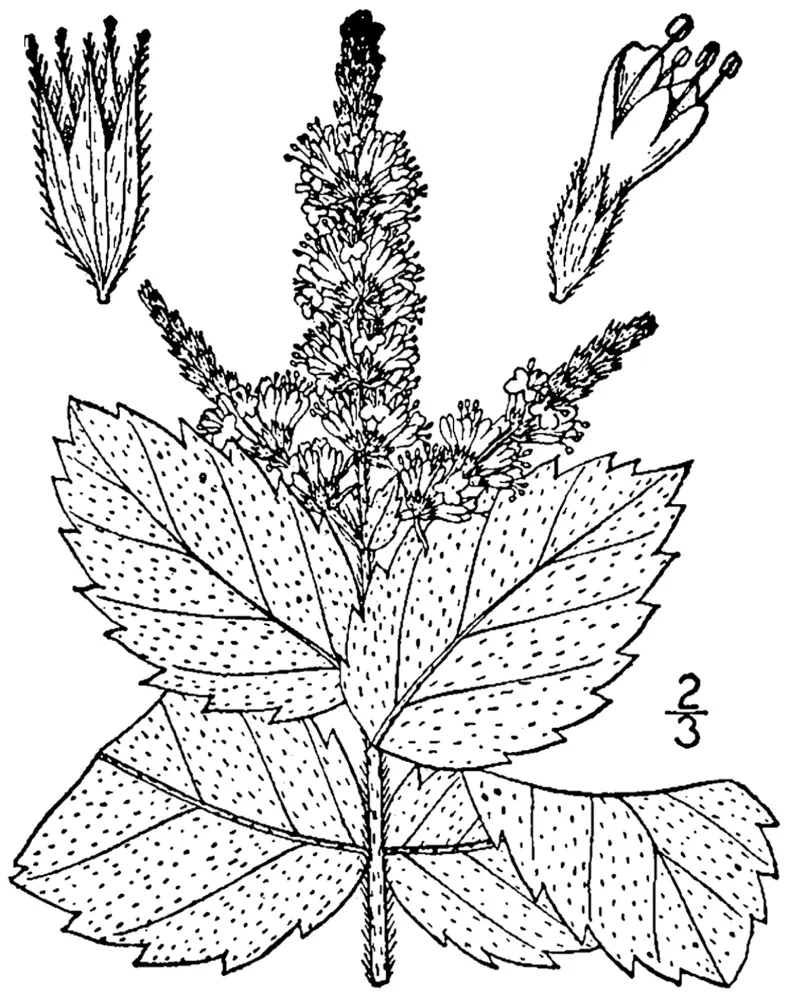
© Britton, N.L., and A. Brown. 1913. An illustrated flora of the northern United States, Canada and the British Possession · Public domain · Commons
Mentha × villosa
CautionMojito-Minze · (Mentha × villosa)
Mint family (Lamiaceae)
Description
Mentha × villosa also known as hairy mint or mojito mint is a hybrid species of mint, a cross between Mentha spicata and Mentha suaveolens.
- TeaAerial partsInternalFolk medicine
Tea from Bowles' mint leaves and sprigs is used in Brazilian and Philippine folk medicine for stomach complaints, nausea, flatulence, and dyspeptic cramps. The effect is attributed to the essential oil (limonene, carvone) and rosmarinic acid content, which act spasmolytically on gastrointestinal smooth muscle.
Preparation & dosage
Steep 2–4 g dried leaves or 4–6 g fresh leaves in 200 ml hot water, covered, for 10 minutes. Drink up to 3 cups daily after meals.
- Dry amount
- 2–4 g
- Doses per day
- 3×
- TeaAerial partsInternalFolk medicine
In Philippine and Caribbean folk medicine, mint tea (Yerba Buena) is used for mild cold symptoms, cough, and sore throat. The essential oil containing limonene and carvone has mild expectorant properties; rosmarinic acid shows antiviral activity in vitro.
Preparation & dosage
Pour 250 ml of boiling water over 2–5 g fresh or dried leaves, steep for 10 minutes. Optionally add honey and lemon. Drink warm.
- Dry amount
- 2–5 g
- Doses per day
- 3×
- Essential oilAerial partsExternalFolk medicine
The essential oil of Mentha × villosa (limonene/carvone chemotype) is used diluted (1–2% in carrier oil or via inhalation) for respiratory infections and relief of nasal congestion. Studies on vasorelaxant activity confirm vasodilatory action of the essential oil via endothelium-dependent mechanisms.
- InhalationLeafExternalFolk medicine
Steam inhalation with fresh Bowles' mint leaves or a few drops of essential oil in hot water is used in folk medicine for colds and sinus complaints. The limonene/carvone content of the oil acts as a mild expectorant and antiseptic on the nasal mucosa.
- RawLeafInternalFolk medicine
Fresh Bowles' mint leaves are used raw in cocktails (mojito, caipirinha variants), salads, desserts, and cold drinks. The mild apple-fresh mint aroma (limonene-dominant, low menthol) makes M. villosa particularly suitable for cold beverages. In Cuba and Brazil, Yerba Buena is a kitchen herb with everyday use.
- GargleAerial partsExternalFolk medicine
Oral rinse formulations based on Mentha villosa extract were tested for antimicrobial activity against oral pathogens in a Brazilian study (Nogueira et al. 2021). Extracts showed growth-inhibitory effects against selected bacterial strains, providing scientific support for the folk use as a gargle for sore throat and gingival inflammation.
- CompressLeafExternalFolk medicine
In Philippine folk medicine, crushed fresh Bowles' mint leaves are used as a compress for mild muscle pain, headaches (applied to the temples), and insect bites. Carvone and limonene show anti-inflammatory activity in vitro; controlled clinical data are lacking.
Distribution in Europe
🪴 Grow at home
- ☀ Light
- partial shade
- 💧 Water
- every few days
- 🌱 Soil
- Moist herb compost
- 🪴 Pot
- 20 cm
- ⭐ Difficulty
- ★☆☆ beginner
- 🐾 Pets
- pet-safe
Tips:
- Keep in its own pot — otherwise crowds out other herbs.
- Harvest before flowering for strongest aroma.
- Cuttings root in 1-2 weeks in a water glass.
Care tips are general indoor-gardening recommendations, not scientific sources.
🤝 Permaculture Partners
In your garden, this plant acts as:
⚠️ Better not planted together
- 🥬 Spearmint Classic companion-planting partner.
Source: Helga und Margarete Langerhorst, Mein gesunder Naturgarten (eigene Kuration)