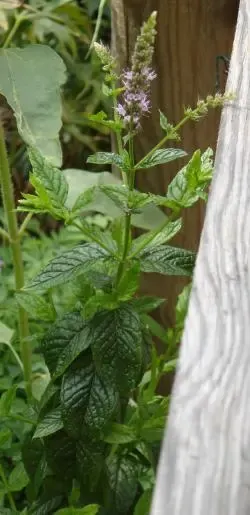
© The original uploader was Burschik at English Wikipedia. · CC BY-SA 3.0 · Commons
Spearmint
CautionGrüne Minze · (Mentha spicata)
Mint family (Lamiaceae)
Description
Spearmint, also known as garden mint, common mint, lamb mint and mackerel mint, is native to Europe and southern temperate Asia, extending from Ireland in the west to southern China in the east. It is naturalized in many other temperate parts of the world, including northern and southern Africa, North America, and South America. It is used as a flavouring in food and herbal teas.
- TeaAerial partsInternalTraditional use
Traditional infusion of leaves and herb tips for mild digestive complaints: flatulence, bloating, mild cramps. Significantly milder and more stomach-friendly than peppermint.
Preparation & dosage
INFUSION: 1.5–2 g (1–2 tsp) dried spearmint leaves (or ~4–5 g fresh) in 200 ml boiling water, covered, steep 8–10 min, strain. 2–3 cups daily between meals, freshly prepared. Traditional use for mild digestive complaints (flatulence, bloating, mild cramps). Milder than peppermint tea — no menthol kick, better tolerated. Not a substitute for medical treatment of persistent gastrointestinal complaints.
- Dry amount
- 1.5–2 g
- Doses per day
- 3×
- Max duration
- 4 weeks
[#src_pfaf_mentha_spicata] [#src_wichtl_mentha] [#src_wp_en_spearmint]
- TeaAerial partsInternalClinical trial
Spearmint tea (2×/day) showed a significant anti-androgenic effect in clinical trials in women with mild hirsutism and PCOS-associated androgen excess — the only well-documented clinical trial indication for this plant.
Preparation & dosage
SPEARMINT TEA (clinical study dose): 1–2 tsp dried spearmint leaves in 250 ml hot water, covered 10 min, strain. 2 cups daily (morning and evening). In two controlled trials (Grant 2010, Akdogan 2007) this dose showed significant reduction of free androgen levels (testosterone/LH) in women with mild hirsutism or PCOS after 30 and 90 days. Not a substitute for endocrinological treatment. Self-use: medical diagnosis and follow-up monitoring recommended.
- Dry amount
- 1.5–2 g
- Doses per day
- 2×
- Max duration
- 12 weeks
[#src_grant_2010_spearmint_hirsutism] [#src_akdogan_2007_spearmint_androgen] [#src_wp_en_spearmint]
- InhalationAerial partsExternalFolk medicine
Steam inhalation with fresh or dried leaves used in folk medicine for colds and sinus complaints — pleasantly mild scent without menthol intensity.
Preparation & dosage
STEAM INHALATION: 2–3 tbsp fresh or 1–2 tbsp dried spearmint leaves in a bowl, add 1 litre boiling water, cool 2–3 min. Lean over bowl, drape towel over head and bowl, inhale slowly and deeply for 5–10 min. 1–2×/day. Folk use for common cold, nasal congestion and sinus pressure. Carvone vapour soothes mucous membranes, but less intensely than peppermint menthol. Keep eyes closed — carvone vapour can irritate conjunctiva.
- Doses per day
- 2×
- GargleAerial partsExternalFolk medicine
Spearmint tea used as a gargle in folk medicine for mild sore throat, bad breath and mild oral mucosal inflammation.
Preparation & dosage
GARGLE: 2–3 tsp dried spearmint leaves brewed in 200 ml hot water, steep 10 min, cool to room temperature, strain. Gargle 30–60 sec 3×/day, then spit out (do not swallow). Folk use for mild sore throat, bad breath and mild oral mucosa inflammation. Mildly antibacterial via carvone and mint oil. For persistent sore throat (>3 days) or fever: seek medical advice.
- Dry amount
- 2–3 g
- Doses per day
- 3×
- Essential oilAerial partsExternalTraditional use
Essential spearmint oil (externally diluted) for headaches, muscle tension and aromatherapy — carvone profile milder than peppermint menthol.
Preparation & dosage
ESSENTIAL OIL (external household use only): Spearmint oil (carvone-dominant, 50–75 %) must NOT be applied undiluted to skin. Ready-to-use dilution: 2–3 drops in 10 ml carrier oil (e.g. jojoba), applied to chest or temples for headache. Aroma diffuser: 3–5 drops per ~20 m² room. No internal use without medical supervision. Not for children under 2 years, not on face or mucous membranes. Less intense than peppermint oil — gentler alternative for sensitive individuals.
- Doses per day
- 2×
- SpiceLeafInternalFolk medicine
Spearmint as a culinary herb — worldwide kitchen use from Morocco to India, sweet and aromatic without menthol sharpness.
Preparation & dosage
KITCHEN: Fresh or dried spearmint leaves are used in countless cuisines worldwide. Uses: Moroccan mint tea (Atay), tabbouleh, raita, chimichurri, mint sauce (English tradition), mojito, chickpea and lamb dishes, salads, yoghurt dips. Fresh leaves have a finer, sweeter flavour than peppermint, without the sharp menthol. Dried: more aromatic and concentrated — use sparingly (1 tsp dried ≈ 1 tbsp fresh). Long-cultivated crop plant in the Mediterranean, Middle East and North Africa.
[#src_wp_en_spearmint] [#src_wp_de_gruene_minze] [#src_pfaf_mentha_spicata]
- BathAerial partsExternalFolk medicine
Spearmint herbal bath used in folk medicine for relaxation, refreshment and mild skin toning — pleasant light mint fragrance without the intense cooling effect of peppermint.
Preparation & dosage
HERBAL BATH: 50–80 g dried spearmint leaves and stems in 1 litre hot water, steep covered 15 min, strain, add infusion to full bath (36–38 °C). Soak 15–20 min. Alternative: 5–8 drops essential spearmint oil dissolved in 30 ml emulsifier (cream, milk, or bath salts) added to bath water. Folk use for relaxation and refreshment, mildly toning. No full bath with essential oil for children under 2 years.
- Dry amount
- 50–80 g
- Doses per day
- 1×
- TinctureAerial partsInternalTraditional use
Traditional spearmint tincture for functional digestive complaints — preserves the carvone-rich essential oil spectrum better than a hot infusion.
Preparation & dosage
TINCTURE (DER 1:5 in 45 % ethanol): 1–2 ml (~20–40 drops) 3× daily, diluted in water, before meals. Traditional use for functional gastrointestinal complaints (flatulence, bloating, mild cramps). Less common than tea; carvone being volatile can partly escape during brewing — tincture better preserves the essential oil spectrum. Not for alcohol sensitivity, liver disease or children.
- Liquid amount
- 1–2 ml
- Doses per day
- 3×
- Max duration
- 4 weeks
Distribution in Europe
🪴 Grow at home
- ☀ Light
- partial shade
- 💧 Water
- every few days
- 🌱 Soil
- Moist herb compost
- 🪴 Pot
- 20 cm
- ⭐ Difficulty
- ★☆☆ beginner
- 🐾 Pets
- pet-safe
Tips:
- Milder than peppermint — good for tea and mojito.
- Keep in own pot.
- Cuttings root easily in water glass.
Care tips are general indoor-gardening recommendations, not scientific sources.
🤝 Permaculture Partners
In your garden, this plant acts as:
⚠️ Better not planted together
- 🥬 Peppermint Classic companion-planting partner.
- 🥬 Mentha × villosa Classic companion-planting partner.
Source: Helga und Margarete Langerhorst, Mein gesunder Naturgarten (eigene Kuration)