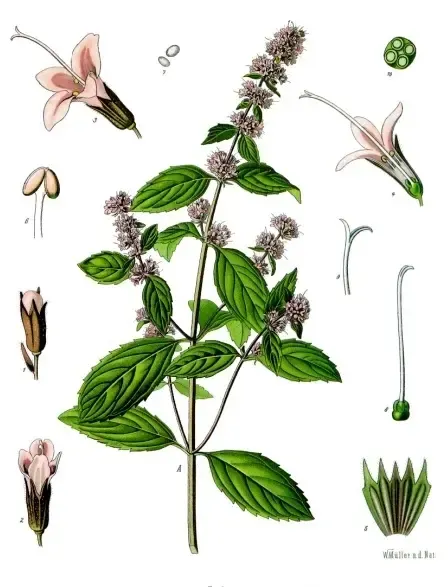
© Franz Eugen Köhler, Köhler's Medizinal-Pflanzen · Public domain · Commons
Peppermint
CautionPfefferminze · (Mentha × piperita)
Mint family (Lamiaceae)
Description
Peppermint is a hybrid species of mint, a cross between watermint and spearmint. Indigenous to Europe and the Middle East, the plant is now widely spread and cultivated in many regions of the world. It is occasionally found in the wild with its parent species.
Critical drug interactions with:
Antazida, H2-Rezeptor-Antagonisten, Protonenpumpenhemmer (PPI)
- TeaLeafInternalCommission E
Peppermint leaf infusion (Kommission E positive) for relief of digestive complaints including flatulence, dyspepsia and spasmodic gastrointestinal symptoms.
Preparation & dosage
INFUSION (Kommission E / EMA traditional): 1.5–3 g of finely cut dried peppermint leaf in 150 ml boiling water, covered, steep 10 min, strain. Three times daily, freshly prepared, preferably between meals or before eating. Daily dose 3–6 g. Indications: dyspepsia, bloating, flatulence, spasmodic gastrointestinal complaints. Children 4–11 yrs: 1–2 g per cup, max. 3× daily. Do not use in reflux / heartburn / hiatal hernia — menthol relaxes the lower oesophageal sphincter. Maximum self-treatment duration 4 weeks without medical evaluation.
- Dry amount
- 1.5–3 g
- Doses per day
- 3×
- Max duration
- 4 weeks
⚠ Age restriction: ≥ 4 years — Not recommended for children under 4. Children 4–11 years with reduced dose (1–2 g). Adult dose from age 12.
[#src_ema_mentha_folium_enriched] [#src_kommission_e_mentha] [#src_escop_mentha_folium] [#src_wichtl_mentha]
- Essential oilLeafInternalEMA well-established
Peppermint oil in enteric-coated capsules (EMA well-established use) — leading herbal preparation for irritable bowel syndrome with solid clinical evidence.
Preparation & dosage
PEPPERMINT OIL — ENTERIC-COATED CAPSULES (EMA well-established use): 0.2–0.4 ml peppermint oil in enteric-coated capsules, 3× daily, swallowed whole (!) with a large glass of water, 30–60 min before meals. Daily dose 0.6–1.2 ml. Children 8–11 yrs: 0.2 ml 3× daily. Indication: irritable bowel syndrome (IBS — spasmodic abdominal pain, meteorism, altered bowel habits). Enteric coating is mandatory — menthol released in the stomach causes heartburn, belching and oesophageal spasm. Do NOT take with antacids, H2-blockers or proton pump inhibitors — premature coating dissolution. Contraindicated in gallstones, cholangitis, achlorhydria, severe liver disease.
- Liquid amount
- 0.2–0.4 ml
- Doses per day
- 3×
- Max duration
- 12 weeks
⚠ Age restriction: ≥ 8 years — Contraindicated under 2 years (menthol-induced apnoea, laryngospasm). Not recommended under 8 years. Children 8–11 yrs: 0.2 ml capsule only.
[#src_ema_mentha_aetheroleum_enriched] [#src_escop_mentha_aetheroleum] [#src_cochrane_ibs_peppermint] [#src_kommission_e_mentha]
- Essential oilLeafExternalEMA well-established
External application of 10 % peppermint oil on forehead and temples for mild tension headache — analgesic effect clinically documented (EMA well-established use).
Preparation & dosage
EXTERNAL USE — TENSION HEADACHE (EMA well-established): 10 % peppermint oil in ethanol applied liberally to forehead and temples. One application, repeat after 15 min if needed, maximum three times. Do not apply to eyes, mucous membranes or wounds. Not for face or nose of infants/toddlers under 2 (apnoea risk). Demonstrated analgesic action via cutaneous cold reflexes (TRPM8 activation) and reduced scalp circulation — clinically comparable to 500 mg paracetamol.
- Doses per day
- 3×
⚠ Age restriction: ≥ 18 years — Per EMA for this specific indication adults 18+ only. General external use from age 12 on small skin areas possible.
[#src_ema_mentha_aetheroleum_enriched] [#src_escop_mentha_aetheroleum] [#src_goebel_1996_headache]
- InhalationLeafExternalTraditional use
Steam inhalation with peppermint oil for symptomatic relief of cold symptoms and upper respiratory tract catarrh (EMA traditional use).
Preparation & dosage
STEAM INHALATION (EMA traditional): 2–4 drops (0.08–0.16 ml) peppermint oil in a bowl of hot (not boiling, ~65–70 °C) water. Cover head with towel, close eyes, breathe deeply through the nose for 5–10 min. Up to 3× daily. Maintain at least 30 cm from the water to avoid scalding. Indication: symptomatic relief of colds, nasal congestion, upper respiratory tract catarrh. Alternative: 1–2 drops on a handkerchief and inhale. NOT for bronchial asthma or hypersensitive airways.
- Liquid amount
- 0.08–0.16 ml
- Doses per day
- 3×
- Max duration
- 2 weeks
⚠ Age restriction: ≥ 12 years — Contraindicated under 2 years. Not recommended under 12 years. From age 12 with reduced dose (1–2 drops).
[#src_ema_mentha_aetheroleum_enriched] [#src_escop_mentha_aetheroleum] [#src_who_mentha]
- TinctureLeafInternalTraditional use
Traditional peppermint tincture for dyspepsia and spasmodic gastrointestinal complaints — alternative to tea for precise dosing.
Preparation & dosage
TINCTURE (DER 1:5 in 45–70 % ethanol): 2–4 ml (40–80 drops) 3× daily, diluted in water, between meals. Daily dose 6–12 ml. Traditional use for dyspepsia, spasmodic gastrointestinal complaints and nervous stomach upsets. Action based on menthol (spasmolytic) and flavonoids (cholagogue). Due to ethanol: not in alcohol dependence, liver disease, pregnancy, lactation or children. Do not use in heartburn / reflux.
- Liquid amount
- 2–4 ml
- Doses per day
- 3×
- Max duration
- 4 weeks
[#src_escop_mentha_folium] [#src_who_mentha] [#src_wichtl_mentha]
- CompressLeafExternalFolk medicine
Folk peppermint compress for muscle tension, tired legs and mild joint complaints — cooling-analgesic effect through menthol.
Preparation & dosage
COMPRESS (folk use): 5–10 g dried peppermint leaves in 500 ml boiling water, steep 15 min, strain, cool to ~40 °C. Soak a linen cloth or gauze bandage, squeeze gently, apply to the affected area (tense neck, tired legs, sore joints) for 10–15 min. Twice daily. Volatile menthol vapour provides local analgesic and cooling effect via TRPM8 stimulation. Do NOT apply to irritated, broken skin or mucous membranes.
- Dry amount
- 5–10 g
- Doses per day
- 2×
- Max duration
- 2 weeks
- SpiceLeafInternalFolk medicine
Fresh and dried peppermint leaves as culinary herb in salads, sauces, beverages and spice mixes — versatile in the kitchen and used worldwide.
Preparation & dosage
KITCHEN: Fresh or dried peppermint leaves are a versatile culinary herb. Fresh leaves: tabbouleh, mint sauce with lamb (British traditional), mojito, mint lemonade, summer salads, yoghurt dips (tzatziki variant), fruit salads, iced teas. Dried leaves: herbal tea blends, marinades, spice mixes (Moroccan ras el hanout). Culinary amounts have no therapeutic effect — safe as a spice. Peppermint propagates easily from cuttings and grows in any moist pot. Note: caution with open-ground planting — the plant spreads via runners and can crowd out other herbs.
Distribution in Europe
🪴 Grow at home
- ☀ Light
- partial shade
- 💧 Water
- every few days
- 🌱 Soil
- Moist herb compost
- 🪴 Pot
- 20 cm
- ⭐ Difficulty
- ★☆☆ beginner
- 🐾 Pets
- pet-safe
Tips:
- In its own pot — otherwise spreads.
- Partial shade better than full sun.
- Divide root in spring for new plants.
Care tips are general indoor-gardening recommendations, not scientific sources.
🤝 Permaculture Partners
In your garden, this plant acts as:
✨ Best symbiotic partners
- 🌿 Matricaria chamomilla Chamomile enhances mint aroma — Holzer favourite pair.
- 🌿 Urtica dioica Classic companion-planting partner.
⚠️ Better not planted together
- 🥬 Lavandula angustifolia Mint needs moist soil, lavender needs dry.
- 🥬 Spearmint Classic companion-planting partner.
- 🥬 Basil Mint overgrows basil and competes for water.
- 🥬 Parsley Classic companion-planting partner.
Source: Helga und Margarete Langerhorst, Mein gesunder Naturgarten (eigene Kuration)