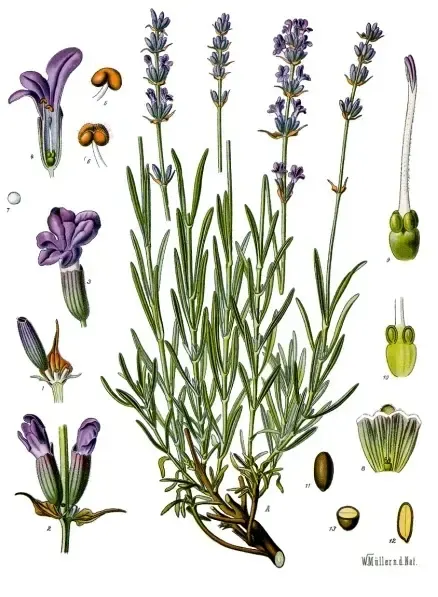
© Franz Eugen Köhler, Köhler's Medizinal-Pflanzen · Public domain · Commons
Lavandula angustifolia
CautionEchter Lavendel · (Lavandula angustifolia)
Mint family (Lamiaceae)
Description
Lavandula angustifolia, formerly L. officinalis, is a flowering plant in the family Lamiaceae, native to the Mediterranean basin. Its common names include lavender, true lavender and English lavender ; also garden lavender, common lavender and narrow-leaved lavender.
CONTRAINDICATED for children
Do NOT use lavender essential oil in children under 12 — EMA cites lack of data, and there are reports of gynaecomastia in prepubertal boys. Tea also only from 12 years.
- TeaFlowerInternalTraditional use
Calming tea for restlessness and mild difficulty falling asleep.
Preparation & dosage
Pour 150–200 ml boiling water over 1–2 tsp (~1–2 g) dried lavender flowers, cover and steep for 10 minutes, then strain. Drink 2–3 cups a day, last cup ~30 min before bedtime.
- Dry amount
- 1–2 g
- Doses per day
- 3×
- Max duration
- 2 weeks
⚠ Age restriction: ≥ 12 years — Per EMA, only for adults and adolescents from 12 years.
- BathFlowerExternalTraditional use
Relaxation bath for nervous tension and sleep problems.
Preparation & dosage
For a relaxing full bath: 100 g dried lavender flowers + 2 L boiling water, steep 10 min, strain and add to bath water. Temperature 35–38 °C, duration 10–20 minutes. Max once daily. Rest afterwards.
- Dry amount
- 100–100 g
- Doses per day
- 1×
- Max duration
- 4 weeks
⚠ Age restriction: ≥ 12 years — Per EMA, only for adults and adolescents from 12 years.
- Essential oilFlowerInternalEMA well-established
Standardised lavender oil (Silexan, 80–160 mg/day) for subsyndromal anxiety and stress-related restlessness — the only lavender application with clinical evidence (EMA well-established use). Several RCTs show effects comparable to low-dose lorazepam, without dependence potential.
Preparation & dosage
Use only as an authorised finished medicine (e.g. Silexan soft capsules): 1 capsule of 80 mg standardised lavender oil per day, if needed 2 (160 mg/day). Swallow with liquid at a meal. IMPORTANT: Never take pure essential oil by the spoon. Effect after 1–2 weeks, trials over 10 weeks.
- Doses per day
- 1×
- Max duration
- 10 weeks
⚠ Age restriction: ≥ 18 years — Internal use of Silexan capsules only for adults from 18 years.
- Essential oilFlowerExternalTraditional use
Diluted lavender oil for relaxation massage in muscle tension and nervous restlessness. Traditional use.
Preparation & dosage
For a relaxing massage: ALWAYS dilute essential oil in a carrier oil. Maximum 1–3 % (5–15 drops per 50 ml). NEVER apply undiluted. Patch test on inner arm before first use. Massage in gently 1–2 times a day.
- Doses per day
- 2×
- Max duration
- 4 weeks
⚠ Age restriction: ≥ 12 years — In children under 12 — especially prepubertal boys — avoid skin-contact use of lavender oil.
- InhalationFlowerExternalTraditional use
Aromatherapy for calming and as a sleep aid — traditional use.
Preparation & dosage
As a sleep aid: 1–2 drops on a handkerchief beside the pillow — not on bedding or skin. Alternatively 2–4 drops in a diffuser ~30 min before bedtime, max 1 hour. Air the room well.
- Doses per day
- 2×
- Max duration
- 4 weeks
⚠ Age restriction: ≥ 12 years — In children under 12, no essential oils in bedroom diffusers.
Distribution in Europe
🪴 Grow at home
- ☀ Light
- full sun
- 💧 Water
- weekly
- 🌱 Soil
- Sandy-loamy, calcareous, with drainage
- 🪴 Pot
- 25 cm
- ⭐ Difficulty
- ★★☆ intermediate
- 🐾 Pets
- pet-safe
Tips:
- Mediterranean — lots of sun, little water, good drainage essential.
- Not ideal in pots — roots want deep soil. Large container.
- Dried flowers in bedroom calming + moth deterrent.
Care tips are general indoor-gardening recommendations, not scientific sources.
🤝 Permaculture Partners
In your garden, this plant acts as:
✨ Best symbiotic partners
- 🌿 Yarrow Classic companion-planting partner.
- 🌿 Oregano Classic companion-planting partner.
- 🌿 Rosemary Mediterranean dry specialists — lavender draws bees, rosemary protects.
- 🌿 Salvia officinalis Classic companion-planting partner.
- 🌿 Thymus vulgaris Classic companion-planting partner.
⚠️ Better not planted together
- 🥬 Peppermint Mint needs moist soil, lavender needs dry.
📦 Part of these planting sets:
Source: Helga und Margarete Langerhorst, Mein gesunder Naturgarten (eigene Kuration)