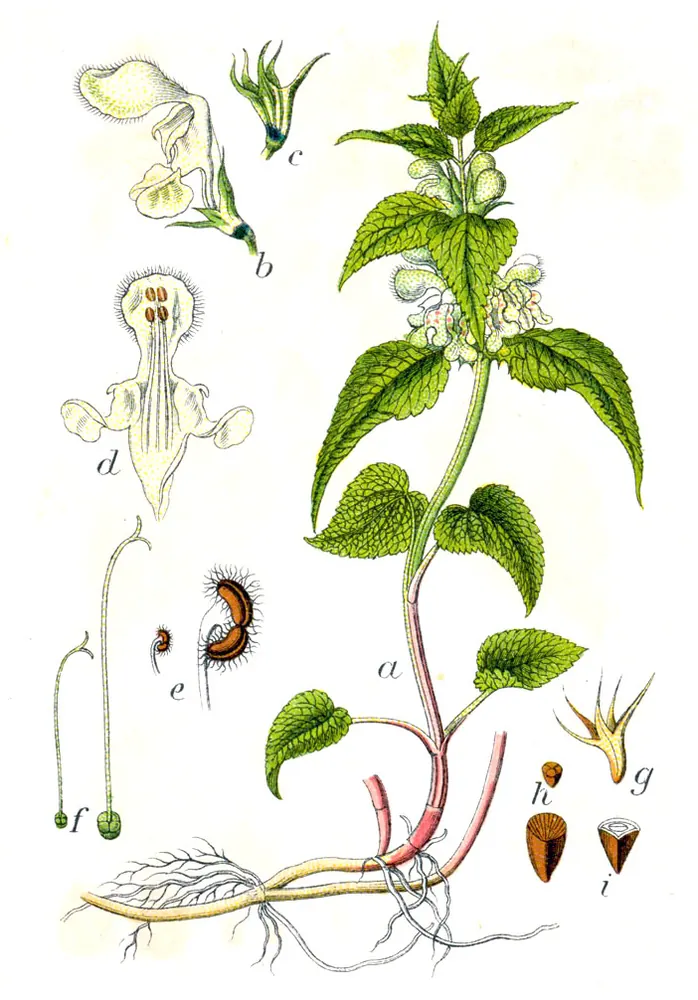
© Jacob Sturm (in: Deutschlands Flora in Abbildungen, 1796) · Public domain · Commons
White deadnettle
Weiße Taubnessel · (Lamium album)
Mint family (Lamiaceae)
Description
White deadnettle is a perennial herb of the mint family with a distinctly square stem and opposite, nettle-like but non-stinging leaves, typically growing 25 to 50 cm tall. Its white, two-lipped flowers appear in false whorls in the upper leaf axils and bear an oblique ring of hairs inside the corolla tube that shields the nectar for long-tongued insects such as bumblebees. The medicinal drug consists mainly of the dried flowers (Lamii albi flos), and less commonly the flowering herb (Lamii albi herba). The plant contains iridoids, flavonols, phenylpropanoid glycosides, tannins and mucilage. It is regarded as a mild, soothing and astringent remedy.
- TeaFlowerInternalCommission E
Taken internally for catarrh of the upper respiratory tract; the mucilage and tannins soothe irritated airway mucous membranes.
Preparation & dosage
Pour boiling water over the dried flowers, cover and steep for about 10 minutes, then strain. Drink freshly prepared up to three times daily for catarrh of the upper respiratory tract.
- Dry amount
- 2–4 g
- Doses per day
- 3×
- Max duration
- 4 weeks
- GargleFlowerExternalCommission E
Used externally as a gargle and rinse for mild inflammation of the mouth and throat mucosa.
Preparation & dosage
Prepare an infusion of the flowers, let it cool and use several times daily as a gargle or mouth rinse. Do not swallow.
- Dry amount
- 2–4 g
- Doses per day
- 3×
- Max duration
- 3 weeks
- TeaFlowerInternalTraditional use
Traditionally a women's remedy for excessive menstruation and increased vaginal discharge; the astringent action of the tannins underlies this folk application.
Preparation & dosage
Prepare a flower infusion and drink up to three times daily. Traditionally used to ease heavy or irregular menstruation.
- Dry amount
- 2–4 g
- Doses per day
- 3×
- Max duration
- 3 weeks
- TinctureFlowerInternalTraditional use
A concentrated preparation for internal use in respiratory catarrh and as a mild women's remedy.
Preparation & dosage
Take 2 to 4 ml of tincture (commonly 1:5 in 25 % alcohol) per single dose in a little water, up to three times daily.
- Liquid amount
- 2–4 ml
- Doses per day
- 3×
- Max duration
- 4 weeks
- CompressAerial partsExternalFolk medicine
Used in folk medicine as a compress for minor wounds, bruises and skin inflammation; traditionally applied as a wound-healing (vulnerary) remedy.
Preparation & dosage
Prepare a strong infusion of the flowering herb, soak a cloth and apply to the affected skin. Renew once or twice daily.
- Dry amount
- 5–10 g
- Doses per day
- 2×
- Max duration
- 2 weeks
- BathAerial partsExternalFolk medicine
A traditional sitz bath for lower abdominal complaints and increased discharge; the astringent action is the main rationale.
Preparation & dosage
Prepare an infusion from about 5 to 10 g of dried herb per litre and add it to a sitz bath. Use at most once daily.
- Dry amount
- 5–10 g
- Doses per day
- 1×
- Max duration
- 2 weeks
- RawLeafInternalFolk medicine
The young shoots and leaves are edible and were formerly eaten as a wild vegetable, raw or cooked.
Preparation & dosage
Gather young leaves and shoot tips before flowering, wash them and add raw to salads or cook like spinach.
- Dry amount
- 10–30 g
- Doses per day
- 1×
- Max duration
- 8 weeks
🤝 Permaculture Partners
In your garden, this plant acts as: