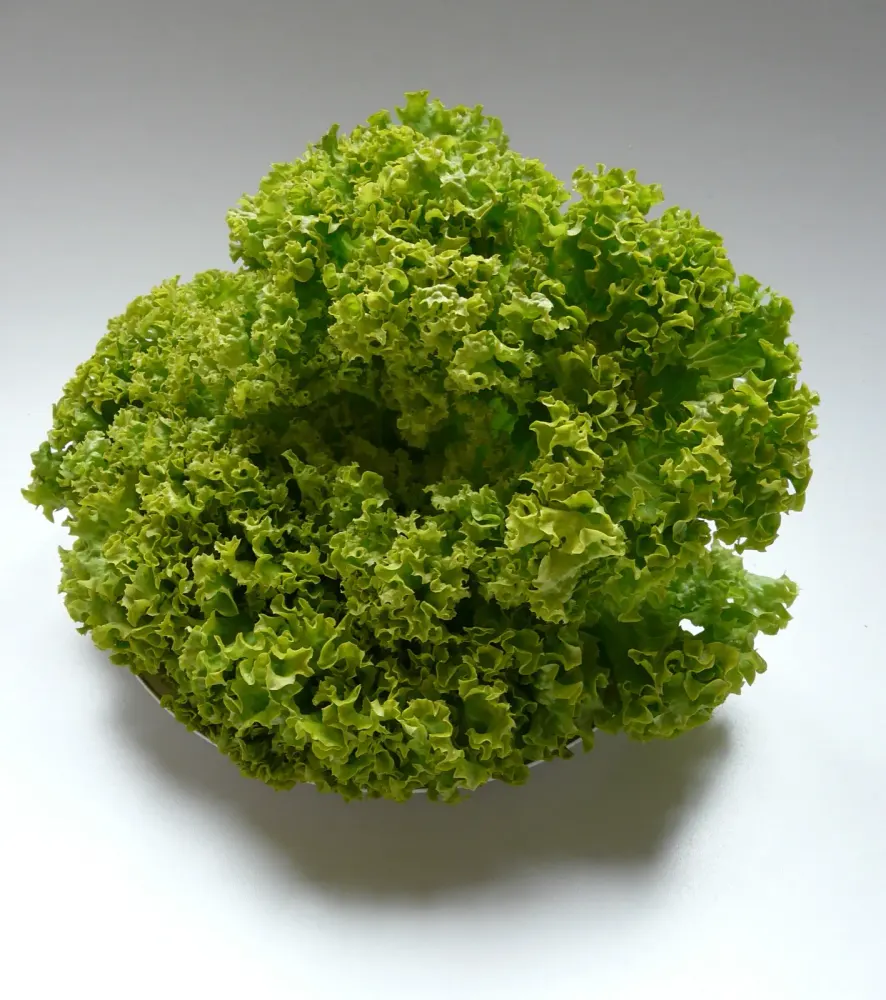
© Photograph: Frank C. Müller, Baden-Baden · CC BY-SA 4.0 · Commons
Lettuce
Schnittsalat · (Lactuca sativa var. crispa)
Daisy family (Asteraceae)
Description
Lettuce is an annual plant of the family Asteraceae mostly grown as a leaf vegetable. The leaves are most often used raw in green salads, although lettuce is also seen in other kinds of food, such as sandwiches, wraps and soups; it can also be grilled. Its stem and seeds are sometimes used; celtuce is one variety grown for its stems, which are eaten either raw or cooked.
- RawLeafInternalTraditional use
Looseleaf or cutting lettuce is a cultivar group of Lactuca sativa that, unlike head lettuce, does not form a closed head but rather a loose rosette of curled or smooth, often coloured leaves (Lollo Rossa, Lollo Bionda, oakleaf). Eaten raw as a leaf salad it supplies per 100 g about 95 % water, around 14 kcal and meaningful amounts of vitamin K1, folate, provitamin A and potassium at very low energy density — a classic satiety vegetable that supports hydration and stimulates intestinal peristalsis through its dietary fibre.
[#src_wp_de_schnittsalat] [#src_wp_en_lettuce] [#src_usda_loose_leaf_lettuce] [#src_pfaf_lactuca]
- RawLeafInternalTraditional use
Looseleaf lettuce is one of the richest vitamin K1 sources among lettuces: USDA data give approx. 125 µg phylloquinone per 100 g fresh — about 100 % of the daily requirement. Vitamin K is essential for carboxylation of coagulation factors II, VII, IX and X and for activating the bone protein osteocalcin. Dark green, red or bronze outer leaves contain substantially more vitamin K and carotenoids than the pale inner leaves and should be eaten rather than discarded.
[#src_usda_loose_leaf_lettuce] [#src_wp_en_lettuce] [#src_nutritionvalue_looseleaf]
- RawLeafInternalTraditional use
Looseleaf lettuce is a relevant source of folate (vitamin B9, approx. 38 µg/100 g) and provitamin A in the form of beta-carotene (approx. 4400 µg/100 g, especially in dark green varieties). Folate is particularly important in early pregnancy for neural tube prevention; beta-carotene is converted to retinol as needed and supports vision, immune defence and skin integrity. Carotenoid absorption improves considerably when the salad is consumed with some fat (oil dressing).
[#src_usda_loose_leaf_lettuce] [#src_nutritionvalue_looseleaf] [#src_wp_en_lettuce]
- TeaAerial partsInternalFolk medicine
In German and European folk medicine of the 18th and 19th centuries, a mild infusion of the bitter milky sap (lettuce opium, Latin lactucarium) from bolting lettuce plants was regarded as a gentle sleep aid, sedative and cough remedy. The dried white latex that exudes when the stem and leaf veins are cut was harvested; it contains the sesquiterpene lactones lactucin and lactucopicrin. Cutting lettuce (L. sativa) yields substantially milder concentrations than the related wild lettuce (L. virosa), from which pharmaceutical lactucarium was obtained. Clinical efficacy data in humans are lacking; the use is purely traditional folk medicine.
Preparation & dosage
[#src_wp_en_lactucarium] [#src_pfaf_lactuca] [#src_wp_en_lactucopicrin]
- CompressLeafExternalFolk medicine
In Central European household tradition, chilled washed lettuce leaves were placed as a cooling compress on tired, swollen eyelids, mildly irritated skin or minor redness. The high water content (~95 %) produces an evaporative cooling effect and eases subjective tension. The use is folkloric and not supported by clinical trials; not advisable on open wounds or eye infections.
- RawLeafInternalFolk medicine
Looseleaf lettuce is particularly well suited to the 'cut-and-come-again' method: instead of harvesting a whole head, only the outer leaves are cut or picked while the plant continues growing from its growing point. This allows continuous small harvests over several weeks — ideal for smoothies, mixed salads, as a wrap filling or garnish. Young leaves are particularly tender and mild; with age and approaching bolting they turn bitter.
🤝 Permaculture Partners
In your garden, this plant acts as:
✨ Best symbiotic partners
- 🌿 Onion Classic companion-planting partner.
- 🌿 Cabbage Classic companion-planting partner.
- 🌿 Kohlrabi Classic companion-planting partner.
- 🌿 Carrot Classic companion-planting partner.
- 🌿 Fragaria vesca Classic companion-planting partner.
- 🌿 Radish Classic companion-planting partner.
📦 Part of these planting sets:
Source: Helga und Margarete Langerhorst, Mein gesunder Naturgarten (eigene Kuration)