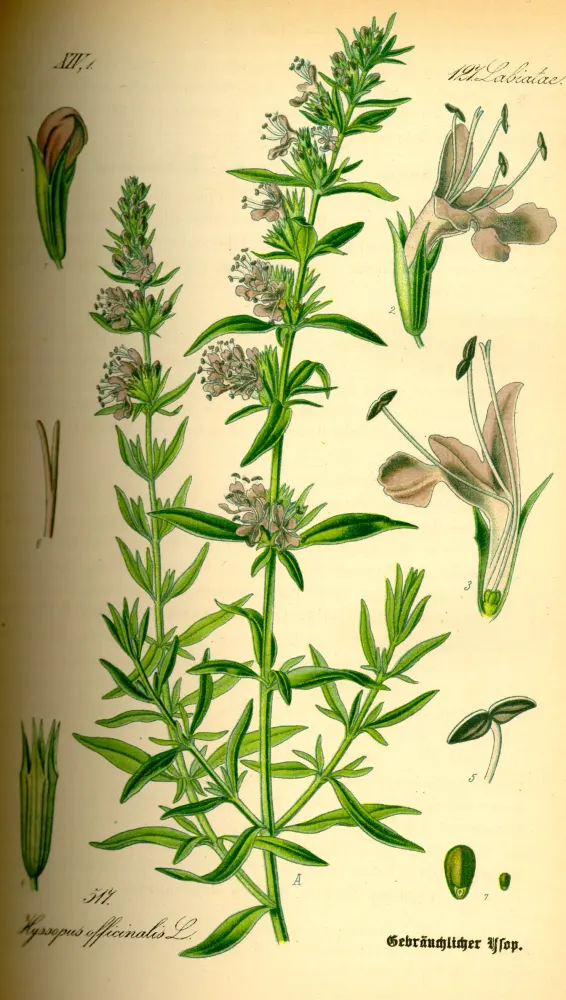
© User:Topjabot · Public domain · Commons
Hyssopus officinalis
CautionEchter Ysop · (Hyssopus officinalis)
Mint family (Lamiaceae)
Description
Hyssop is a small evergreen subshrub of the Mediterranean with narrow leaves and deep blue flower spikes, grown in monastery and cottage gardens since the Middle Ages. Its aroma is intensely minty with a pronounced bitter edge; in cooking it seasons robust dishes, appears in some za'atar blends and flavours herbal liqueurs such as Chartreuse and absinthe. The flowering herb is the part harvested. Traditionally, an infusion serves for stubborn cough, bronchitis and congested airways; the diterpene lactone marrubiin is considered the main expectorant component, while the 1,8-cineole in the essential oil underpins its use in steam inhalation. Cooled and concentrated, the same infusion becomes a gargle for sore throats, and warm it serves as a compress for bruises. One caution stands out: the pure essential oil belongs on the skin only diluted and never in the mouth — even a few drops can trigger seizures in children.
CONTRAINDICATED during pregnancy
Do not use during pregnancy — may induce uterine contractions and promote miscarriage.
Critical drug interactions with:
Antikonvulsiva / Antiepileptika
Infusion from flowering hyssop herb is the traditional remedy for bronchitis, persistent cough, and mucus congestion of the airways. The diterpene lactone marrubiin is considered the primary agent responsible for the expectorant (mucus-loosening) action.
Preparation & dosage
Pour boiling water over 2–4 g dried flowering herb, steep 10 minutes, strain. 3 cups daily, maximum 4 weeks.
- Dry amount
- 2–4 g
- Doses per day
- 3×
- Max duration
- 4 weeks
Concentrated cooled infusion used as a gargle for sore throat and oral mucosa inflammation. Astringent tannins and antimicrobial phenolic acids support the antiseptic action.
Hyssop tea stimulates gastric secretion, acts carminatively (reducing flatulence), and relieves cramps of the upper digestive tract. Historically used in chronic gastritis, loss of appetite, and bloating.
Preparation & dosage
Pour boiling water over 2–3 g dried herb; drink warm before or after meals.
- Dry amount
- 2–3 g
- Doses per day
- 3×
Fresh or dried hyssop leaves and flowers used as an aromatic culinary herb in Mediterranean and Middle Eastern cuisine. Component of the Middle Eastern spice blend za'atar; also used in Chartreuse and absinthe. Intense minty flavour with a slight bitterness.
Sources: [1]
Warm compresses with concentrated hyssop infusion applied for rheumatism, bruises, and poorly healing wounds. Antimicrobial and anti-inflammatory properties of the essential oil and flavonoids support topical application.
Steam inhalation with hyssop herb infusion for upper respiratory tract catarrh. 1,8-Cineole in the essential oil has mucosal soothing and bronchodilatory properties.
Sources: [3]
Essential oil for EXTERNAL use only and diluted; never ingest neat. Even small amounts of pure oil (2–3 drops in children) can trigger seizures. Tea in normal dosage is considered safe for adults.
⏱ Max continuous use: 4 weeks
Do not use during pregnancy — may induce uterine contractions and promote miscarriage.
Insufficient data for breastfeeding; avoid as a precaution.
Essential oil contraindicated for children of any age. Tea from the herb in small amounts may be used in children over 12 with medical guidance; under 12 only under supervision.
Drug interactions
Antikonvulsiva / Antiepileptika
Pinocamphone in the essential oil may have pro-convulsant action — contraindicated in epilepsy. Interaction with anticonvulsants possible.
Sedativa / Schlafmittel
Possible additive CNS depressant effect.
Contraindications
- Pregnancy.
- Epilepsy or other seizure disorders (essential oil absolutely contraindicated; tea with caution).
- Known hypersensitivity to plants in the Lamiaceae family.
Harvested part: flowering herb
- Time of day:
- Morning after dew has dried, in dry sunny weather for highest oil content.
- Drying:
- Tie shoots into small bundles and hang upside down in a ventilated, shaded location. Drying time approx. 6 days; dry weight approximately one-third of fresh weight.
- Storage:
- 18 months — In dark, airtight containers at room temperature; usable for up to 18 months.
- Time of day:
- First harvest at start of flowering (May–June) possible; second harvest at full bloom (July–August) yields more essential oil.
- Drying:
- Same as main summer harvest; early cutting encourages a vigorous second flush of growth.
- Storage:
- 18 months — Store in dark, airtight containers, dry and cool.
- Pinocamphor und cis-PinocamphorEssential oilContent: 2,94–63,55 % im ätherischen ÖlAerial parts
Characteristic ketones of hyssop oil; responsible for the expectorant potential but also for the neurotoxic (pro-convulsant) risk at excessive doses.
- 1,8-Cineol (Eucalyptol)Essential oilContent: bis zu 53 % im ätherischen Öl (Chemotyp-abhängig)Aerial parts
Monoterpene oxide; mucolytic, bronchodilatory, and anti-inflammatory in the respiratory tract.
- MarrubiinBitterAerial parts
Diterpene lactone; considered the primary agent responsible for hyssop's expectorant action; structurally related to the marrubiin of white horehound (Marrubium vulgare).
- Diosmin und HesperidinFlavonoidFlower
Flavonoid glycosides; diosmin strengthens capillary walls and counters venous problems; hesperidin is antioxidant and anti-inflammatory.
- RosmarinsäurePhenolic acidContent: ca. 0,5 %Aerial parts
Polyphenolic acid with antioxidant, antimicrobial, and anti-inflammatory properties; widespread in the Lamiaceae family.
- Luteolin, Apigenin und Quercetin (Glykoside)FlavonoidAerial parts
Flavones and flavonols with antioxidant and anti-inflammatory properties; luteolin shows additional antispasmodic potential.
- Gerbstoffe (Tannine)TanninContent: 5–8 %Aerial parts
High tannin content provides astringent action on mucous membranes; relevant for gargling and wound applications.
- β-PinenEssential oilContent: 6,69–21,91 % im ätherischen ÖlAerial parts
Bicyclic monoterpene; antimicrobial and antifungal; contributes to the fresh-woody scent of hyssop.
- [2]MonographHyssopus officinalis — Plants for a Future database(accessed: 2026-05-21)
- [3]MonographAtazhanova et al. (2024): The Genus Hyssopus: Traditional Use, Phytochemicals and Pharmacological Properties — Plants(accessed: 2026-05-21)
- [1]WikipediaHyssop (Wikipedia EN)(accessed: 2026-05-21)
Distribution in Europe
🤝 Permaculture Partners
In your garden, this plant acts as:
✨ Best symbiotic partners
- 🌿 Cucurbita pepo Classic companion-planting partner.
- 🌿 Fragaria vesca Classic companion-planting partner.
Source: Helga und Margarete Langerhorst, Mein gesunder Naturgarten (eigene Kuration)