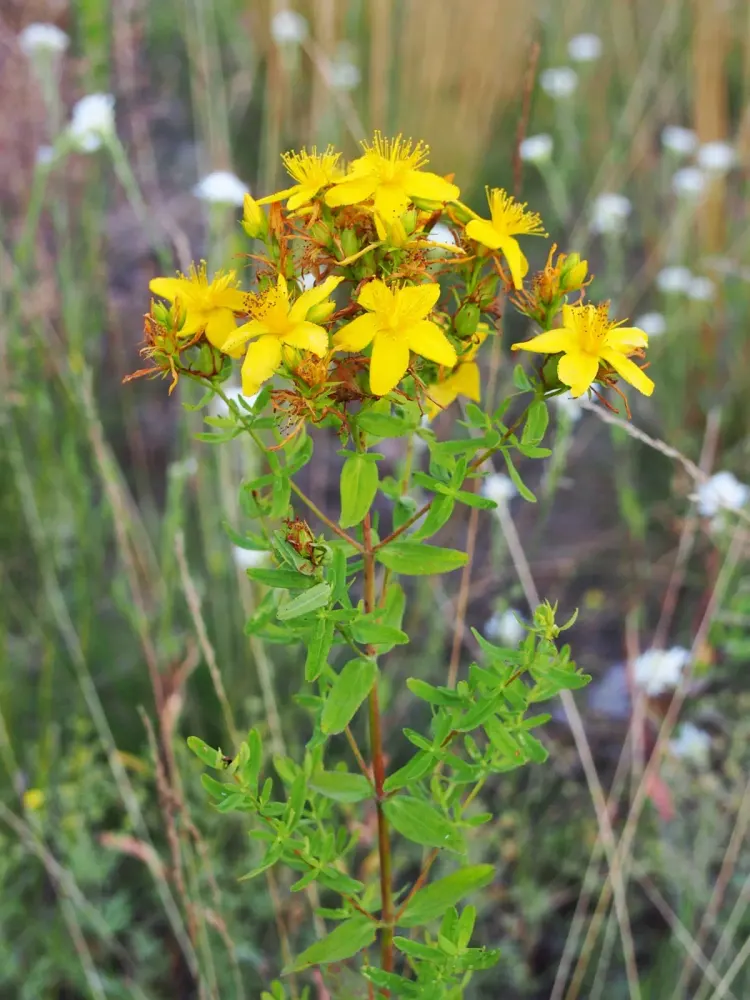
© Agnieszka Kwiecień, Nova · CC BY-SA 4.0 · Commons
Hypericum perforatum
Caution🐾Echtes Johanniskraut · (Hypericum perforatum)
St John's wort family (Hypericaceae)
Description
Crush the yellow flowers of St John's wort between your fingers and a reddish juice appears — the source of the folk name "red oil" for the oil macerate traditionally applied externally to sunburn and minor wounds. Taken as tea, the flowering herb is traditionally used for temporary mental fatigue and nervous restlessness with difficulty falling asleep. Extracts richer in hyperforin have EMA-recognised "well-established use" status for mild-to-moderate depressive episodes, though the effect typically takes about four weeks to appear. Caution matters here: St John's wort is one of the most interaction-prone medicinal plants, accelerating the breakdown of numerous drugs, from the contraceptive pill to blood thinners. Medical or pharmacist advice should always be sought before use, especially alongside other regular medication. During use, intense sun exposure should also be avoided, as the skin can become more sensitive to light.
CONTRAINDICATED during pregnancy
Per EMA not recommended — animal studies showed signs of reproductive toxicity.
CONTRAINDICATED during breastfeeding
Per EMA not recommended — safety during breastfeeding not established.
CONTRAINDICATED for children
Per EMA, not recommended for children and adolescents under 18 years (internal) or under 12 years (external).
Critical drug interactions with:
Hormonelle Kontrazeptiva (Pille, Vaginalring, Pflaster) · Cumarin-Antikoagulanzien (Warfarin, Phenprocoumon) · Immunsuppressiva (Cyclosporin, Tacrolimus, Sirolimus, Everolimus) · HIV-Protease-Inhibitoren und Reverse-Transkriptase-Hemmer · Antidepressiva (SSRI, SNRI, MAO-Hemmer, Buspiron)
Traditional use for temporary mental exhaustion — gentle infusion with low hyperforin content and accordingly lower interaction profile than extracts.
Preparation & dosage
INFUSION: Pour 150 ml boiling water over 1.5–2 g comminuted dried St John's wort, cover, steep for 10 minutes, then strain. Drink a freshly prepared cup 2–3 times daily, total daily amount 3–6 g. For temporary mental exhaustion. Note: tea contains only very small amounts of hyperforin (< 1 mg/day) — much lower interaction risk than alcoholic extracts. Effect may only set in after several days.
- Dry amount
- 1.5–2 g
- Doses per day
- 3×
- Max duration
- 2 weeks
⚠ Age restriction: ≥ 18 years — Per EMA, only for adults — insufficient data on safe use in children and adolescents under 18 years.
Sources: [1]
Traditional use as a supportive treatment for nervous restlessness and associated difficulties in falling asleep.
Preparation & dosage
INFUSION for nervous restlessness and difficulty falling asleep: Pour 150 ml boiling water over 2–3 g comminuted St John's wort, cover, steep for 10 minutes, then strain. Drink twice daily — one cup during the day, one cup about an hour before bedtime.
- Dry amount
- 2–3 g
- Doses per day
- 2×
- Max duration
- 2 weeks
⚠ Age restriction: ≥ 18 years — Per EMA, only for adults.
Sources: [1]
Clinically supported use (EMA well-established use) for mild-to-moderate depressive episodes or short-term treatment of mild depressive symptoms. IMPORTANT: Due to the hyperforin content, pronounced interactions with many medications — always check with a doctor or pharmacist before use.
Preparation & dosage
Standardised dry extract — typical daily dose 600–1800 mg, split into 1–3 single doses. Only use as a finished medicinal product with declared hypericin and hyperforin content. Effect only sets in after about 4 weeks. Continuous treatment is possible for mild-to-moderate depressive episodes; for symptomatic treatment of mild depressive disorders maximum 6 weeks.
- Dry amount
- 0.3–1.8 g
- Doses per day
- 3×
- Max duration
- 6 weeks
⚠ Age restriction: ≥ 18 years — Per EMA, only for adults.
Sources: [1]
Traditional external use as red oil for minor skin inflammations (sunburn) and minor wounds.
Preparation & dosage
ST JOHN'S WORT OIL (red oil): Apply a ready-made oil macerate thinly to the affected skin area, several times daily. For symptomatic treatment of minor skin inflammations and as a supportive aid in healing minor wounds. DIY: Macerate fully opened flowers in cold-pressed olive oil for 4–6 weeks in a warm, sunny spot — the oil turns deep red. IMPORTANT: Do not expose treated skin areas to direct sunlight or UV radiation during and after use.
- Doses per day
- 3×
- Max duration
- 1 weeks
⚠ Age restriction: ≥ 12 years — Per EMA, only from 12 years onwards for cutaneous use.
Sources: [1]
WARNING — MAJOR DRUG INTERACTIONS: St John's wort is the most pharmacologically active medicinal plant and induces liver enzymes CYP3A4, CYP2B6, CYP2C9, CYP2C19 and the transporter P-glycoprotein. This accelerates the breakdown of many medicines and can cause them to fail — e.g. the contraceptive pill (risk of unintended pregnancy!), coumarin-type anticoagulants, immunosuppressants, HIV medication, certain cancer drugs, digoxin, theophylline, some antidepressants. Always inform your doctor or pharmacist. Concomitant use with SSRIs carries a risk of serotonin syndrome. Enzyme induction takes about 1 week after discontinuation to subside. Discontinue at least 1 week before planned surgery. PHOTOSENSITISATION: Avoid intense sunlight during use. Onset of antidepressant effect only after about 4 weeks. ASPCA classification (accessed 2026-08-10): toxic to dogs and cats.
⏱ Max continuous use: 6 weeks
Per EMA not recommended — animal studies showed signs of reproductive toxicity.
Per EMA not recommended — safety during breastfeeding not established.
Per EMA, not recommended for children and adolescents under 18 years (internal) or under 12 years (external).
Drug interactions
Hormonelle Kontrazeptiva (Pille, Vaginalring, Pflaster)
Induces CYP3A4 and accelerates breakdown of estrogen/progestin components. Pregnancy can occur despite correct pill use. Use additional non-hormonal contraception.
Cumarin-Antikoagulanzien (Warfarin, Phenprocoumon)
Accelerated breakdown via CYP2C9 lowers anticoagulant effect — thrombosis risk. Concomitant use contraindicated.
Immunsuppressiva (Cyclosporin, Tacrolimus, Sirolimus, Everolimus)
Drastic drop in plasma levels. Documented transplant rejection — concomitant use contraindicated.
HIV-Protease-Inhibitoren und Reverse-Transkriptase-Hemmer
Drop in antiviral plasma levels with risk of resistance and treatment failure — contraindicated.
Antidepressiva (SSRI, SNRI, MAO-Hemmer, Buspiron)
Pharmacodynamic interaction. Risk of serotonin syndrome with sweating, tachycardia, fever, agitation, confusion, tremor.
Digoxin
P-gp induction lowers digoxin levels — risk of loss of effect in heart failure or atrial fibrillation.
Theophyllin
Accelerated breakdown lowers plasma levels — risk of insufficient bronchodilation.
Allgemein- und Regionalanästhetika (vor Operationen)
Possible interactions with anaesthetic medication. Discontinue at least 1 week before planned surgery.
Contraindications
- Hypersensitivity to St John's wort.
- Concomitant use of coumarin-type anticoagulants.
- Concomitant use of immunosuppressants.
- Concomitant use of HIV medication.
- Pregnancy and breastfeeding.
- Internal use under 18 years; external use under 12 years.
Harvested part: flowering herb
- Time of day:
- Classically around St John's Day (24 June) and the weeks after — cut on a dry, sunny morning.
- Drying:
- Pick the flowering upper 15–30 cm. Hang in bunches upside down in airy, shaded place. Keep temperature below 35 °C.
- Storage:
- 12 months — Store light-protected in dark jars — hypericin is sensitive to light and oxygen.
- Time of day:
- For oil-making, pick only fully opened individual flowers on a sunny morning — if they turn deep red when rubbed, hypericin content is optimal.
- Drying:
- For oil: pick fresh and process immediately. For dried flowers: dry in single layer in the shade below 35 °C.
- Storage:
- 12 months — Store dried flowers light-protected. Keep home-made red oil in dark glass bottles in a cool place.
- Hypericin und Pseudohypericin (Naphthodianthrone)GlycosideContent: 0,1–0,3 %Flower
Red pigments — typical of St John's wort oil. Contribute to antidepressant activity and are main carriers of photosensitisation.
- Hyperforin (Phloroglucin-Derivat)BitterContent: 2–4 % (Trockenkraut)Flower
Main cause of drug interactions: induces CYP3A4/2B6/2C9/2C19 and P-gp. Aqueous tea contains only small amounts; alcoholic extracts much more.
- Flavonoide (Hyperosid, Rutin, Quercitrin, Quercetin, Isoquercitrin)FlavonoidContent: 2–4 %Aerial parts
Contribute to overall activity — antioxidant and mildly anti-inflammatory.
- Biflavonoide (Amentoflavon, Biapigenin)FlavonoidFlower
Characteristic of Hypericum — used for identity testing.
- Gerbstoffe (Catechin-Typ)TanninContent: 6–15 %Aerial parts
Contribute to the slightly astringent, wound-healing effect of the oil.
- Ätherisches ÖlEssential oilContent: 0,05–0,3 %Flower
Small amount — contains α-pinene, β-pinene, sesquiterpenes, and n-alkanes.
- [1]MonographEMA/HMPC/7695/2021 — European Union herbal monograph on Hypericum perforatum L., herba (Final, Revision 1, 23 November 2022)(accessed: 2026-05-18)
- [2]MonographASPCA Animal Poison Control — Klamath Weed (Hypericum perforatum)(accessed: 2026-08-10)
- [3]MonographCliniTox Giftpflanzen — Hypericum perforatum L.s.str.: giftig + (Institut für Veterinärpharmakologie und -toxikologie, Universität Zürich)(accessed: 2026-08-10)