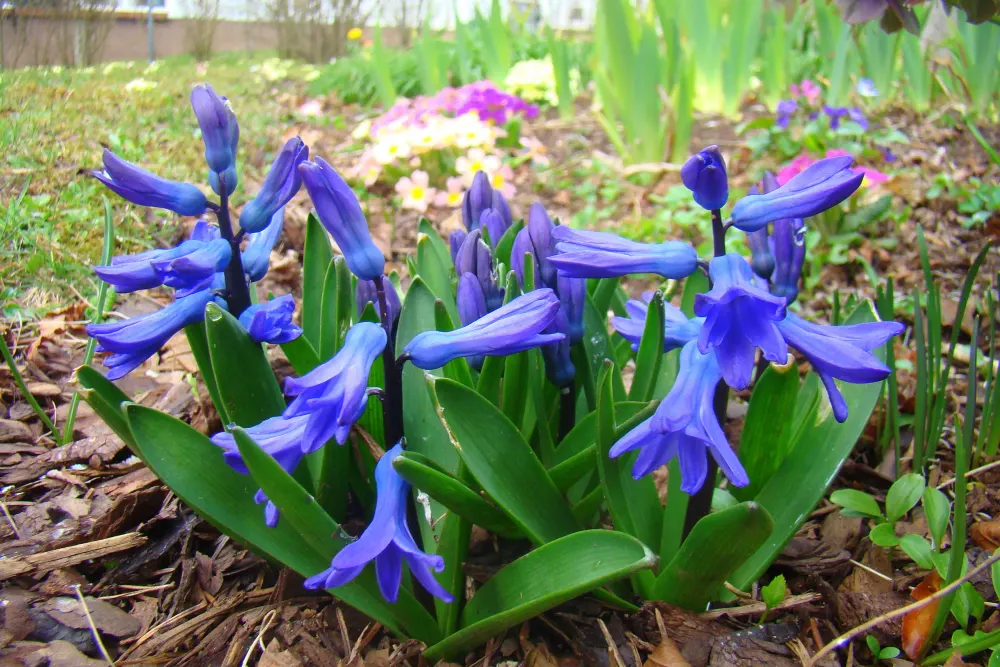
© Photo by Lukas Kaffer (S.lukas) · CC BY-SA 3.0 · Commons
Hyacinthus orientalis
Caution🐾Gartenhyazinthe · (Hyacinthus orientalis)
Asparagus family (Asparagaceae)
Description
Hyacinthus orientalis, the common hyacinth, garden hyacinth or Dutch hyacinth, is a species of flowering plant in the family Asparagaceae, subfamily Scilloideae. It is native to western Asia, from southern Turkey, through Syria and Lebanon to northern Israel. It was introduced to Europe in the 16th century.
🌿 Risk of confusion — read before wild-harvesting!
Accidental ingestion (classically by children or through confusion with kitchen onion) triggers nausea, vomiting, abdominal cramps and diarrhoea within 30 to 90 minutes; with larger amounts dehydration and weakness.
External use only!
This plant must NOT be taken internally. Use only as compress, salve, or bath.
- RawFlowerExternalFolk medicine
Classic spring ornamental for pot and garden: Hyacinthus orientalis has been the most important fragrant bulb ornamental in Europe since the late 16th century. The intensely sweet flower (February to April) serves as forced indoor display at Christmas and Valentine's Day and as garden spring-bloomer in beds, borders and rockeries. Indoors, one or two inflorescences often suffice to fragrance an entire room — caution in bedrooms or with fragrance-sensitive people, as the scent can trigger headaches. Dutch forcing nurseries supply the global market with around 60 cultivars in white, pink, red, blue, violet and yellow; well-known cultivars include 'Delft Blue', 'Pink Pearl', 'Carnegie' and 'Woodstock'.
Preparation & dosage
[#src_wp_en_hyacinthus_orientalis] [#src_wp_de_hyacinthus_orientalis] [#src_rhs_hyacinthus_orientalis]
- Essential oilFlowerExternalFolk medicine
Hyacinth absolute (Absolue de jacinthe): high-grade, very expensive perfumery component obtained from fresh hyacinth flowers by solvent extraction (hexane or petroleum ether) to concrete and subsequent ethanol wash to absolute. About 5,000 kg of flowers yield roughly 1 kg of absolute — hence prices of several thousand euros per kilogram and use only in luxury perfumes. Aroma profile: sweet-green, floral, slightly spicy with a narcotic, earthy undertone; main constituents are cinnamyl alcohol, phenylacetaldehyde, benzyl alcohol, methyl phenylacetate and (E)-cinnamaldehyde. Used as a floral heart note in classical flower perfumes (e.g. in the tradition of Guerlain 'Chamade', Caron 'N'Aimez Que Moi'). In modern perfumes often replaced by synthetic reconstructions (hyacinth bases), as the real absolute is rare and costly.
Preparation & dosage
[#src_pellmyr_hyacinthus_orientalis] [#src_perfumery_book_hyacinthus_orientalis] [#src_wp_en_hyacinthus_orientalis]
- RawFlowerExternalFolk medicine
Cultural-historical and symbolic significance in Persia and the Mediterranean: in Iranian tradition the hyacinth (Persian 'sonbol') is one of the 'Haft Sin' — the seven symbols starting with S on the traditional Nowruz table (Persian New Year at the spring equinox, 20/21 March). The hyacinth stands for spring, rebirth and beauty. In Greek mythology Hyakinthos is a young Spartan prince loved by Apollo and accidentally killed with a discus; from his blood, per Ovid, grew a flower — botanically probably larkspur (Consolida) or gladiolus, not the modern hyacinth. The name carried over and was transferred to the oriental bulb plant in the 16th century. Purely symbolic and cultural use — no medicinal indication.
Preparation & dosage
[#src_wp_nowruz_hyacinthus_orientalis] [#src_wp_hyakinthos_hyacinthus_orientalis] [#src_wp_en_hyacinthus_orientalis]
- Rawuse.plant_part.bulbExternalFolk medicine
Occupational contact dermatitis 'hyacinth dermatitis' or 'hyacinth itch': florists, bulb sorters and forcing-nursery workers who handle the dry outer scales of the hyacinth bulb without protection develop itching, reddened skin rashes on hands, forearms and neck. Clinically documented by Bruijnzeel (1996) and earlier Dutch occupational dermatologists from the 1950s onward. Main triggers are calcium oxalate raphides (mechanical component) and saponins in the outer scales — analogous to 'tulip fingers' (Tulipa) and 'daffodil rash' (Narcissus). Sensitisation may increase with repeated contact. Standard prevention: tight gloves (nitrile or PVC), long-sleeved clothing, skin care after work. No therapeutic application — this description documents an occupational-medicine risk.
Preparation & dosage
[#src_bruijnzeel_hyacinthus_orientalis] [#src_wp_en_hyacinthus_orientalis]
- Rawuse.plant_part.bulbExternalFolk medicine
Economic history: the Dutch 'hyacinth mania' of 1734 — also called 'Hyacintenwindhandel' or 'minor tulip mania' — was a speculative price bubble on hyacinth bulbs in Haarlem and surroundings, roughly a century after the famous tulip mania of 1636/37. Rare cultivars reached prices of several thousand guilders per bulb; after the crash an anonymous satirist published the dialogue 'Samen-spraak tusschen Waarmondt ende Gaergoedt' (1734) as a warning. The episode is today a standard example in economic historiography (Charles Mackay 1841, 'Extraordinary Popular Delusions') and behavioural economics. Purely cultural-historical and economic significance — no medicinal indication.
Preparation & dosage
[#src_wp_hyacintenwindhandel_hyacinthus_orientalis] [#src_wp_de_hyacinthus_orientalis]