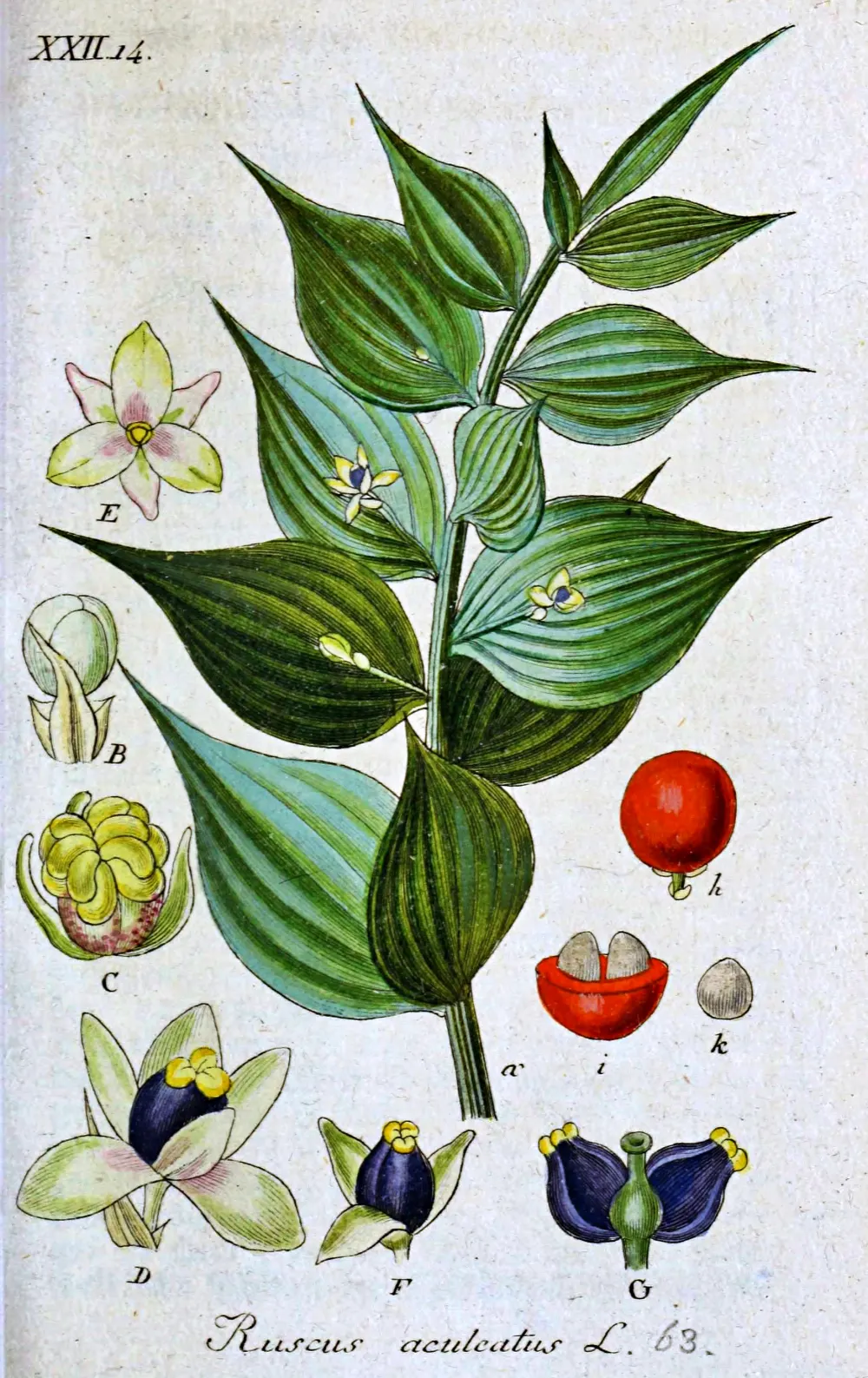
© Jacob Sturm (J. Sturm), Deutschlands Flora in Abbildungen, 1821 · Public domain (PD-old-70-expired) · Commons
Butcher's broom
CautionStechender Mäusedorn · (Ruscus aculeatus)
Asparagus family (Asparagaceae)
Description
Butcher's broom is a low, evergreen, stiff dioecious shrub reaching 20 to 80 (rarely 90) centimetres in height. Instead of true leaves it bears flattened, leaf-like shoots (cladodes) each ending in a sharp spine tip. The small, inconspicuous greenish flowers sit singly on the surface of the cladodes; on female plants they develop into bright red berries about 1 centimetre across. The medicinal part is the underground rhizome (Rusci rhizoma). This drought-tolerant species grows on warm, dry, stony slopes and in open woodland around the Mediterranean, and is valued as an evergreen dry-shade shrub.
CONTRAINDICATED for children
There is no relevant indication for children and adolescents; use is not recommended. The berries are especially hazardous to children.
Traditional herbal medicine to relieve discomfort and heaviness of the legs related to minor venous circulatory disturbances (chronic venous insufficiency). The ruscogenins are attributed vein-toning, capillary-sealing and anti-inflammatory properties.
Preparation & dosage
Traditionally taken as a standardised dry extract or as dried powdered rhizome (350 mg three times daily). Commercial products are standardised to ruscogenins (total of ruscogenin and neoruscogenin); the recommended daily dose provides about 7 to 11 mg of ruscogenins. If symptoms persist for more than 2 weeks, consult a doctor.
- Dry amount
- 0.35–0.35 g
- Doses per day
- 3×
- Max duration
- 2 weeks
Traditional herbal medicine for the symptomatic relief of itching and burning associated with haemorrhoids. Its use is based exclusively on long-standing experience.
Preparation & dosage
For the symptomatic relief of itching and burning associated with haemorrhoids, after a doctor has ruled out serious conditions. Taken internally as a standardised dry extract or dried powdered rhizome (350 mg three times daily, providing about 7 to 11 mg ruscogenins per day). If rectal bleeding occurs, consult a doctor.
- Dry amount
- 0.35–0.35 g
- Doses per day
- 3×
- Max duration
- 2 weeks
⚠ Age restriction: ≥ 18 years — For use in adults only; there is no relevant indication for children and adolescents.
Generally well tolerated; occasionally nausea, gastrointestinal complaints or diarrhoea may occur (stop use if diarrhoea develops). Because of a lack of data, do not use in pregnancy, breastfeeding, or in children and adolescents. In case of sudden, one-sided leg swelling, skin inflammation, hardened tissue, ulcers, or cardiac or renal insufficiency, seek medical advice - this may indicate thrombosis. The red berries are mildly toxic and must not be eaten.
Safety during pregnancy has not been established; in the absence of sufficient data, use is not recommended.
Safety during breastfeeding has not been established; in the absence of sufficient data, use is not recommended.
There is no relevant indication for children and adolescents; use is not recommended. The berries are especially hazardous to children.
Drug interactions
Antikoagulantien / Anticoagulants
The official monograph reports no interactions. As a precaution, monitoring by a doctor is advisable when taken together with blood-thinning medicines.
Alpha-adrenerge Substanzen / Alpha-adrenergic agents
Ruscogenins act in part through adrenergic (vasoconstrictive) mechanisms. No clinically relevant interactions are documented; monitoring is advisable if corresponding circulatory medicines are taken concurrently.
Contraindications
- Hypersensitivity (allergy) to the active substance.
- The red berries must not be eaten (mildly toxic).
Harvested part: Rhizome (underground rootstock)
- Time of day:
- Best dug in the morning once the soil has dried.
- Drying:
- Clean the rhizome thoroughly of soil, slice it, and dry it airy in the shade or at no more than 40 °C.
- RuscogeninSaponinRhizome
Steroidal saponin aglycone; together with neoruscogenin the medicinally decisive compound to which extracts are standardised.
- NeoruscogeninSaponinRhizome
Steroidal saponin aglycone; a potent agonist of the nuclear receptor RORα.
- Ruscin (Steroidsaponin)SaponinRhizome
Steroidal saponin glycoside with ruscogenin as its aglycone.
- Ruscosid (Steroidsaponin)SaponinRhizome
Steroidal saponin glycoside with neoruscogenin as its aglycone.
- Flavonoide (u.a. Rutin-Typ)FlavonoidRhizome
Polyphenolic companion compounds with antioxidant and vessel-protective properties.
- PhytosteroleOtherRhizome
Plant sterols, accompanying constituents of the rhizome.
- Ätherisches Öl (Spuren)Essential oilRhizome
Present only in small, trace amounts.
- [1]MonographCommunity herbal monograph on Ruscus aculeatus L., rhizoma (EMEA/HMPC/261938/2007)(accessed: 2026-07-02)
- [2]MonographRusci rhizoma - herbal medicine overview, European Medicines Agency (HMPC)(accessed: 2026-07-02)
- [6]MonographCurrent Insights into the Phytochemistry and Pharmacological Properties of Ruscus aculeatus (PMC review)(accessed: 2026-07-02)
- [3]WikipediaStechender Mäusedorn - Wikipedia (deutsch)(accessed: 2026-07-02)
- [4]WikipediaRuscus aculeatus - Wikipedia (English)(accessed: 2026-07-02)
- [7]CommonsRuscus aculeatus, Deutschlands Flora, plate (J. Sturm, 1821) - Wikimedia Commons(accessed: 2026-07-02)
- [5]WikidataRuscus aculeatus (Q159868) - Wikidata(accessed: 2026-07-02)
🤝 Permaculture Partners
In your garden, this plant acts as: