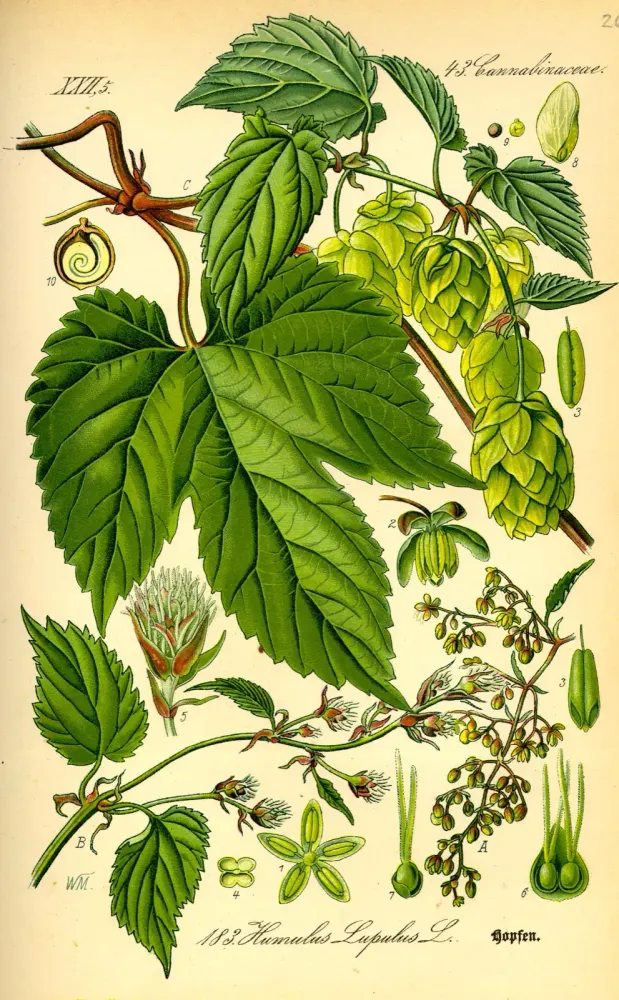
© Unknown (see Commons) · Public domain · Commons
Humulus lupulus
Caution🐾Echter Hopfen · (Humulus lupulus)
Hemp family (Cannabaceae)
Description
The resinous, papery cones of common hop are best known for flavouring beer, but the female flower clusters of this hemp-family plant also carry a long tradition as a calming remedy. They are rich in bitter acids (humulone, lupulone), essential oil and the compound xanthohumol. Taken as tea or tincture, hops are traditionally used for nervous restlessness and mild difficulty falling asleep, often paired with valerian. A particularly evocative form of use is the hop pillow, already recommended by Sebastian Kneipp in the 19th century — a deeply rooted tradition, though without scientific backing. Note that hops act as a mild sedative and can impair the ability to drive. The plant also contains 8-prenylnaringenin, one of the most potent known plant estrogens, so anyone with a hormone-sensitive condition should seek medical advice before use. Hop pickers have long recognised the hormonal effect of handling the resinous cones by hand.
CONTRAINDICATED for children
Per EMA, not for children under 12 years. Traditional hop pillow as pure scent application without oral intake is exempt.
Critical drug interactions with:
Östrogen-Hormontherapie, hormonelle Kontrazeptiva, Tamoxifen / Aromatase-Hemmer
Traditional calming and sleep-aid remedy for nervous restlessness and mild sleep disorders.
Preparation & dosage
Sleep tea: 0.5–1.0 g comminuted hop strobiles (1 level tsp) in 150–200 ml boiling water, cover and steep 10–15 minutes, strain. Drink warm 30–60 minutes before bedtime. Classic combination with valerian root strengthens the effect. Very bitter — a little honey makes it more palatable.
- Dry amount
- 0.5–1 g
- Doses per day
- 1×
- Max duration
- 2 weeks
⚠ Age restriction: ≥ 12 years — Per EMA, only for adults and adolescents from 12 years.
Sources: [1]
For mild stress symptoms and nervous restlessness during the day.
Preparation & dosage
Calming tea for nervous tension: 0.5 g comminuted hop strobiles in 150–200 ml boiling water, steep 10–15 min, strain. Up to 4 cups a day during the day.
- Dry amount
- 0.5–0.5 g
- Doses per day
- 4×
- Max duration
- 2 weeks
⚠ Age restriction: ≥ 12 years — Per EMA, only for adults and adolescents from 12 years.
Sources: [1]
Concentrated form for travel. Combines well with valerian tincture.
Preparation & dosage
Hop tincture (1:5 in 60% ethanol): 1–2 ml (~20–40 drops) up to 3× a day in a little water. For sleep, main dose 30–60 min before bed.
- Liquid amount
- 1–2 ml
- Doses per day
- 3×
- Max duration
- 2 weeks
⚠ Age restriction: ≥ 12 years — Due to alcohol content, also unsuitable for pregnant and breastfeeding women.
Sources: [1]
The hop pillow is a deeply rooted tradition — already recommended by Sebastian Kneipp in the 19th century. No EMA evidence, but centuries of experience.
Preparation & dosage
Hop pillow: Fill a small cotton or linen bag with 50–100 g of freshly dried whole hop strobiles, place beside or under the regular pillow. Refresh the hops yearly. Classically often mixed with lavender, lemon balm, and valerian root.
⚠ Age restriction: ≥ 0 years — As an external, scent-based application, also conceivable for children.
Sources: [1]
Hops have a mild sedative effect — do not take before driving. Hops contain phytoestrogens — in particular the potent 8-prenylnaringenin. In case of hormone-sensitive conditions (estrogen-dependent tumors, endometriosis, fibroids), use only after medical consultation. ASPCA classification (accessed 2026-08-10): toxic to dogs.
⏱ Max continuous use: 2 weeks
Per EMA, safety during pregnancy has not been established.
Insufficient data for breastfeeding. Phytoestrogens may theoretically pass into breast milk.
Per EMA, not for children under 12 years. Traditional hop pillow as pure scent application without oral intake is exempt.
Drug interactions
ZNS-Sedativa (Benzodiazepine, Barbiturate, Z-Drugs, Opioide, Antihistaminika der 1. Generation)
The mild sedative effect may add to other CNS depressants and alcohol. Increased drowsiness possible.
Östrogen-Hormontherapie, hormonelle Kontrazeptiva, Tamoxifen / Aromatase-Hemmer
Hops contain one of the most potent known phytoestrogens. Theoretically may enhance hormone therapy or weaken antiestrogenic effect of tamoxifen.
Contraindications
- Hypersensitivity to hops or other Cannabaceae plants.
- Children under 12 years (oral use).
- Estrogen-dependent tumors — only after medical consultation.
- Existing clinical depression — hops may worsen depressive mood.
Harvested part: female flower clusters (hop cones)
- Time of day:
- On dry, sunny mornings once the dew has completely dried.
- Drying:
- Pick only the female cones, shortly before full ripeness. Pick carefully, do not crush. Dry in single layer in shade at max 35 °C. Caution: fresh hop sap can cause contact dermatitis.
- Storage:
- 9 months — Store in dark, airtight jars cool (preferably 0–5 °C in fridge), use within 9–12 months.
- Bittersäuren (Humulone / α-Säuren, Lupulone / β-Säuren)BitterContent: 15–25 %Flower
Main active group. Located in the golden lupulin glands. During storage, the actual sedative principle 2-methyl-3-buten-2-ol forms from these bitter acids.
- 2-Methyl-3-buten-2-olOtherFlower
Volatile alcohol that forms during storage. Considered the actual sedative compound — binds to GABA and melatonin receptors in the brain.
- Ätherisches Öl (Myrcen, β-Caryophyllen, Humulen, Farnesen)Essential oilContent: 0,5–1,5 %Flower
Gives hops and beer their characteristic resinous-spicy aroma.
- Xanthohumol (prenyliertes Chalkon)FlavonoidContent: 0,1–1 %Flower
Unique prenylated chalcone flavonoid, almost exclusively in hops. Strongly antioxidant.
- 8-PrenylnaringeninFlavonoidFlower
One of the most potent known phytoestrogens. Explains the historical hop-picker's menstruation.
- Gerbstoffe (Catechin-Gerbstoffe)TanninContent: 2–4 %Flower
Contribute to a slightly astringent effect and the bitter taste.
- [1]MonographEMA/HMPC/682384/2013 — Community herbal monograph on Humulus lupulus L., flos (Final, 6 May 2014)(accessed: 2026-05-18)
- [2]MonographASPCA Animal Poison Control — Hops (Humulus lupulus)(accessed: 2026-08-10)