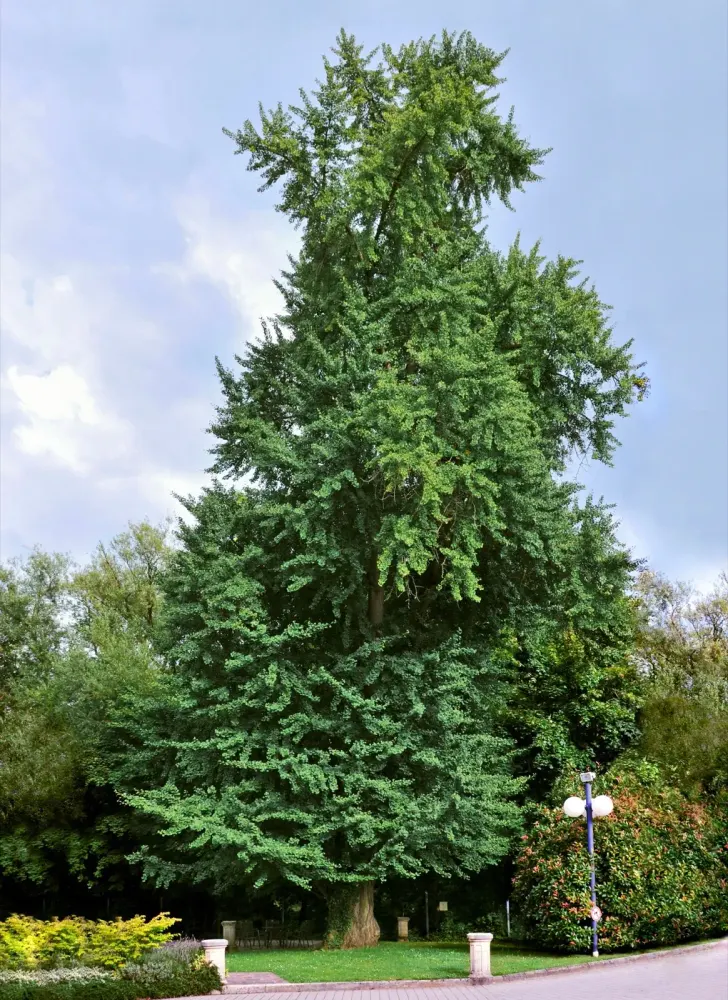
© EecherplazGinkgo06.jpg: Cayambe derivative work: Ginkgotree (talk) · CC BY-SA 3.0 · Commons
Ginkgo biloba
Caution🐾Ginkgo · (Ginkgo biloba)
Ginkgo family (Ginkgoaceae)
Description
Ginkgo biloba, commonly known as ginkgo, also known as the maidenhair tree, and often misspelled "gingko" is a species of gymnosperm tree native to East Asia. It is the last living species in the order Ginkgoales, which first appeared over 290 million years ago. Fossils similar to the living species, belonging to the genus Ginkgo, extend back to the Middle Jurassic epoch about 170 million years ago.
CONTRAINDICATED during pregnancy
Ginkgo leaf extracts are contraindicated in pregnancy: anticoagulant effect increases bleeding risk at parturition; ginkgotoxin from seeds may be teratogenic. EMA and ESCOP recommend strict avoidance of therapeutic doses in pregnancy. Occasional consumption of small amounts of cooked nuts in Japanese/Chinese cuisine is sometimes tolerated, but not recommended during pregnancy.
CONTRAINDICATED for children
Standardised ginkgo leaf extracts not recommended for children and adolescents under 18 (EMA) — no safety data. Ginkgo seeds (nuts) strictly contraindicated in children: ginkgotoxin causes seizures particularly easily in children (lower seizure threshold, higher relative intake per kg body weight). Poisoning cases (some fatal) from mass consumption of ginkgo nuts in Japanese and Chinese children have been reported.
Critical drug interactions with:
Antikoagulanzien und Thrombozytenaggregationshemmer (Warfarin, Phenprocoumon, ASS, Clopidogrel, Heparin, NOAK) · Antiepileptika (Phenobarbital, Phenytoin, Carbamazepin, Valproat)
- TinctureLeafInternalEMA well-established
Standardised dry extract (EGb 761) for improving cognitive function and quality of life in mild dementia — the only ginkgo preparation with EMA well-established use status.
Preparation & dosage
STANDARDISED DRY EXTRACT (EMA well-established use): Standardised dry leaf extracts, e.g. EGb 761 (Tebonin) or LI 1370, DER 35–67:1, acetone 60 % V/V, standardised to 22–27 % flavonol glycosides and 5–7 % terpene lactones. Daily dose 120–240 mg, in 2–3 single doses with meals. EMA indication: improvement of cognitive function and quality of life in elderly patients with mild dementia. Onset after 4–6 weeks of continuous use. Do not self-medicate confirmed dementia without diagnosis — ginkgo does not replace treatment of neurodegenerative disease. Inform physician before surgery and when taking anticoagulants (bleeding risk).
- Doses per day
- 2×
- Max duration
- 24 weeks
⚠ Age restriction: ≥ 18 years — Per EMA, adults only — insufficient safety data for children/adolescents under 18.
[#src_ema_ginkgo_folium] [#src_escop_ginkgo] [#src_kommission_e_ginkgo]
- TinctureLeafInternalTraditional use
Standardised ginkgo dry extract for symptomatic treatment of peripheral arterial occlusive disease (PAOD Fontaine II) — traditional use per the EMA monograph.
Preparation & dosage
STANDARDISED DRY EXTRACT — peripheral circulation (EMA traditional use): As above (EGb 761 / LI 1370), 120–160 mg daily in 2 single doses. Indication: symptomatic treatment of peripheral arterial occlusive disease (PAOD) Fontaine stage II (increasing pain-free walking distance). Adjunctive to exercise training. Medical diagnosis mandatory before self-treatment. Onset 6–8 weeks; EMA treatment duration up to 6 months observed.
- Doses per day
- 2×
- Max duration
- 12 weeks
⚠ Age restriction: ≥ 18 years — Per EMA, adults only.
- TinctureLeafInternalTraditional use
Standardised ginkgo extract for age-associated tinnitus and vertigo of vascular origin — traditional use per the EMA monograph.
Preparation & dosage
STANDARDISED DRY EXTRACT — tinnitus / vertigo (EMA traditional use): 120–160 mg daily in 2 single doses (EGb 761). Indication: symptomatic treatment of age-associated tinnitus and vertigo of vascular origin. Best evidence for vascular-origin complaints; less clear for purely idiopathic tinnitus. Medical assessment of cause required before starting. Not a substitute for specific ENT therapy. Sudden hearing loss or stroke: immediate emergency call.
- Doses per day
- 2×
- Max duration
- 16 weeks
⚠ Age restriction: ≥ 18 years — Adults only (EMA).
[#src_ema_ginkgo_folium] [#src_escop_ginkgo] [#src_who_ginkgo]
- TeaLeafInternalTraditional use
Traditional leaf infusion to support circulation and mental freshness — lower active constituent concentration than standardised extracts, EMA: traditional use.
Preparation & dosage
INFUSION (traditional use): 2–3 g dried, coarsely cut ginkgo leaves in 200 ml boiling water, covered, steep 10 min, strain. 2× daily with meals. IMPORTANT: A simple leaf infusion contains flavonol glycosides and ginkgolides, but at much lower and more variable concentrations than standardised extracts — clinical efficacy comparable to EGb 761 is not established for leaf tea. Tea form is traditional use (EMA traditional) for supporting circulation and mental freshness during temporary exhaustion. Beyond 8 weeks without improvement, consult a doctor.
- Dry amount
- 2–3 g
- Doses per day
- 2×
- Max duration
- 8 weeks
⚠ Age restriction: ≥ 18 years — Adults only — no safety data for children.
[#src_ema_ginkgo_folium] [#src_pfaf_ginkgo] [#src_wichtl_ginkgo]
- RawSeedInternalFolk medicine
Edible seeds (ginkgo nuts) — cooked only, max. 5–10 nuts/day for adults; raw seeds and seed coat toxic/allergenic (ginkgotoxin, ginkgolic acids).
Preparation & dosage
GINKGO NUTS (seeds, cooked): Remove the fleshy outer seed coat (sarcotesta) — CAUTION: contains ginkgolic acids, causes severe contact dermatitis (similar to poison ivy), wear gloves. Crack or boil the hard inner stone (the actual 'nut') until soft (10–15 min). Traditionally used in Japanese and Chinese cuisine in dishes such as chawanmushi, congee, as garnish with sushi/sashimi, briefly pan-roasted, or grilled in the shell. Raw seeds contain 4'-O-methylpyridoxine (MPN, 'ginkgotoxin') — neurotoxic in larger amounts (seizures possible). MAXIMUM for adults: no more than 5–10 cooked nuts per day. Children, pregnant women, and people with epilepsy or vitamin B6 deficiency: NO ginkgo nuts.
- TinctureLeafInternalFolk medicine
Folk ginkgo tincture for mental exhaustion and poor concentration — non-standardised, lower evidence level than EGb 761.
Preparation & dosage
FOLK GINKGO TINCTURE (1:5 in 50–60 % ethanol): 1–2 ml (~20–40 drops) 3× daily in water or juice. Folk use for mental exhaustion, difficulty concentrating, and general circulatory weakness. Not equivalent to standardised extracts — no defined flavonol glycoside content. Do not combine with anticoagulants or antiplatelet agents without medical advice. Never use in children. Due to ethanol content, avoid in alcohol dependence, liver disease, or epilepsy.
- Liquid amount
- 1–2 ml
- Doses per day
- 3×
- Max duration
- 8 weeks
- TeaLeafInternalFolk medicine
TCM-inspired leaf infusion for respiratory complaints and cough — limited Western evidence; do not discontinue prescribed asthma medications without medical advice.
Preparation & dosage
FOLK RESPIRATORY INFUSION: 1–2 g dried ginkgo leaves in 200 ml hot water, steep 8 min, strain. 2× daily. In traditional Chinese medicine (TCM), ginkgo leaves and seeds are used for asthma, chronic cough and whooping cough — terpene lactones (especially bilobalide) are said to have bronchodilatory and anti-inflammatory effects. Clinical evidence for this indication in Western phytotherapy is limited. Do not use as substitute for prescribed asthma medications.
- Dry amount
- 1–2 g
- Doses per day
- 2×
- Max duration
- 4 weeks