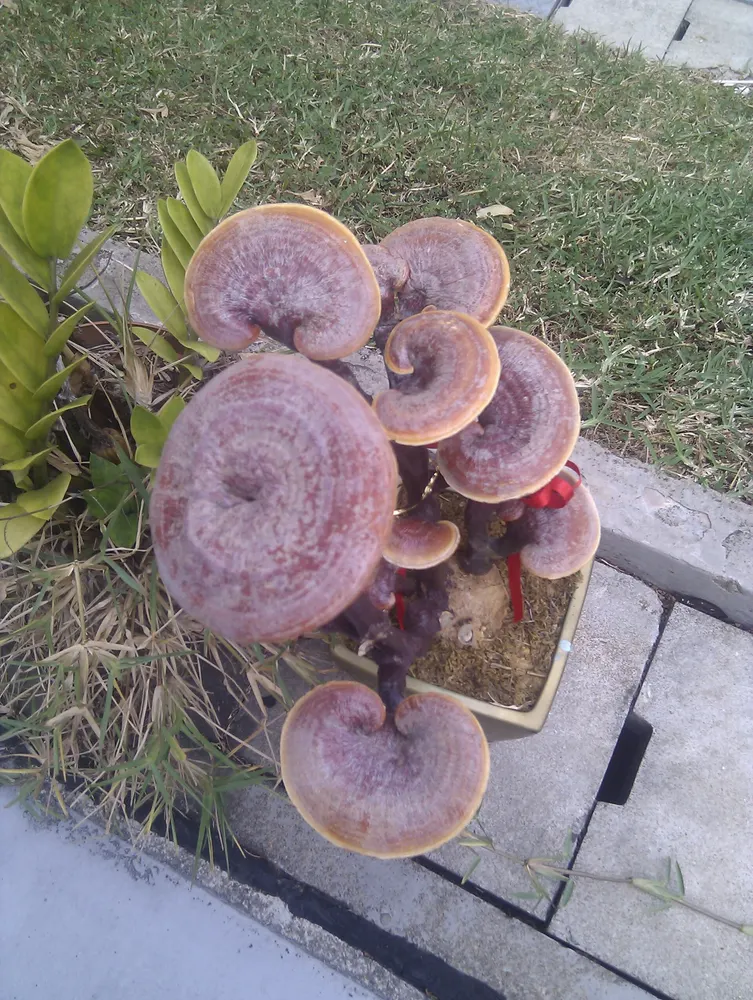
© Techieoldfox (via Mushroom Observer) · CC BY-SA 3.0 · Commons
Reishi / Lingzhi
CautionReishi / Glänzender Lackporling · (Ganoderma lingzhi)
Ganoderma family (Ganodermataceae)
Description
The glossy, lacquered, kidney-shaped fruiting body of reishi grows from September to November, mostly on hardwood stumps, and belongs to the Ganoderma family. Its tissue contains triterpenes such as ganoderic and lucidenic acids alongside beta-glucans and further heteropolysaccharides, plus ergosterol and peptidoglycans including the fungus-specific Ling Zhi-8. In traditional Chinese medicine, the hard, woody fruiting body is prepared as tea or tincture and traditionally used for fatigue, as a general tonic and to support the immune system; folk use also extends to stress and sleep. Reishi is not a culinary mushroom and is not eaten as food. It is generally well tolerated but may enhance the effect of blood-thinning medication, so medical advice is worthwhile before surgery or when taking such drugs. Use is not recommended in pregnancy, breastfeeding or childhood due to lack of data.
🌿 Risk of confusion — read before wild-harvesting!
For powdered reishi there are case reports of liver damage, in one instance fatal — it is not advisable with liver disease.
Decoction (long simmering) of the dried, chopped fruiting body used as a general tonic and immune-supporting tea in Traditional Chinese Medicine.
Alcoholic or dual extract (water plus alcohol) of the fruiting body, taken to capture both the water-soluble polysaccharides and the alcohol-soluble triterpenes.
Dried fruiting-body powder in capsules or stirred into liquid, used as a modern dietary supplement for immune support.
Generally well tolerated; nausea, dry mouth, insomnia, itching and vertigo have been reported. For powdered reishi there are case reports of liver damage, in one instance fatal — it is not advisable with liver disease. Reishi may enhance the effect of anticoagulant/antiplatelet drugs and increase bleeding risk; consult a clinician if taking such medication or before surgery. Rare allergic reactions and digestive upset have been reported. Avoid in pregnancy, breastfeeding and in children due to lack of data. Not a culinary mushroom – the fruiting body is woody and not eaten as food.
No studies in pregnant women. Reishi is not an edible mushroom but is taken as an extract or infusion — with no data, it should not be used in pregnancy.
No data on passage into breast milk or on effects in breastfed infants.
Not studied in children.
Drug interactions
Gerinnungshemmer und Thrombozytenhemmer
Reishi can increase the risk of bleeding; extracts prolonged clotting values (INR, PT, aPTT) in studies. Clear it medically with anticoagulant treatment and before surgery.
Immunsuppressiva
Reishi enhances the immune response and thus works against a deliberate suppression of the immune system — for instance after organ transplantation or in autoimmune disease.
Arzneimittel mit Abbau über Cytochrom P450
In vitro, reishi polysaccharides inhibited the enzymes CYP2E1, CYP1A2 and CYP3A and could thus alter the levels of drugs handled by them. The clinical relevance is not known.
Harvested part: fruiting body
- Time of day:
- Harvest once the white growing margin at the cap edge has gone and the upper surface is an even lacquer red — the fruiting body is then mature. Wait longer and it lignifies further, and the spore dust coats everything around it. Cut close to the substrate.
- Drying:
- The fruiting body is hard and woody from the start. Saw or cut it into thin slices while fresh, then dry through at 40 to 50 degrees. Dried whole, it is afterwards barely possible to divide.
- Storage:
- 24 months — Dry and dark, airtight. Reishi keeps for a long time thanks to its hard structure, but it draws moisture.
- Triterpene (Ganodersäuren, Lucidensäuren)Other
Lanostane triterpenoids such as ganoderic acids A, C2, I; alcohol-soluble and responsible for the bitter taste.
- Beta-Glucane / PolysaccharidePolysaccharide
Mainly β-(1→3)/(1→6)-glucans, water-soluble; regarded as the main immunomodulating component.
- Hetero-Polysaccharide (Arabinose, Galactose, Glucose, Xylose, Mannose)Polysaccharide
Sugar building blocks of the reishi polysaccharides.
- Sterole / ErgosterolOther
Fungal sterols, a provitamin D2 precursor.
- Proteine und Peptidoglykane (z.B. Ling-Zhi-8)Other
Protein-bound polysaccharides with reported immune-active properties.
- [3]MonographGanoderma lucidum (Lingzhi or Reishi): A Medicinal Mushroom — Herbal Medicine: Biomolecular and Clinical Aspects (NCBI Bookshelf)(accessed: 2026-05-31)
- [4]MonographReishi Mushroom — Memorial Sloan Kettering Cancer Center, About Herbs(accessed: 2026-05-31)
- [5]MonographJin X. et al. — Ganoderma lucidum (Reishi mushroom) for cancer treatment (Cochrane Systematic Review)(accessed: 2026-05-31)
- [6]MonographGanoderma lucidum—From Ancient Remedies to Modern Applications: Chemistry, Benefits, and Safety (Antioxidants, MDPI)(accessed: 2026-05-31)
- [1]WikipediaLingzhi (mushroom) — Wikipedia(accessed: 2026-05-31)
- [2]WikipediaGlänzender Lackporling — Wikipedia(accessed: 2026-05-31)
- [7]CommonsFile:Ganoderma lingzhi Wu, Cao & Dai 574883.jpg — Wikimedia Commons(accessed: 2026-05-31)