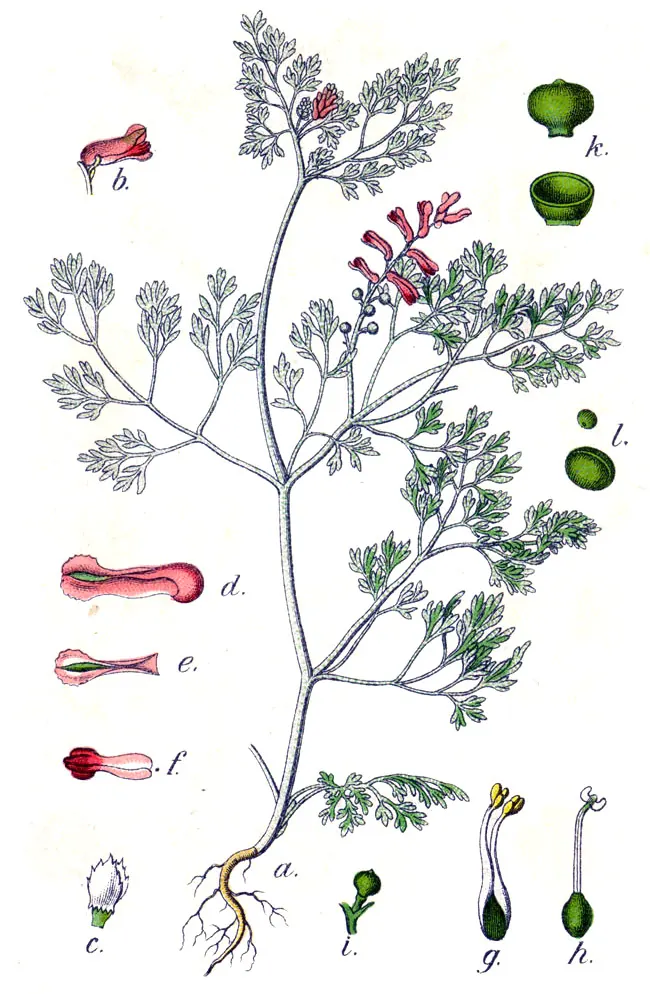
© Jacob Sturm (Johann Georg Sturm, Deutschlands Flora in Abbildungen, 1796) · Public domain · Commons
Common fumitory
CautionGewöhnlicher Erdrauch · (Fumaria officinalis)
Poppy family (Papaveraceae)
Description
Common fumitory is an annual herbaceous plant 10 to 50 cm tall, with delicate, finely divided, bluish-green leaves and a sprawling to ascending habit. From April to October it bears loose racemes of numerous small pink to purple flowers tipped with dark red, which develop into rounded single-seeded fruits. It is a typical weed of cultivated fields and disturbed, nutrient-rich ground. The medicinal part is the flowering herb (Fumariae herba), the aerial parts, which contain isoquinoline alkaloids such as protopine. Traditionally fumitory is used for digestive complaints related to bile flow.
CONTRAINDICATED during pregnancy
Due to a lack of safety data, use during pregnancy is not recommended.
CONTRAINDICATED during breastfeeding
Due to a lack of data, use during breastfeeding is not recommended.
CONTRAINDICATED for children
Use in children and adolescents under 18 years is not recommended due to lack of data.
- TeaAerial partsInternalTraditional use
Traditional fumitory tea to increase bile flow for indigestion such as fullness, flatulence and slow digestion.
Preparation & dosage
Pour about 250 ml of boiling water over 1.5 to 2 g of comminuted herb, cover and steep for 10 minutes, strain and drink several times a day before meals.
- Dry amount
- 1.5–2 g
- Doses per day
- 3×
- Max duration
- 2 weeks
[#src_ema_monograph] [#src_ema_overview] [#src_kommission_e]
- TinctureAerial partsInternalTraditional use
Fumitory tincture as a convenient form for the traditional stimulation of bile flow in dyspeptic complaints.
Preparation & dosage
Tincture (1:5, ethanol 45% V/V): 0.5 to 1 ml as a single dose, 1 to 4 ml in total per day, taken before meals in a little water.
- Liquid amount
- 0.5–1 ml
- Doses per day
- 3×
- Max duration
- 2 weeks
⚠ Age restriction: ≥ 18 years — Use in children and adolescents under 18 years is not recommended due to lack of data.
- TeaAerial partsInternalCommission E
Commission E recommends fumitory herb for crampy complaints of the gallbladder, bile ducts and gastrointestinal tract; the alkaloids have a mild spasmolytic effect.
Preparation & dosage
Prepared as an infusion, as described by Commission E for crampy complaints of the gallbladder and gastrointestinal tract; drink freshly prepared several times a day.
- Dry amount
- 1.5–2 g
- Doses per day
- 3×
- Max duration
- 2 weeks
- SalveAerial partsExternalClinical trial
In a randomised double-blind trial a cream containing Fumaria officinalis and silymarin showed improvement of the SCORAD score in mild to moderate eczema comparable to mometasone.
Preparation & dosage
Apply externally as a cream or salve to affected skin; in one trial a standardised cream was used twice daily for two weeks. Use home-made preparations externally only and on intact skin.
- Dry amount
- 5–10 g
- Doses per day
- 2×
- Max duration
- 2 weeks
- TeaAerial partsInternalFolk medicine
In folk medicine fumitory is regarded as a blood-purifying remedy taken internally for skin impurities and chronic skin conditions; this use is not scientifically substantiated.
Preparation & dosage
Prepared as an infusion and drunk as a course; used in folk tradition as a 'blood-cleansing' spring tea for impure skin. Use only briefly and moderately because evidence is lacking.
- Dry amount
- 1.5–2 g
- Doses per day
- 2×
- Max duration
- 2 weeks
- TinctureAerial partsInternalTraditional use
Traditional use of the tincture to support liver and bile; the alkaloids are said to stimulate bile flow.
Preparation & dosage
Tincture diluted in water before meals; traditionally used to support liver and bile activity. Seek medical advice if complaints persist.
- Liquid amount
- 0.5–1 ml
- Doses per day
- 2×
- Max duration
- 2 weeks
⚠ Age restriction: ≥ 18 years — Not recommended for children and adolescents under 18 years.
🤝 Permaculture Partners
In your garden, this plant acts as: