© Unknown (see Commons) · Public domain · Commons
Fennel
CautionFenchel · (Foeniculum vulgare)
Carrot family (Apiaceae)
Description
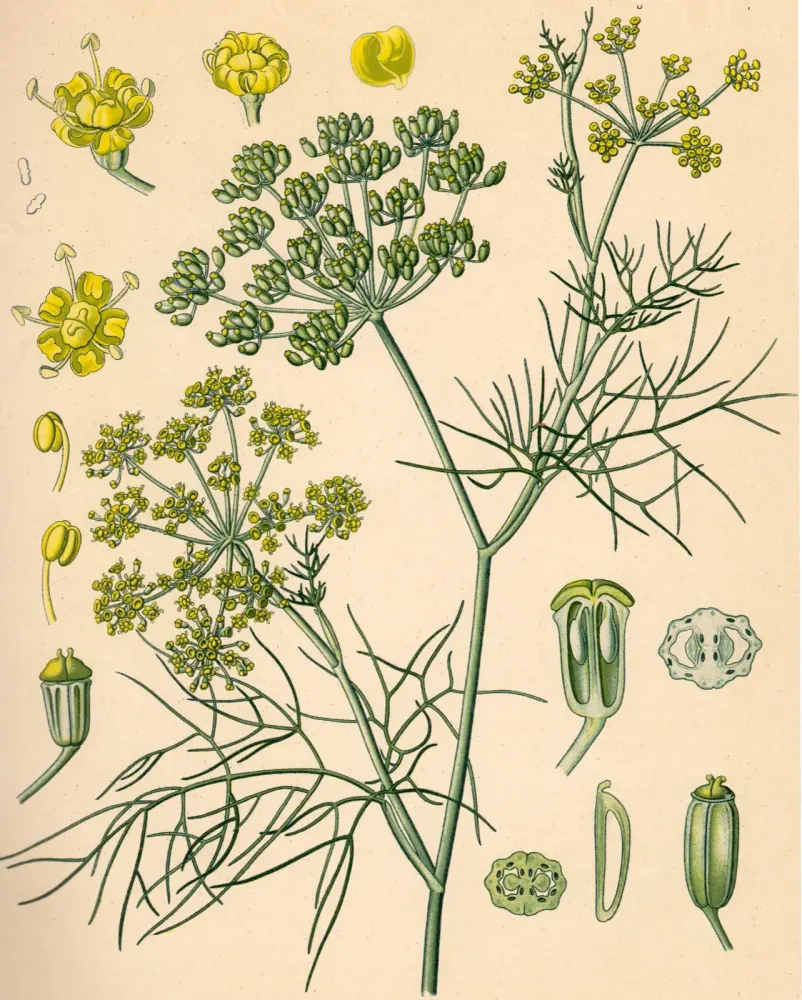
Feathery, dill-like foliage and a distinctly anise-sweet scent make fennel easy to identify; it is the slender fruits, ripening in late summer, that are put to use. Depending on the variety they contain 2 to 6 percent essential oil dominated by trans-anethole, the source of their characteristic sweet flavour. An infusion of crushed fennel fruit is traditionally drunk for digestive complaints such as bloating and is also used for cough and respiratory irritation. It matters that the seeds are crushed before brewing, since whole fruits release almost none of their essential oil. Pure fennel essential oil is highly concentrated and must not be used on infants or toddlers, and anyone allergic to Apiaceae plants should avoid fennel altogether. If symptoms persist beyond one to two weeks, medical advice should be sought.
Classic digestive tea for mild GI cramps, bloating, fullness.
Preparation & dosage
IMPORTANT — Crush seeds in mortar before infusing. 1.5–2.5 g + 150 ml boiling water, steep 10–15 min covered, strain. 3–4× daily. Max ~7 g/day.
- Dry amount
- 1.5–2.5 g
- Doses per day
- 4×
- Max duration
- 2 weeks
⚠ Age restriction: ≥ 4 years — Per EMA from 4 years. Pure essential oil NOT for infants/toddlers (estragole).
Cough tea for productive cold cough.
Preparation & dosage
Crush seeds first. 1.5–2.5 g + 150 ml boiling water, steep 10–15 min. 2–3× daily warm for cold cough.
- Dry amount
- 1.5–2.5 g
- Doses per day
- 3×
- Max duration
- 1 weeks
⚠ Age restriction: ≥ 4 years — From 4 years.
Concentrated application.
Preparation & dosage
Tincture (1:5 in 70% ethanol): 2–5 ml in glass of water 3× daily after meals.
- Liquid amount
- 2–5 ml
- Doses per day
- 3×
- Max duration
- 2 weeks
⚠ Age restriction: ≥ 12 years — Alcoholic tincture from 12 years.
Sources: [1]
Sweet child-friendly fennel cough syrup.
Preparation & dosage
FENNEL HONEY for children from 4 years. Pharmacy products easiest. Homemade: 1 tsp crushed seeds + 150 ml water simmer 10 min, strain, mix with 2 tbsp honey (no honey under 1 year!).
- Dry amount
- 0.5–1 g
- Doses per day
- 3×
- Max duration
- 1 weeks
⚠ Age restriction: ≥ 4 years — From 4 years. Honey from 1 year (botulism).
Sources: [2]
ALWAYS crush seeds before infusion. Pure essential oil NOT for infants/toddlers (estragole). Avoid in Apiaceae allergy. ASPCA classification (accessed 2026-08-10): non-toxic to dogs and cats.
⏱ Max continuous use: 2 weeks
Culinary amounts OK. Avoid therapeutic doses due to estragole.
Traditionally milk-promoting. Culinary OK; avoid therapeutic doses.
Tea from 4 years officially. Pure essential oil CONTRAINDICATED in infants. Tincture from 12.
Drug interactions
Östrogene / hormonelle Kontrazeptiva / Tamoxifen
Weak estrogen-like effect. Avoid therapeutic regular use with hormone-sensitive tumors or tamoxifen.
Ciprofloxacin und andere Fluorchinolone
Mucilage may reduce antibiotic absorption. Separate by 2 hours.
Contraindications
- Hypersensitivity to Apiaceae.
- Children under 4 for self-medication.
- Pure essential oil absolutely contraindicated in infants/toddlers.
- Therapeutic doses in pregnancy/lactation.
Harvested part: ripe fruits
- Time of day:
- On dry morning.
- Drying:
- Cut umbel stems when fruits yellowish-green to greyish-brown but still firm in umbel.
- Storage:
- 24 months — Store WHOLE seeds airtight, dark, cool — 2 years. Crush only before use.
- Ätherisches Öl (Bitterfenchel)Essential oilContent: 4–6 %Fruit
EMA min 40 ml/kg. trans-anethole ≥60 %, fenchone ≥15 % (bitter taste), more estragole than sweet variety.
- Ätherisches Öl (Süßfenchel)Essential oilContent: 2–6 %Fruit
Sweet fennel: ≥80 % trans-anethole, less fenchone, lower estragole — preferred for children's tea.
- trans-AnetholEssential oilContent: 60–80 %Fruit
Main component. Carminative, spasmolytic, secretolytic.
- FenchonEssential oilContent: 1–20 %Fruit
Bicyclic ketone, camphor-like aftertaste.
- Estragol (Methylchavicol)Essential oilContent: 1–10 %Fruit
Suspected carcinogenic at high doses. Reason essential oil restricted. Tea amounts negligible.
- Cumarine (Bergapten, Umbelliferon, Scopoletin)Phenolic acidContent: SpurenFruit
Trace furanocoumarins — rarely phototoxic.
- Flavonoide (Quercetin-, Kaempferol-Glykoside, Rutin)FlavonoidFruit
Mildly antioxidant and anti-inflammatory.
- Fettes ÖlOtherContent: 10–20 %Fruit
Rich in petroselinic acid (~60 %).
- [1]MonographEMA/HMPC/372841/2016 Rev.1 — European Union herbal monograph on Foeniculum vulgare subsp. vulgare var. vulgare, fructus (Bitter fennel, Final, 31 August 2022)(accessed: 2026-05-18)
- [2]MonographEMA/HMPC/372839/2016 Rev.1 — European Union herbal monograph on Foeniculum vulgare subsp. vulgare var. dulce, fructus (Sweet fennel, Final, 31 August 2022)(accessed: 2026-05-18)
- [3]MonographASPCA Animal Poison Control — Fennel (Foeniculum vulgare)(accessed: 2026-08-10)
Distribution in Europe
🤝 Permaculture Partners
In your garden, this plant acts as:
⚠️ Better not planted together
- 🥬 Dill Fennel and dill cross-pollinate and compete.
- 🥬 Apium graveolens Classic companion-planting partner.
- 🥬 Capsicum annuum Classic companion-planting partner.
- 🥬 Caraway Classic companion-planting partner.
- 🥬 Coriander Fennel inhibits coriander germination (Apiaceae conflict).
- 🥬 Parsley Classic companion-planting partner.
- 🥬 Tomato Fennel strongly inhibits tomato growth (allelopathic).
- 🥬 Tropaeolum majus Fennel is strongly allelopathic and inhibits nearly all neighbours.
Source: Gertrud Franck, Gesunder Garten durch Mischkultur (1980, eigene Kuration)