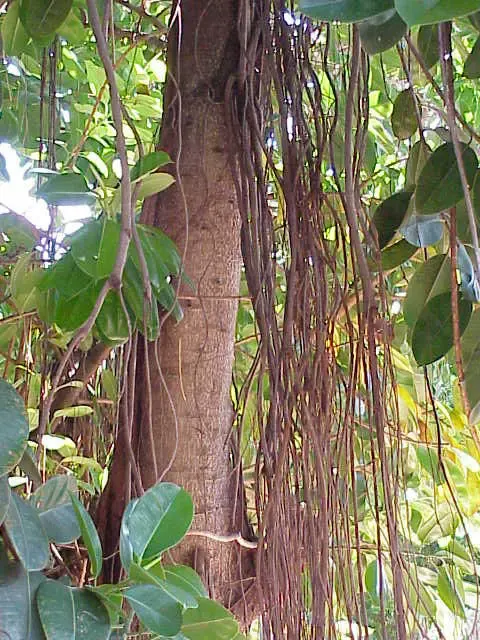
© Unknown · CC BY-SA 3.0 · Commons
Ficus elastica
Caution🐾Gummibaum · (Ficus elastica)
Mulberry family (Moraceae)
Description
Ficus elastica, the rubber fig, rubber bush, rubber tree, rubber plant, or Indian rubber bush, Indian rubber tree, or rambung is a species of flowering plant in the family Moraceae, native to eastern parts of South and Southeast Asia. It has become naturalized in Sri Lanka, the West Indies, and the US state of Florida. Its common names reflect its historical use as a source of rubber within its native range, but it is not used in the modern commercial-scale production of natural rubber.
External use only!
This plant must NOT be taken internally. Use only as compress, salve, or bath.
- RawLeafExternalClinical trial
Placed as a living houseplant, Ficus elastica demonstrably absorbs formaldehyde from indoor air. Wolverton's 1989 NASA study lists it as an effective air-purifying plant.
- RawLeafExternalFolk medicine
The large, glossy leaves release moisture through transpiration, thus improving the indoor climate in dry interiors.
- RawBarkExternalFolk medicine
In Southeast Asia, the milky sap of the rubber plant is traditionally applied externally to skin wounds and inflammatory skin conditions. Caution is advised due to the irritation potential of furanocoumarins.
- RawBarkExternalTraditional use
Historically (19th century until early plantation agriculture), latex from Ficus elastica was harvested in India and Myanmar for rubber production, before Hevea brasiliensis became economically dominant. It is still occasionally used for small craft objects.
- RawLeafExternalFolk medicine
In addition to formaldehyde, Ficus species also reduce trichloroethylene and further volatile organic compounds (VOCs) indoors, according to supplementary studies.
Distribution in Europe
🪴 Grow at home
- ☀ Light
- bright, indirect
- 💧 Water
- weekly
- 🌱 Soil
- Standard compost, well-draining
- 🪴 Pot
- 25 cm
- ⭐ Difficulty
- ★☆☆ beginner
- 🐾 Pets
- toxic to pets
Tips:
- Dust leaves regularly — otherwise photosynthesis suffers.
- Rotate for even growth, don't constantly relocate.
- Milky sap when cut — wash hands.
Care tips are general indoor-gardening recommendations, not scientific sources.