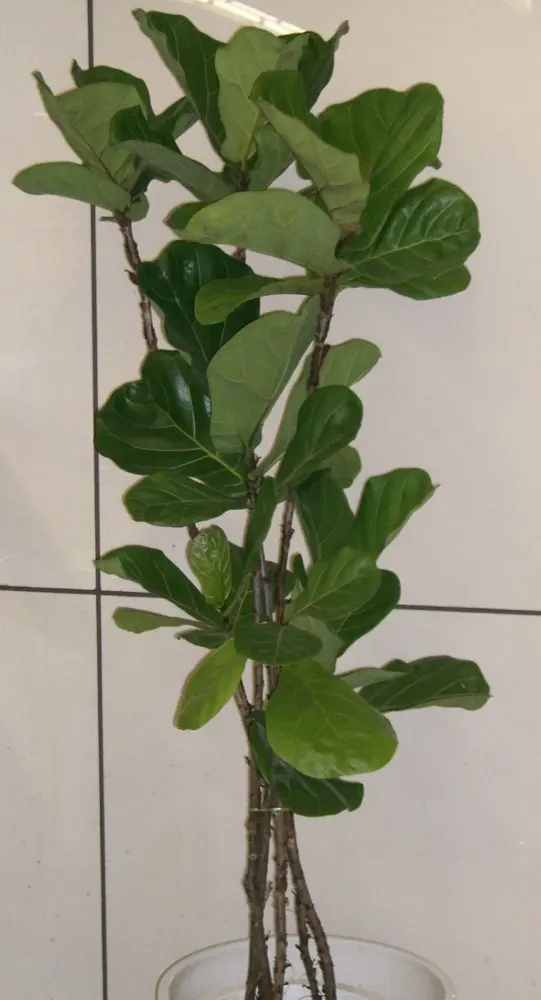
© KENPEI · CC BY-SA 3.0 · Commons
Fiddle-leaf fig
Caution🐾Geigenfeige · (Ficus lyrata)
Mulberry family (Moraceae)
Description
Ficus lyrata, commonly known as the fiddle-leaf fig, is a species in the mulberry family Moraceae, native to the tropical rainforests of western Africa. It is characterised by its exceptionally large, dark green, fiddle-shaped leaves with prominent pale veins. In its native habitat it can grow as a tree up to 15 metres tall. Because Ficus lyrata is not frost-hardy and cannot withstand outdoor temperatures in Central Europe or Bulgaria, it can only be cultivated as a houseplant in these regions.
External use only!
This plant must NOT be taken internally. Use only as compress, salve, or bath.
- RawWhole plantExternalFolk medicine
The fiddle-leaf fig (Ficus lyrata) is one of the most popular decorative houseplants of recent years. Its strikingly large, violin-shaped leaves with pale veins give living spaces, offices and gallery architecture a bold, sculptural accent. Since around 2014 it has been an 'Instagram darling' of the interior design scene. Living houseplants have long been associated with a positive influence on subjective wellbeing indoors (the biophilia concept); specific clinical evidence for F. lyrata does not exist.
[#src_wp_en_ficus_lyrata] [#src_wp_de_geigenfeige] [#src_rhs_ficus_lyrata]
- RawWhole plantExternalFolk medicine
Despite its reputation as a 'low-maintenance' office and living-room plant, the fiddle-leaf fig is in fact notoriously fussy: it needs a very bright, stable position out of draughts, evenly moist (not waterlogged) soil, and frequently responds to relocation or stress by dropping leaves. Once acclimatised, however, it tolerates long stretches with little intervention and can grow several metres tall. It therefore suits owners willing to establish a fixed location and a consistent care routine.
[#src_wp_en_ficus_lyrata] [#src_rhs_ficus_lyrata] [#src_useful_tropical_plants]
- RawWhole plantExternalTraditional use
In its native range (tropical western Africa from Sierra Leone and Cameroon to Angola and the Congo basin) Ficus lyrata grows in lowland rainforests as a tree up to 12-15 m tall. Like many other African Ficus species, it often begins as an epiphyte on a host tree and later develops a strangling root network ('strangler fig'). In parts of its native area it is grown as a shade and ornamental tree; West African ethnobotanical sources place it among the ornamental figs and report occasional use of the wood as local timber.
[#src_wp_en_ficus_lyrata] [#src_useful_tropical_plants] [#src_kew_pow_ficus_lyrata]
- RawLeafExternalTraditional use
The milky white latex that exudes from cut leaves or shoots can irritate sensitive skin and trigger allergic contact dermatitis. Cross-reactivity with natural latex (Hevea brasiliensis) is well documented for the closely related Ficus benjamina; for F. lyrata no specific controlled studies exist, but an analogous precaution is reasonable, especially in latex-allergic individuals. When tending the plant (pruning, repotting) wear gloves and keep sap away from skin and eyes.
[#src_wp_en_ficus_lyrata] [#src_wp_de_geigenfeige] [#src_aspca_ficus]
- RawLeafExternalFolk medicine
The unusual leaf shape gives the plant its name: Latin lyratus = lyre-shaped, German 'Geigenfeige', English 'fiddle-leaf fig'. The leathery leaves grow up to 45 cm long and 30 cm wide, are broadened in the upper third and constricted in the middle, resembling the silhouette of a fiddle or lyre. In interior design, well-foliaged individual specimens are deliberately used as a 'statement plant' in living rooms, hallways and lobbies.
[#src_wp_en_ficus_lyrata] [#src_wp_de_geigenfeige] [#src_rhs_ficus_lyrata]
🪴 Grow at home
- ☀ Light
- bright, indirect
- 💧 Water
- weekly
- 🌱 Soil
- Well-draining, nutrient-rich potting compost with added perlite
- 🪴 Pot
- 25 cm
- ⭐ Difficulty
- ★★★ experienced
- 🐾 Pets
- toxic to pets
Tips:
- Ficus lyrata is not frost-hardy and can only be kept as a houseplant in Central Europe and Bulgaria — frost or temperatures below 10 °C are lethal for the plant.
- Once you have chosen a location, try not to move the plant — fiddle-leaf figs are sensitive to relocation and respond by dropping leaves.
- Bright, indirect light is ideal; direct midday sun scorches the leaves, while too little light causes leaf drop.
- Avoid waterlogging at all costs — only water when the top layer of soil has dried out.
- Wipe leaves regularly with a damp cloth so the plant can absorb light optimally.
Care tips are general indoor-gardening recommendations, not scientific sources.