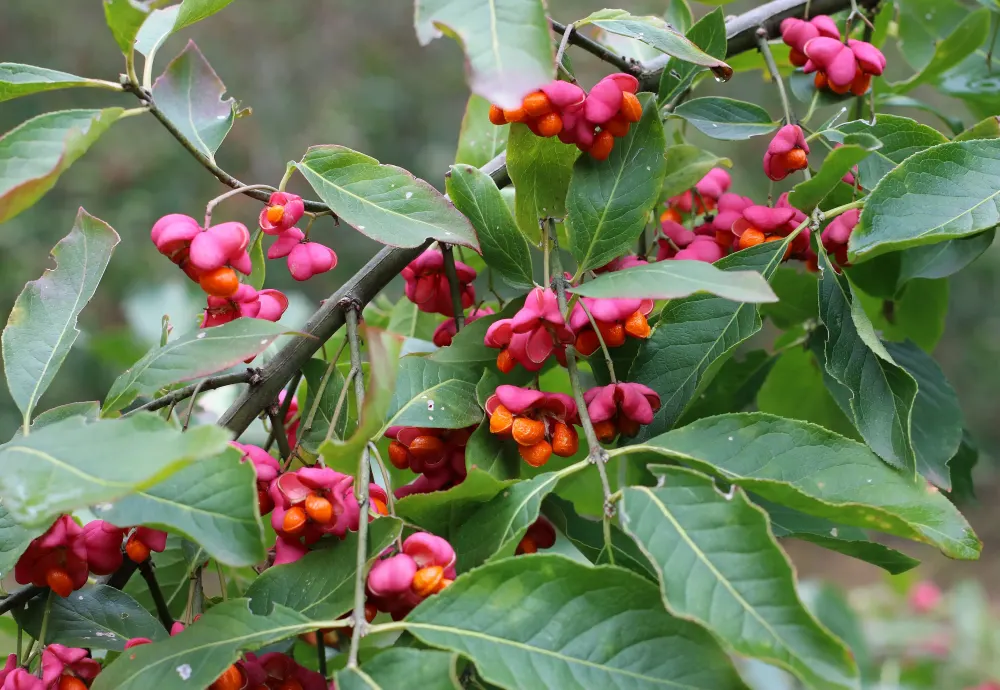
© George Chernilevsky · CC BY 4.0 · Commons
Euonymus europaeus
Toxic🐾Gewöhnlicher Spindelstrauch · (Euonymus europaeus)
Spindle family (Celastraceae)
Description
Euonymus europaeus, the spindle, European spindle, or common spindle, is a species of flowering plant in the family Celastraceae, native to much of Europe, where it inhabits the edges of forest, hedges and gentle slopes, tending to thrive on nutrient-rich, chalky and salt-poor soils. It is a deciduous shrub or small tree.
🌿 Risk of confusion — read before wild-harvesting!
STRONGLY TOXIC — ALL PLANT PARTS, ESPECIALLY THE BRIGHT ORANGE SEEDS. Euonymus europaeus contains cardenolide glycosides (evonoside, evobioside, evomonoside — digitalis-like cardioactive) and sesquiterpenoid alkaloids (evonine, evonoline) plus bitter substances and saponins. Characteristic is the LONG LATENCY: symptoms appear 8–15 hours after ingestion — so the link to the plant is often recognised too late. Typical poisoning symptoms: nausea, severe vomiting, cramping abdominal pain, bloody diarrhoea, cold sweats, circulatory collapse, dilated pupils, seizures and dangerous cardiac arrhythmias (bradycardia, extrasystoles, AV block) similar to digitalis poisoning. As few as 5–10 ripe seeds can trigger severe poisoning in children; 30–40 seeds are considered potentially lethal in adults (literature values vary substantially — individual sensitivity is unpredictable). Skin contact with the sap during pruning can cause irritation and, in rare cases, contact dermatitis. On suspicion of ingestion: IMMEDIATELY contact poison control (regional centres, emergency 112/911) — even if no symptoms are yet present, because the latency masks the severity of the poisoning. Activated charcoal useful within the first hour. Never induce vomiting yourself if the affected person is already convulsing or unconscious.
External use only!
This plant must NOT be taken internally. Use only as compress, salve, or bath.
CONTRAINDICATED during pregnancy
Cardenolide glycosides and sesquiterpenoid alkaloids from Euonymus europaeus cross the placenta and are embryotoxic in animal studies; in addition, Euonymus material was historically used as an abortifacient — supporting the suspicion of uterotonic action. Any form of internal use or accidental ingestion during pregnancy is strictly contraindicated. Even garden work pruning the shrub is sensible only with gloves and without risk of injury from sap splashes.
CONTRAINDICATED during breastfeeding
Transfer of cardenolides and alkaloids into breast milk has not been sufficiently studied; given the already cardiotoxic effect at low doses in the infant (bradycardia, AV block), any self-application during breastfeeding is contraindicated. Symbolic garden use of the ornamental shrub is permitted, but any plant parts that can be picked, chewed or swallowed must be kept out of the reach of breastfeeding mothers and their infants.
CONTRAINDICATED for children
Children are the main risk group for spindle poisoning — the bright pink-orange capsule fruits and the egg-yolk-yellow seeds look attractive like sweets and appear at toddler eye level in hedges, hedgerows, parks and playground edges. In German poison control centres, Euonymus europaeus is regularly among the five most frequent childhood plant poisonings in autumn. Ingestion of 1–2 seeds usually causes only nausea; from 5 seeds upward serious symptoms are to be expected. Parents and educators: plant the shrub in family gardens only out of reach (above eye level), specifically educate children, in case of poisoning immediately call poison control and keep one ripe seed or fruit fragment for identification.
Critical drug interactions with:
Herzglykoside (Digoxin, Digitoxin, Methyldigoxin) · Kaliumverlust-Diuretika (Furosemid, Hydrochlorothiazid, Indapamid) · Antiarrhythmika (Amiodaron, Sotalol, Verapamil, Diltiazem)
- RawWhole plantExternalFolk medicine
The most important modern use of European spindle is as an ornamental shrub in wild hedges, woodland edges, cottage gardens and urban park and hedgerow plantings. Valued for its spectacular autumn colour (bright orange-red to purple-red) and its unmistakable pink-red, four-lobed capsule fruits with orange seed arils that remain on the bare shrub after leaf fall. In ecologically managed hedges (e.g. North German Knicks) it provides food and nesting sites for birds (robin, blackcap); the flowers are an important pollen source for wild bees, hoverflies and the spindle ermine moth (Yponomeuta cagnagella). No medicinal use — this entry explicitly documents horticultural and ecological use with a toxicity warning.
Preparation & dosage
[#src_wp_de_euonymus_europaeus] [#src_wp_en_euonymus_europaeus] [#src_pfaf_euonymus_europaeus]
- RawWhole plantExternalFolk medicine
Eponymous historical use of the very fine, dense and tough spindle wood for turned spindles for wool spinning, small toothpicks, shoemaker's wooden pegs, knitting needles, carved figures, piano keys and weaving shuttles. The hard, evenly grained wood can be worked extremely finely — hence the German names 'Spindelstrauch', 'Spillbaum' and English 'spindle tree'. The folk name 'Pfaffenhütchen' (priest's cap, French bonnet-de-prêtre) refers not to the wood but to the shape of the four-lobed capsule fruits, which resemble the square biretta cap (pileolus) of Catholic clergy.
[#src_wp_de_euonymus_europaeus] [#src_wp_en_euonymus_europaeus] [#src_pfaf_euonymus_europaeus]
- RawWhole plantExternalFolk medicine
Artist's charcoal ('powder wood', French fusain): peeled European spindle twigs carbonised in low-oxygen iron vessels yield a particularly soft, fine-drawing charcoal for artists' sketches — hence the French term 'fusain' (which is at the same time the French name of the plant). The charcoal abrades evenly on paper, blends easily with the finger and has been a standard sketching material in European art academies since the Renaissance. Until the 19th century, spindle charcoal was also used in gunpowder manufactories as a component for black powder (low sulphur content, even burn rate).
[#src_wp_de_euonymus_europaeus] [#src_wp_en_euonymus_europaeus] [#src_wikidata_euonymus_europaeus]
- RawSeedExternalFolk medicine
Historical folk-medicinal use of powdered ripe seed against head lice, crab lice and scabies mites in humans and livestock: the seed powder was mixed with lard, pork fat or vegetable oil and rubbed into the scalp or animal fur. The action is based on the sesquiterpenoid alkaloids contained in the seed oil (evonine, evonoline) and on the cardenolide glycosides, which act as acaricides and insecticides. Hieronymus Bock (1546) and Lonicerus (1557) already describe this application — today strictly obsolete because systemic skin absorption can cause cardiac arrhythmias with prolonged use, and safe, non-toxic alternatives (permethrin, dimeticone) are available. Pure historical documentation, NO recommendation for use.
[#src_wp_de_euonymus_europaeus] [#src_pfaf_euonymus_europaeus] [#src_henriette_euonymus_europaeus]
- RawFruitExternalFolk medicine
Dyeing and craft use of the capsule fruits and orange seed arils: the carotenoids of the aril yielded a yellow-orange dye (historical application in Central European butter tincture and for wool), while the crushed pink capsule wall mordanted with alum gave a pinkish-brown wool textile shade. The dried capsule fruits are also used in floristry for autumn arrangements and dried wreaths — caution: children must NOT be assigned to collect them, as the temptation to place the bright seeds in the mouth is acutely life-threatening. The fruit is NOT a food colouring and must NOT be used for butter, cheese or baked goods.
[#src_wp_de_euonymus_europaeus] [#src_pfaf_euonymus_europaeus] [#src_commons_euonymus_europaeus]
Historical documentation only — do NOT use
These internal applications are historically documented. This plant is highly toxic — self-treatment can cause severe poisoning or death. For documentation only, explicitly NOT a recommendation.
- TinctureBarkInternalFolk medicine
Historically, the dried and powdered root and stem bark of European spindle was applied in homeopathic and folk-medicinal drop preparations as a drastic purgative (hydragogue) and cholagogue for constipation, dropsy (oedema) and jaundice. The North American relative Euonymus atropurpureus (Wahoo) was officially used in 19th-century Eclectic Medicine in the form of 'euonymin' as a liver and bile remedy. Mechanism: cardenolide glycosides (evonoside, evobioside, evomonoside) massively irritate the intestinal mucosa and act digitalis-like on the heart — hence the high risk of nausea, bloody diarrhoea, collapse and cardiac arrhythmias even at therapeutic doses. Today entirely obsolete and not included in any current phytotherapy guideline.
[#src_wp_en_euonymus_europaeus] [#src_pfaf_euonymus_europaeus] [#src_henriette_euonymus_europaeus]