Legal notice
Internationally controlled compounds: cathinone (Schedule I) and cathine (Schedule III) of the 1971 UN Convention; banned in many countries.
The plant itself is not under international control, but its compounds cathinone and cathine are. The legal situation differs from country to country — legal in some countries of origin, prohibited in many others. Inform yourself about the laws that apply to you.
For education and documentation only. Not a consumption guide, not legal or medical advice. Possession, cultivation and use are regulated differently by country and species — check the law that applies to you.
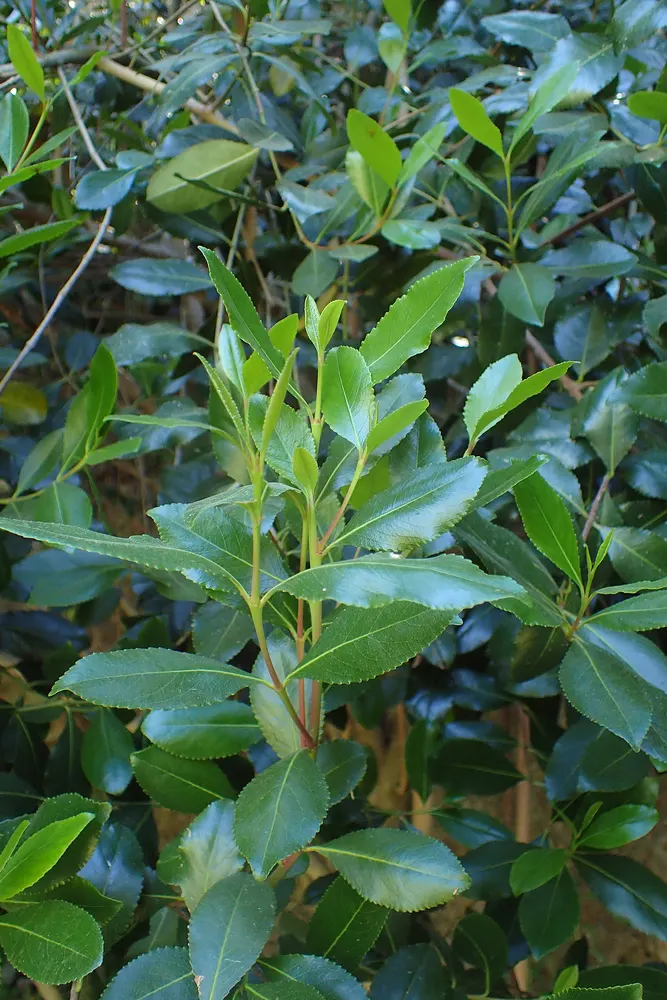
© Krzysztof Ziarnek (Kenraiz) · CC BY-SA 4.0 · Commons
Khat
Toxic🐾Kathstrauch (Khat) · (Catha edulis)
Staff-vine family (Celastraceae) (Celastraceae)
Description
Catha edulis, the khat shrub, is an evergreen shrub or small tree (1–5 m) in the staff-vine family (Celastraceae) and the sole species of the genus Catha. It is native to East Africa and the Arabian Peninsula; its cultivation originated in Ethiopia's Harar region and spread from there to East Africa and South Arabia. Fresh shoot tips and young leaves have been chewed for centuries in the Horn of Africa and Yemen, mainly for their stimulant effect. The medieval historian al-Maqrizi already described the herb as sharpening intellect and memory. Its principal active compound is the amphetamine-like alkaloid cathinone, which degrades rapidly after harvest.
Historical documentation only — do NOT use
These internal applications are historically documented. This plant is highly toxic — self-treatment can cause severe poisoning or death. For documentation only, explicitly NOT a recommendation.
- RawLeafInternalTraditional use
Traditionally, fresh shoot tips and young leaves are chewed in the Horn of Africa and Yemen as a central-nervous-system stimulant, against fatigue, and in social settings. Documentary only; not a consumption recommendation.
- RawLeafInternalFolk medicine
Khat has been used as a folk medicine by some indigenous peoples of East Africa; neither the plant nor its compounds have achieved broad medical acceptance.