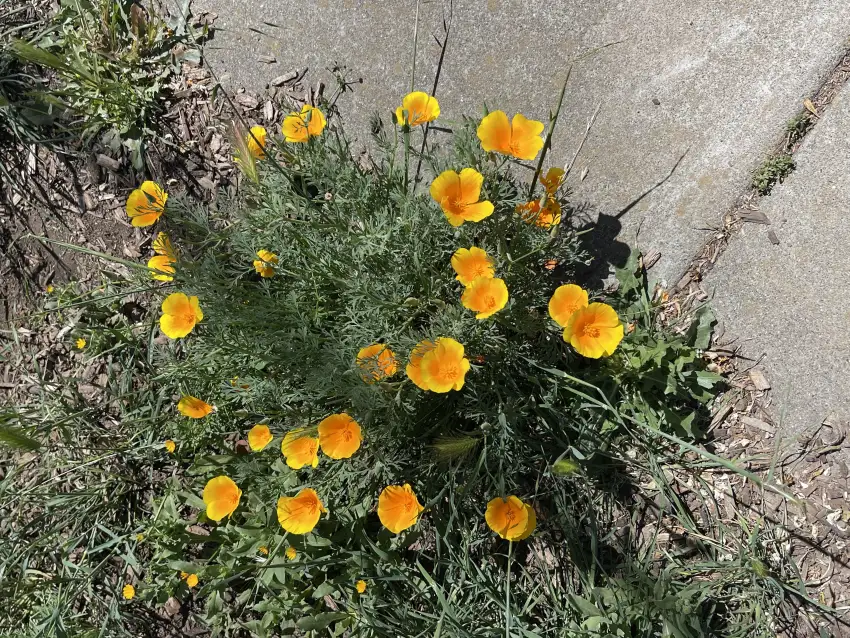
© Missvain · CC BY 4.0 · Commons
California poppy
Kalifornischer Mohn · (Eschscholzia californica)
Poppy family (Papaveraceae)
Description
The California poppy (also called golden poppy or 'Schlafmützchen' in German) is a low-growing annual to short-lived perennial of the poppy family, with finely divided blue-green foliage and brilliant orange to golden saucer-shaped flowers that open in sunshine and close at night and in cold weather. Native to California and the southwestern United States and Mexico, it is now cultivated worldwide as an ornamental. Despite its name it is not the same as the opium poppy (Papaver somniferum): it contains no morphine and no opiates. Its effects come from an entirely different group of alkaloids (including californidine, eschscholtzine and protopine). The medicinal part is the flowering aerial parts of the herb (Eschscholziae herba).
CONTRAINDICATED during pregnancy
Safety in pregnancy not established; per the EMA monograph, use during pregnancy is not recommended.
CONTRAINDICATED for children
Not to be used in children and adolescents under 18 years owing to a lack of data (EMA monograph).
Traditional tea from the herb to relieve mild symptoms of mental stress and as a gentle sleep aid. Unlike the opium poppy it is not addictive and contains no morphine.
Preparation & dosage
Pour about 150 ml of boiling water over 1–2 g of dried, comminuted herb, cover and steep for 10 minutes, then strain. As a sleep aid, drink one cup about 30–60 minutes before going to bed; for relief of mild mental stress, spread doses over the day.
- Dry amount
- 1–2 g
- Doses per day
- 2×
⚠ Age restriction: ≥ 18 years — Adults aged 18 and over only; not for children and adolescents under 18 due to lack of data (EMA HMPC).
Alcoholic extract of the flowering herb, traditionally used for mild mental stress and difficulty falling asleep. Because of the alcohol content and sedative effect, do not take before driving.
Preparation & dosage
Take 1–4 ml of tincture (typically 1:5 in alcohol) in a little water. As a sleep aid, take one dose about 30–60 minutes before bedtime; for mild mental stress, as needed, up to twice daily.
- Liquid amount
- 1–4 ml
- Doses per day
- 2×
⚠ Age restriction: ≥ 18 years — Adults aged 18 and over only; not for children and adolescents under 18 due to lack of data (EMA HMPC).
May cause drowsiness and impair reactions — do not drive or operate machinery after an evening dose. The sedative effect may add to that of other sedatives and of alcohol. Owing to a lack of data, do not use during pregnancy and breastfeeding, nor in children and adolescents under 18 years. If symptoms last longer than two weeks or worsen, consult a doctor or qualified healthcare practitioner.
Safety in pregnancy not established; per the EMA monograph, use during pregnancy is not recommended.
Safety during breastfeeding not established; per the EMA monograph, use during lactation is not recommended.
Not to be used in children and adolescents under 18 years owing to a lack of data (EMA monograph).
Drug interactions
Sedatives/CNS depressants (benzodiazepines, alcohol)
The calming, sleep-promoting effect may theoretically add to that of central nervous system depressants and alcohol, increasing drowsiness. The EMA monograph reports no confirmed interactions, but concurrent use should be approached with caution.
Contraindications
- Hypersensitivity to California poppy or other members of the poppy family.
- Combine only with caution with other sedatives, sleep aids or alcohol.
Harvested part: Flowering aerial parts (herb)
- CalifornidineAlkaloidContent: variableAerial parts
Quaternary pavine alkaloid and one of the lead alkaloids of the herb. Not morphine or an opiate.
- EschscholtzineAlkaloidAerial parts
Isoquinoline alkaloid (pavine type), characteristic of the genus Eschscholzia.
- ProtopineAlkaloidAerial parts
Isoquinoline alkaloid to which calming and antispasmodic properties are attributed.
- AllocryptopineAlkaloidAerial parts
Further isoquinoline alkaloid of the herb. Overall the herb contains only small amounts of alkaloids (about 0.3 %).
- Rutin (Flavonoide)FlavonoidAerial parts
Flavonol glycoside; representative of the flavonoids found in the herb.
- CarotenoideOtherFlower
Yellow-orange pigments (including eschscholtzxanthin) that give the petals their brilliant colour.
- [1]MonographEuropean Union herbal monograph on Eschscholzia californica Cham., herba (EMA/HMPC/680372/2013)(accessed: 2026-06-12)
- [2]MonographEMA — Eschscholziae herba (California poppy): herbal medicine overview(accessed: 2026-06-12)
- [3]MonographEMA — Final assessment report on Eschscholzia californica Cham., herba(accessed: 2026-06-12)
- [4]WikipediaEschscholzia californica — Wikipedia (English)(accessed: 2026-06-12)
- [5]WikipediaKalifornischer Mohn — Wikipedia (Deutsch)(accessed: 2026-06-12)
- [7]CommonsFile:Eschscholzia californica - May 2023 - Sarah Stierch.jpg — Wikimedia Commons(accessed: 2026-06-12)
- [6]WikidataEschscholzia californica (Q156831) — Wikidata(accessed: 2026-06-12)
🤝 Permaculture Partners
In your garden, this plant acts as: