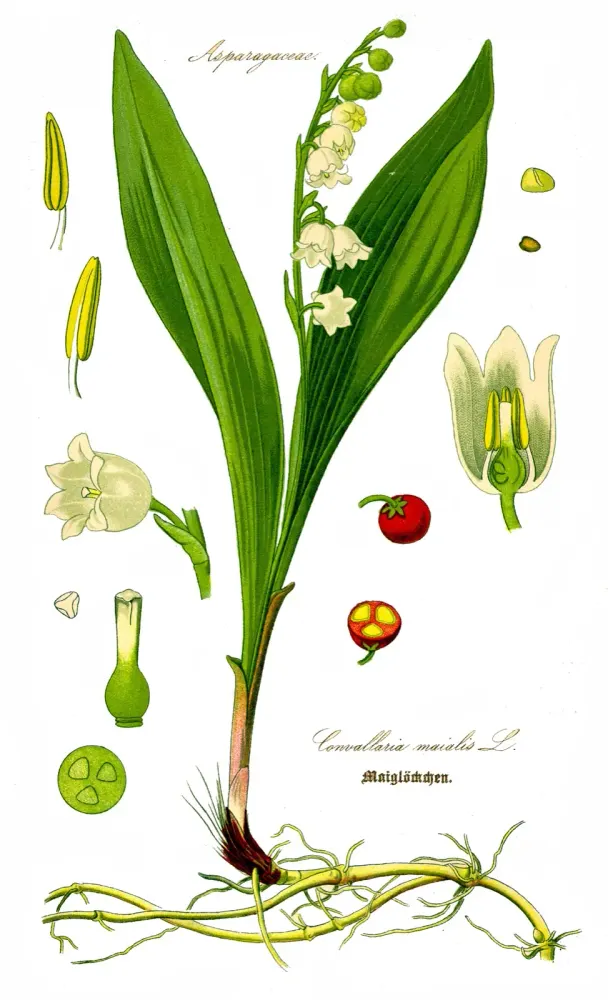
© Unknown · Public domain · Commons
Lily of the valley
Toxic🐾Maiglöckchen · (Convallaria majalis)
Asparagus family (Asparagaceae)
Description
Lily-of-the-valley, also written as lily of the valley, is a woodland flowering plant with sweetly scented, pendent, bell-shaped white flowers borne in sprays in spring. It is native to Europe, Western Asia and Northern Asia.
🌿 Risk of confusion — read before wild-harvesting!
Lily of the valley (Convallaria majalis) contains cardenolide cardiac glycosides (convallatoxin, convalloside, convallatoxol) that can cause life-threatening cardiac arrhythmias, AV block, and ventricular fibrillation when overdosed.
External use only!
This plant must NOT be taken internally. Use only as compress, salve, or bath.
CONTRAINDICATED during pregnancy
Cardiac glycosides cross the placental barrier and can cause foetal cardiac arrhythmias. Any internal use during pregnancy is strictly contraindicated.
CONTRAINDICATED during breastfeeding
Cardiac glycosides can pass into breast milk and cause cardiotoxic effects in the infant. Internal use during lactation is strictly contraindicated.
CONTRAINDICATED for children
Children are particularly at risk of poisoning due to lower body mass and more sensitive cardiac physiology. Any internal contact with plant parts must be strictly avoided in children. First aid: contact a poison control centre.
Critical drug interactions with:
Herzglykoside (Digitalis, Digoxin, Digitoxin) · Kaliumverlust-Diuretika (Thiazide, Schleifendiuretika) · Antiarrhythmika (Chinidin, Amiodaron, Verapamil)
- TinctureFlowerExternalFolk medicine
Historically, lily of the valley flower oil and extract was rubbed topically for joint pain and gout. This external folk use was widespread in Northern Europe. Despite low dermal absorption, there is also a theoretical poisoning risk externally with large-area application on damaged skin.
Historical documentation only — do NOT use
These internal applications are historically documented. This plant is highly toxic — self-treatment can cause severe poisoning or death. For documentation only, explicitly NOT a recommendation.
- TinctureAerial partsInternalCommission E
The German Commission E issued a positive monograph in 1984 for Convallaria glycosides in mild cardiac insufficiency (NYHA I–II) and cardiac arrhythmias. Convallatoxin and convalloside inhibit Na⁺/K⁺-ATPase of cardiac muscle cells and increase contractile force (positive inotropic). Today largely replaced by Digitalis glycosides; of historical-pharmaceutical significance.
[#src_kommission_e_convallaria] [#src_wiki_convallaria_de] [#src_wiki_convallaria_en]
- TinctureFlowerInternalTraditional use
In traditional European medicine of the 16th–19th centuries, lily of the valley tincture from flowers and leaves was used as a cardiac remedy for oedema, dropsy, and heart weakness. Leonhart Fuchs described its use in his herbal of 1543. Before the advent of standardised Digitalis preparations, Convallaria was a widely used cardiac tonic.
- TeaLeafInternalFolk medicine
In the folk medicine of Central and Eastern Europe, lily of the valley leaf tea was prepared for heart palpitations and dizziness. Due to the narrow therapeutic index of cardiac glycosides, folk users substantially underestimated the poisoning risk. Historical use without modern dosage control.
- TinctureAerial partsInternalFolk medicine
Homoeopathic preparations of Convallaria majalis (mother tincture D1–D30) are used in homoeopathy for cardiac arrhythmias, angina pectoris, and oedema. Homoeopathic use is based on the principle of similars — highly diluted preparations are considered safe. Outside the homoeopathic framework, the plant is highly toxic.
- TinctureAerial partsInternalFolk medicine
In Russian and Scandinavian folk medicine, lily of the valley extract was used for exhaustion, neurasthenia, and functional cardiac complaints. Russian pharmacopoeias of the early 20th century contained Convallaria preparations as official medicines. The weak evidence base differs markedly from the well-documented cardiac effect.