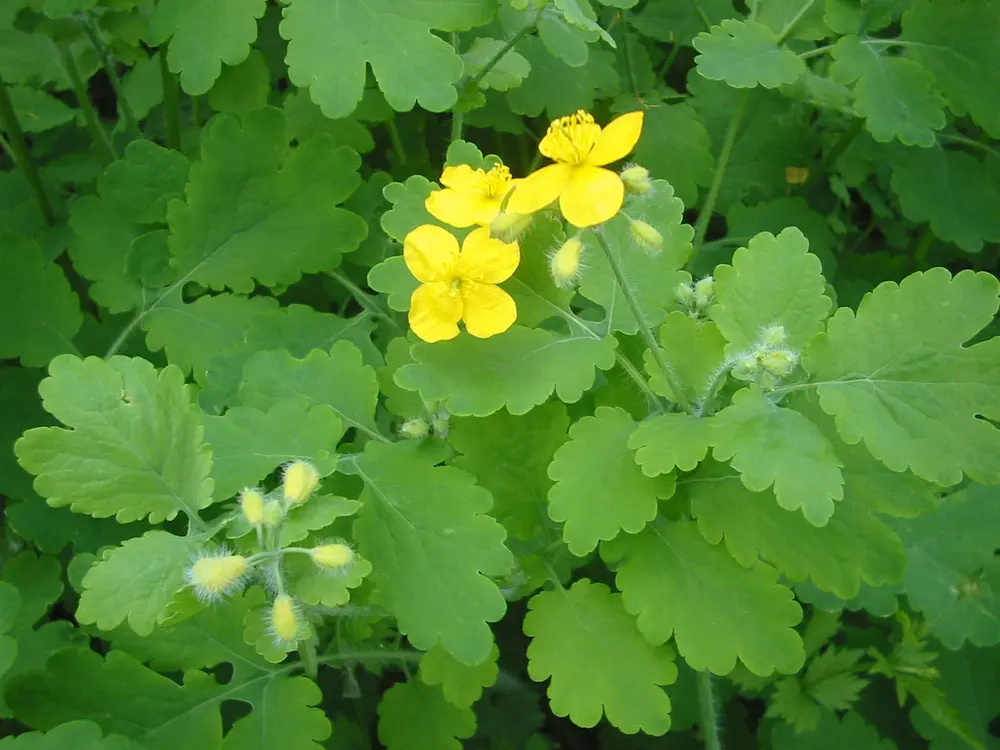
© Bogdan (Wikimedia Commons) · CC BY-SA 3.0 · Commons
Greater celandine
Toxic🐾Schöllkraut · (Chelidonium majus)
Poppy family (Papaveraceae)
Description
Greater celandine is a biennial to perennial herbaceous plant of the poppy family, growing up to about 70 cm tall. When the plant is injured it exudes a characteristic yellow to orange latex from its articulated laticifers. The alternate leaves are deeply lobed and pinnate, and the small four-petalled yellow flowers appear from May to October. The whole plant contains more than twenty isoquinoline alkaloids and is toxic, with the root being especially poisonous. Traditionally its fresh latex was applied externally against warts.
- RawAerial partsExternalTraditional use
The fresh yellow-orange latex is traditionally dabbed directly onto warts several times a day. A folk practice in several European countries; surrounding healthy skin should be avoided as the sap is irritating.
Historical documentation only — do NOT use
These internal applications are historically documented. This plant is highly toxic — self-treatment can cause severe poisoning or death. For documentation only, explicitly NOT a recommendation.
- TinctureAerial partsInternalTraditional use
Internally, an alcoholic tincture of the herb was traditionally used for cramping biliary and digestive complaints. Internal use is now discouraged because of documented, sometimes severe liver injury (toxic hepatitis up to liver failure).
- TeaAerial partsInternalFolk medicine
A tea (infusion) of the dried herb was a folk remedy regarded as antispasmodic for stomach, intestinal and biliary complaints. Because of the alkaloids' hepatotoxicity, internal intake is strongly discouraged.