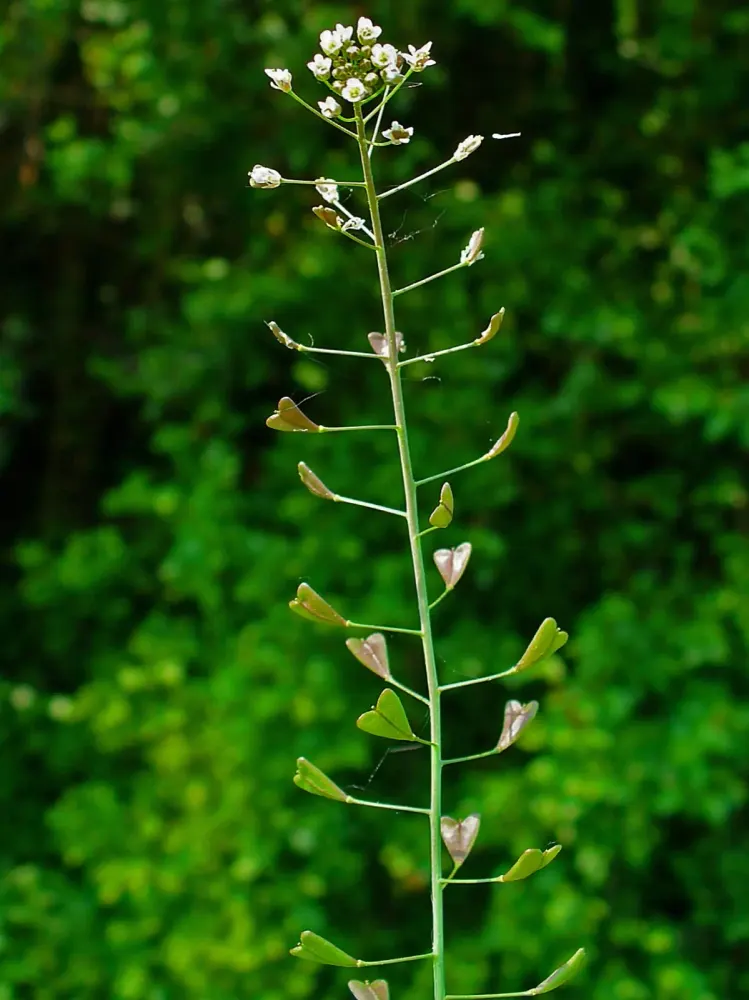
© H. Zell · CC BY-SA 3.0 · Commons
Capsella bursa-pastoris
CautionGewöhnliches Hirtentäschel · (Capsella bursa-pastoris)
Cabbage family (Brassicaceae)
Description
Capsella bursa-pastoris, commonly known as shepherd's purse or lady's purse, is a small flowering plant in the mustard family. It has been described as a protocarnivore because its seeds contain mucilage, which traps nematodes.
CONTRAINDICATED during pregnancy
Strictly to be avoided in pregnancy. Shepherd's purse was historically a classic labour stimulant ('midwives' herb') used specifically to stimulate uterine contraction and to staunch postpartum bleeding — therefore contraindicated before onset of labour due to possible risk of abortion and premature contractions. Also no culinary use in larger amounts.
Critical drug interactions with:
MAO-Hemmer (Tranylcypromin, Moclobemid, Selegilin)
- TeaAerial partsInternalCommission E
Classic for excessively heavy, prolonged or too frequent menstrual bleeding (menorrhagia, metrorrhagia) as well as symptomatic post-bleeding and capillary oozing. Positively assessed by German Commission E ('Bursae pastoris herba').
Preparation & dosage
[#src_kommission_e_capsella] [#src_escop_capsella] [#src_heilkraeuter] [#src_madaus]
- TinctureAerial partsInternalTraditional use
Main folk-medicine preparation for hemostasis: for menorrhagia, nosebleeds, hemorrhoidal bleeding and postpartum bleeding. Shepherd's purse tincture served as a substitute for ergot preparations in World War I.
Preparation & dosage
[#src_escop_capsella] [#src_heilkraeuter] [#src_madaus] [#src_henriettes]
- CompressAerial partsExternalFolk medicine
Folk-medicine wound compress for minor bleeding cuts and abrasions, nosebleeds (tampon), hemorrhoidal bleeding and superficial skin injuries — hemostatic and astringent.
Preparation & dosage
[#src_heilkraeuter] [#src_madaus] [#src_henriettes] [#src_pfaf]
- RawLeafInternalFolk medicine
Spring wild herb: young basal leaves are used raw in salads, as a spinach substitute, in wild-herb soups, herbed quark and pestos — nutty cress-like flavour (glucosinolates, typical of Brassicaceae). Vitamin- and mineral-rich, traditionally one of the 'nine herbs' of Maundy Thursday soup.
Preparation & dosage
- GargleAerial partsExternalFolk medicine
Folk medicine for bleeding gums, mild gum inflammation (gingivitis) and bleeding mouth after tooth extraction — astringent and hemostatic.
Preparation & dosage
- TeaAerial partsInternalFolk medicine
Folk-medicine support for mild high blood pressure complaints and as a mild diuretic for fluid retention — the blood-pressure regulating and mildly diuretic properties have been used for centuries (tyramine content, flavonoids).
Preparation & dosage
[#src_pfaf] [#src_heilkraeuter] [#src_madaus] [#src_henriettes]