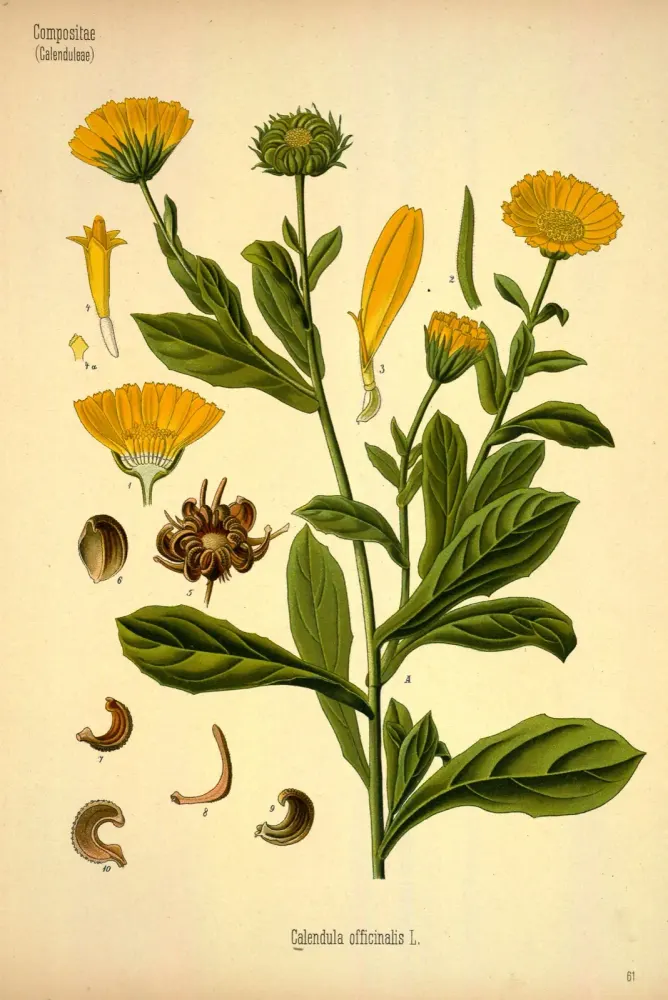
© Oceancetaceen - Alice Chodura · Public domain · Commons
Calendula officinalis
CautionRingelblume · (Calendula officinalis)
Daisy family (Asteraceae)
Description
Calendula officinalis, Mary's gold, common marigold, the pot marigold, Scotch marigold, or ruddles, is a flowering plant in the daisy family, Asteraceae. It is probably native to southern Europe, but its long history of cultivation makes its precise origin unknown, and it is widely naturalised. The florets are edible and the plant has historically been used as medicine.
- CompressFlowerExternalTraditional use
Traditional moist compress to support the treatment of minor skin inflammation (e.g. sunburn) and as an aid in healing minor superficial wounds.
Preparation & dosage
INFUSION for moist compress: Pour 150 ml hot water over 1–2 g dried calendula flowers, cover and steep for about 10 minutes, strain. Soak a clean cotton or linen cloth in the still-warm infusion and place on the affected area (minor wound, mild sunburn) for 30–60 minutes. Refresh 2–4 times a day.
- Dry amount
- 1–2 g
- Doses per day
- 3×
- Max duration
- 1 weeks
⚠ Age restriction: ≥ 6 years — Per EMA, use in children under 6 years is not recommended due to insufficient data.
- SalveFlowerExternalTraditional use
Classic calendula ointment for care of minor skin wounds, abrasions and irritated skin patches.
Preparation & dosage
CALENDULA OINTMENT: Use an ointment containing 2–10 % calendula flower (ready-made or home-prepared). Apply a thin layer 2–4 times a day to the affected skin — for minor wounds, abrasions, mild sunburn, or rough, irritated skin.
- Doses per day
- 3×
- Max duration
- 1 weeks
⚠ Age restriction: ≥ 6 years — Per EMA, not recommended for children under 6 years.
- TinctureFlowerExternalTraditional use
Ethanolic tincture as a shelf-stable concentrate — diluted for wound care.
Preparation & dosage
CALENDULA TINCTURE (1:5 in ethanol 70–90 %): For compresses, dilute at least 1:3 with freshly boiled, cooled water. 2–4 times a day. Do not apply undiluted to open wounds.
- Doses per day
- 3×
- Max duration
- 1 weeks
⚠ Age restriction: ≥ 6 years — Per EMA, not recommended for children under 6 years.
- GargleFlowerExternalTraditional use
Mouth rinse and gargle to support the treatment of minor inflammation in the mouth and throat.
Preparation & dosage
INFUSION for gargle and mouth rinse: Pour 150 ml hot water over 1–2 g dried calendula flowers, steep 10 minutes covered, strain, cool to drinking temperature. Gargle 2–4 times a day, then spit out.
- Dry amount
- 1–2 g
- Doses per day
- 3×
- Max duration
- 1 weeks
⚠ Age restriction: ≥ 12 years — For mouth/throat use, EMA sets age limit of 12 years.
- BathFlowerExternalTraditional use
Traditional soothing bath for larger irritated skin areas.
Preparation & dosage
PARTIAL BATH / WASH: Pour 1 litre hot water over 20–50 g dried calendula flowers, steep 15 minutes, strain and add to lukewarm bath water (sitz, hand, or foot bath). Bathe for about 10–15 minutes.
- Dry amount
- 20–50 g
- Doses per day
- 1×
- Max duration
- 2 weeks
⚠ Age restriction: ≥ 6 years — For small children only after pediatrician consultation; EMA skin-use age limit is 6 years.
Distribution in Europe
🪴 Grow at home
- ☀ Light
- full sun
- 💧 Water
- every few days
- 🌱 Soil
- Standard potting compost
- 🪴 Pot
- 20 cm
- ⭐ Difficulty
- ★☆☆ beginner
- 🐾 Pets
- pet-safe
Tips:
- Self-seeding — collect seeds or let it spread.
- Deadhead regularly for long flowering.
- Flowers edible (salads) or for salve infusion.
Care tips are general indoor-gardening recommendations, not scientific sources.
🤝 Permaculture Partners
In your garden, this plant acts as:
✨ Best symbiotic partners
- 🌿 Garlic Classic companion-planting partner.
- 🌿 Borage Calendula and borage — the dual insect magnet.
- 🌿 Capsicum annuum Classic companion-planting partner.
- 🌿 Cucumber Calendula deters nematodes and attracts beneficials.
- 🌿 Cucurbita pepo Classic companion-planting partner.
- 🌿 Zucchini Classic companion-planting partner.
- 🌿 Fragaria vesca Classic companion-planting partner.
- 🌿 Matricaria chamomilla Classic companion-planting partner.
- 🌿 Ocimum tenuiflorum Classic companion-planting partner.
- 🌿 Tomato Calendula attracts beneficials and deters nematodes.
- 🌿 Potato Classic companion-planting partner.
- 🌿 Tagetes patula Classic companion-planting partner.
- 🌿 Tropaeolum majus Classic companion-planting partner.
📦 Part of these planting sets:
Source: Helga und Margarete Langerhorst, Mein gesunder Naturgarten (eigene Kuration)