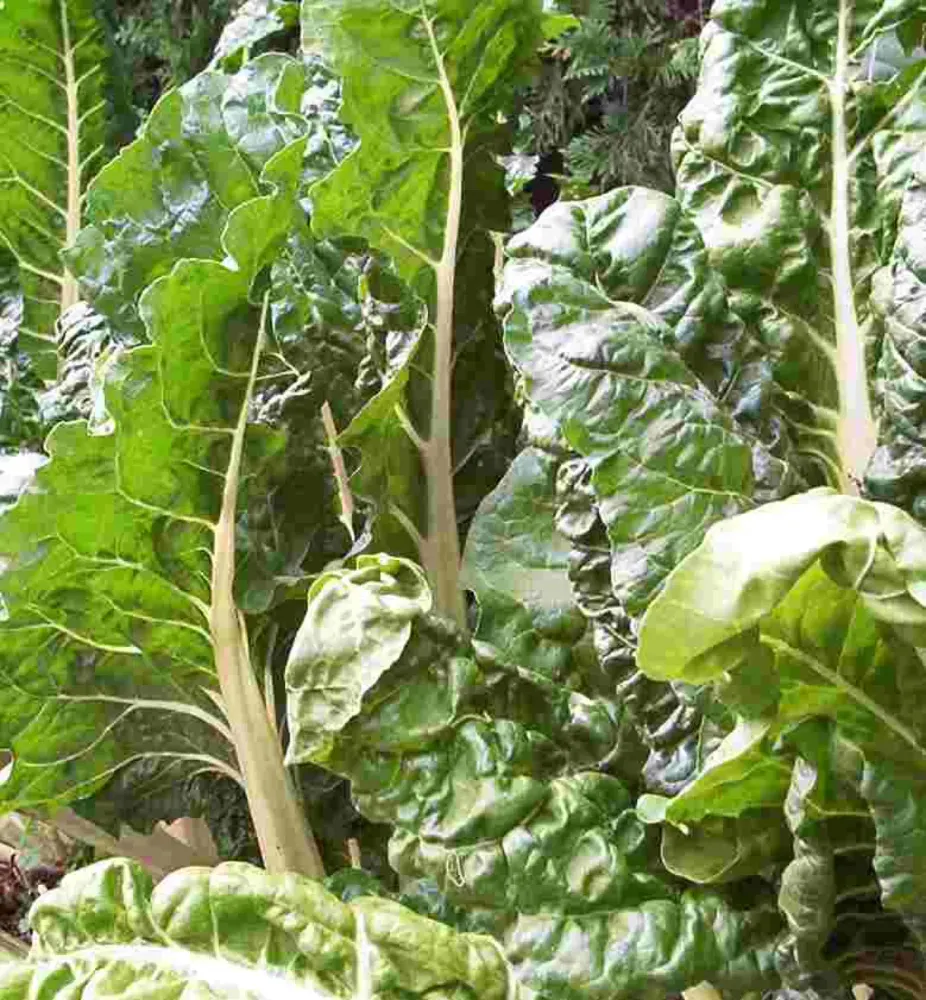
© Unknown · Public domain · Commons
Chard
CautionMangold · (Beta vulgaris subsp. vulgaris var. cicla)
Amaranth family (Amaranthaceae)
Description
Chard is a green leafy vegetable. It is also called silver beet, perpetual spinach, beet spinach, seakale beet, and leaf beet, but because it is the same species as beetroot, these other common names may overlap.
- RawLeafInternalClinical trial
Chard leaves are among the most nutrient-dense vegetables in Central Europe. Per 100 g fresh weight they contain approx. 830 µg of vitamin K (> 600 % of daily requirement), approx. 6,100 IU of vitamin A as provitamin carotenoids and approx. 30 mg of vitamin C. Magnesium (approx. 81 mg/100 g), iron (approx. 1.8 mg/100 g), potassium (approx. 379 mg/100 g) and manganese (approx. 0.37 mg/100 g) are also well represented. Suitable raw in salads or as a wrap substitute; cooked like spinach — blanched, sautéed or in soups and stews. Young, tender leaves have the lowest oxalate content and are best suited for raw consumption.
Preparation & dosage
- RawLeafInternalClinical trial
Chard is one of the best plant-based sources of vitamin K (approx. 830 µg/100 g). Vitamin K is essential for blood coagulation (factors II, VII, IX, X), bone mineralisation (osteocalcin) and regulates vascular calcification (matrix Gla protein). Particularly relevant for persons with vitamin K deficiency or increased osteoporosis risk. Note: with vitamin K antagonists (phenprocoumon, warfarin), consumption must be kept constant, as varying amounts affect INR values.
- RawLeafInternalTraditional use
In the folk medicine of various cultures (Dalmatia, Turkey, the Near East), chard is considered a stomach-friendly and liver-supportive vegetable. The Babylonian Talmud praises cooked chard as good for the heart, eyes and especially the intestines. Flavonoids (vitexin, kaempferol) and betaine in the leaves are associated with antioxidant and hepatoprotective activity — human data are so far limited. Traditionally also known as a mild laxative for sluggish digestion.
[#src_wp_en_chard] [#src_pmc_betalains_chard] [#src_wikidata_chard]
- RawLeafInternalTraditional use
Chard was historically an important winter vegetable in Mediterranean countries and Central Europe (prevention of spring nutritional deficiency). The combination of iron, folate and vitamin C makes chard a traditionally recommended dish for exhaustion states and to support haematopoiesis — although iron absorption is limited by the oxalic acid it contains. Blanching improves iron availability, since soluble oxalates partly pass into the cooking water.
[#src_wp_de_mangold] [#src_pfaf_beta] [#src_pmc_betalains_chard]
- TeaLeafInternalFolk medicine
In the folk medicine of south-eastern Europe, an infusion of dried chard leaves is occasionally used for digestive complaints, mild liver problems and to stimulate bile production. The phytochemical basis (betaine, flavonoids) is plausible, but clinical evidence for the tea infusion is lacking. Cold or lukewarm preparation (no boiling) is said to better preserve the sensitive flavonoids.
Preparation & dosage
Pour 200 ml of hot water (not boiling, approx. 80 °C) over 3–5 g of dried chard leaves, steep for 10 minutes, strain. 1–2 cups daily, not longer than 2 weeks at a stretch.
- Dry amount
- 3–5 g
- Doses per day
- 2×
- CompressLeafExternalFolk medicine
In Mediterranean and Eastern European folk medicine, blanched or slightly warmed chard leaves are applied as wraps to inflamed skin irritations, minor burns (grade I) and poorly healing wounds. The cooling, moist leaf mass is said to reduce inflammation and promote healing. Not a substitute for medical wound care.
- RawLeafInternalTraditional use
Due to its high magnesium (approx. 81 mg/100 g) and potassium content, chard is classified in nutritional science as supportive for muscle and nerve function and electrolyte regulation. Magnesium contributes to normal muscle function, protein synthesis and bone maintenance. Naturopaths traditionally recommend chard for cramps and exhaustion, which is phytochemically plausible given the magnesium content.
🤝 Permaculture Partners
In your garden, this plant acts as:
✨ Best symbiotic partners
- 🌿 Carrot Classic companion-planting partner.
- 🌿 Phaseolus vulgaris Classic companion-planting partner.
Source: Helga und Margarete Langerhorst, Mein gesunder Naturgarten (eigene Kuration)