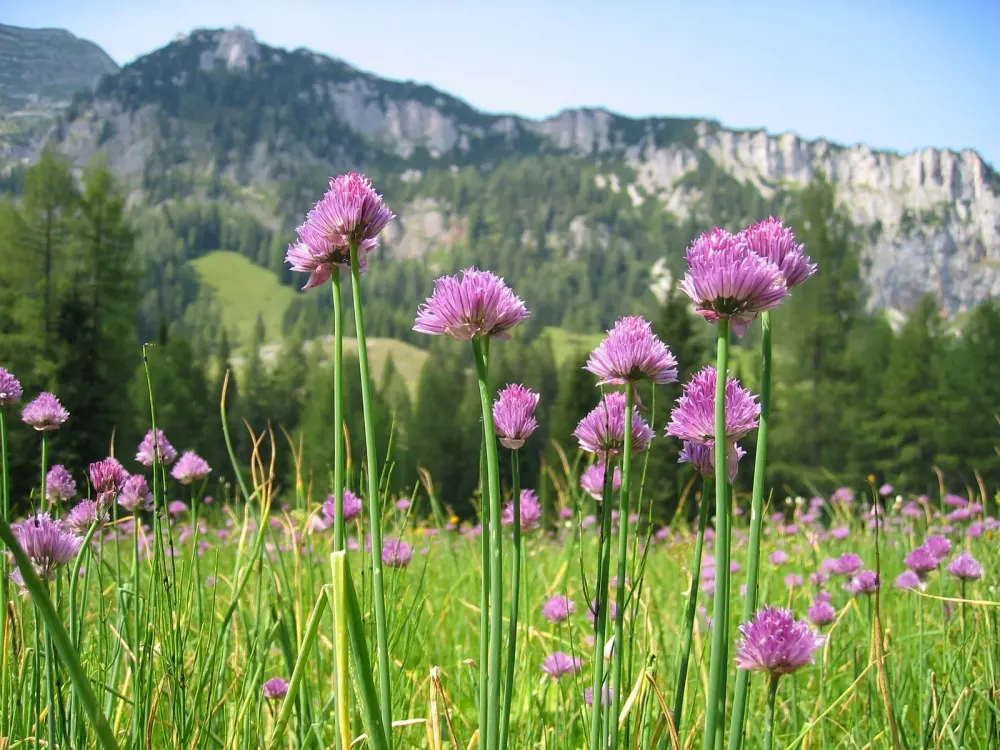
© User:Tigerente · CC BY 2.5 · Commons
Chives
Caution🐾Schnittlauch · (Allium schoenoprasum)
Amaryllis family (Amaryllidaceae)
Description
Chives is a species of flowering plant in the genus Allium of the family Amaryllidaceae. Cultivated worldwide as a culinary herb with a mild onion-like flavour, it has been valued as a medicinal plant since antiquity. Its slender hollow tubular leaves and edible purple flowers are rich in vitamin C and sulfur compounds.
- SpiceLeafInternalTraditional use
Chives are a classic culinary herb of European and Asian cooking, cultivated since the Middle Ages. Finely cut, they are added to salads, soups, egg dishes, potato dishes, quark, butter and dips. The leaves develop their mild onion flavour best when fresh — heating significantly reduces the volatile sulphur compounds. In Bavarian-Austrian cuisine, the chive bread (buttered bread with fresh chives and salt) is a traditional snack speciality. Chives are part of the French 'fines herbes' (with tarragon, chervil, parsley).
Preparation & dosage
- SpiceFlowerInternalTraditional use
The purple flowers of chives are edible and used as decoration in salads, vinegars (chive blossom vinegar) and as garnish. In flavour somewhat stronger than the leaves but equally mild and onion-like. Chive blossom vinegar: steep fresh flowerheads in white wine vinegar — after 2–3 weeks the result is a vividly purple-coloured aromatic vinegar.
- RawLeafInternalClinical trial
Chives are an exceptionally rich source of vitamin K: approx. 213 µg/100 g (177 % daily value). Vitamin K1 (phylloquinone) is essential for the blood coagulation cascade and bone metabolism (osteocalcin). Since chives are consumed only in small amounts (~5–10 g) as a flavouring herb, the absolute vitamin K intake per portion is low (approx. 10–20 µg) — however, consistent use should still be considered when on anticoagulant therapy.
[#src_wp_en_chives] [#src_healthbenefitstimes_chives] [#src_usda_chives]
- RawLeafInternalClinical trial
Chives contain approx. 58 mg vitamin C/100 g (65 % DV), approx. 105 µg folate/100 g (26 % DV) and approx. 218 µg vitamin A/100 g (31 % DV, as beta-carotene). This nutrient combination supports immune function, skin and mucosal integrity, and DNA synthesis. Carotenoids (lutein, zeaxanthin) in chives protect ocular tissue from oxidative stress. As a flavouring herb the absolute amounts per serving are low — nevertheless a nutrient-dense addition.
[#src_wp_en_chives] [#src_healthbenefitstimes_chives] [#src_usda_chives]
- RawLeafInternalFolk medicine
In European and Chinese folk medicine, chives have been valued since antiquity as an appetite-stimulating and digestive culinary herb. The Romans traditionally used chives to relieve throat complaints and sunburn pain, and as a diuretic. In traditional Chinese medicine (TCM) chives are used as a warming, circulatory-stimulating remedy. These traditions are folk medicinal and not clinically confirmed.
- RawLeafInternalTraditional use
Chives — like all Allium species — contain sulphur-containing compounds (cysteine sulfoxides) that upon cutting are enzymatically converted into allicin and further thiosulfinates as well as disulfides (dimethyl disulfide, diallyl sulfide, methylpentyl sulfides). Allicin and its derivatives have shown antibacterial, antifungal and antioxidant properties in laboratory studies. Compared to garlic (Allium sativum) the sulphur concentrations in chives are considerably lower — the effects correspondingly milder.
[#src_wp_de_schnittlauch] [#src_pfaf_allium] [#src_healthbenefitstimes_chives]
- Spiceuse.plant_part.bulbInternalFolk medicine
The small bulbs (max. 10 mm diameter) of chives are also edible and have a mild onion flavour. They can be used like spring onions — in salads, pickled dishes or as a flavouring vegetable. In folk cookery chive bulbs were traditionally used similarly to garlic for circulatory strengthening and as a tonic. No clinical proof of efficacy.
🤝 Permaculture Partners
In your garden, this plant acts as:
✨ Best symbiotic partners
- 🌿 Onion Both Allium family, coexist without issue.
- 🌿 Carrot Chives deter carrot fly — classic Allium companion pairing.
- 🌿 Fragaria vesca Chives protect strawberry from fungi (grey mould).
- 🌿 Lettuce Chives distract aphids and keep lettuce pests away.
- 🌿 Tomato Chives deter aphids from tomatoes and attract bees for pollination.
⚠️ Better not planted together
- 🥬 Phaseolus vulgaris Alliums inhibit nitrogen-fixing legumes (classic rule).
- 🥬 Pea Alliums inhibit pea growth — separate spatially.
📦 Part of these planting sets:
Source: Helga und Margarete Langerhorst, Mein gesunder Naturgarten (eigene Kuration)