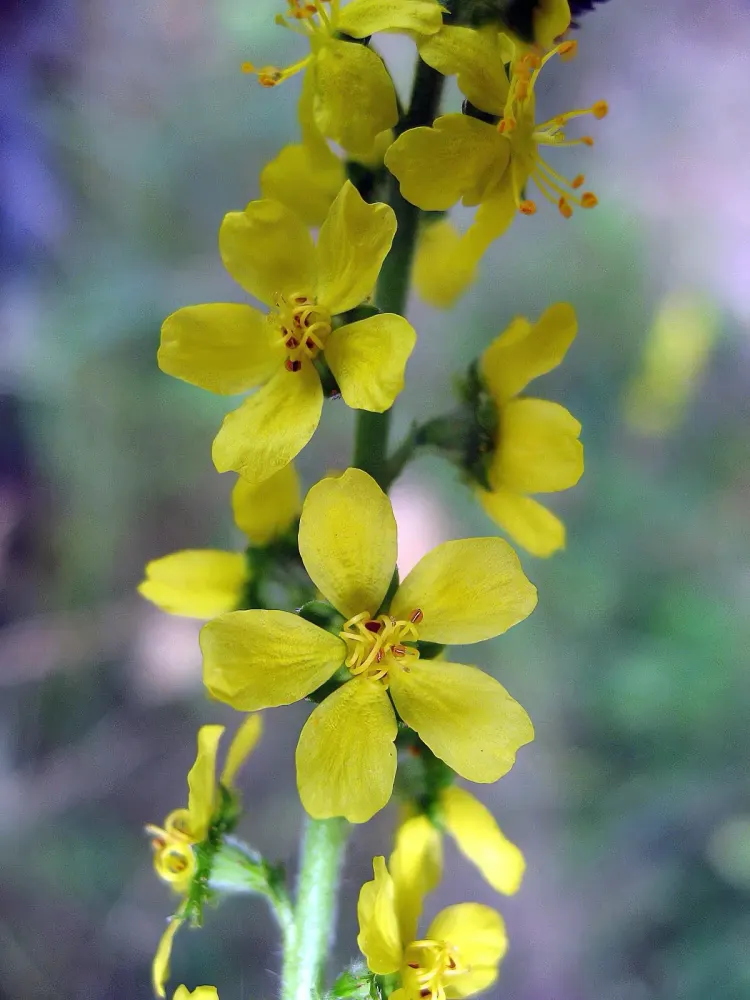
© "pastilletes"/Joan Simon, Barcelona, España · CC BY-SA 2.0 · Commons
Agrimonia eupatoria
CautionGemeiner Odermennig · (Agrimonia eupatoria)
Rose family (Rosaceae)
Description
Agrimonia eupatoria is a species of agrimony that is often referred to as common agrimony, church steeples or sticklewort.
- TeaAerial partsInternalCommission E
Agrimony herb infusion for mild diarrhoea and digestive complaints — astringent effect of catechin tannins, positively assessed by Kommission E.
Preparation & dosage
INFUSION (Kommission E / EMA traditional use): 3–4 g of dried, finely cut agrimony herb (Herba Agrimoniae) in 250 ml boiling water, covered, steep 10–15 min, strain. 3 cups daily between meals, preferably warm. Indication: non-specific mild acute diarrhoea (without blood or fever), mild digestive complaints, flatulence/bloating. Tannins (mainly catechin-type) act astringently on intestinal mucosa. Limit use without improvement to 3–4 days; consult doctor if blood in stool, fever or symptoms last >3 days. Maintain adequate fluid intake during diarrhoea.
- Dry amount
- 3–4 g
- Doses per day
- 3×
- Max duration
- 4 weeks
⚠ Age restriction: ≥ 12 years — No adequate safety data for children under 12 — consult a doctor.
[#src_ema_agrimoniae_herba] [#src_kommission_e_agrimoniae] [#src_escop_agrimoniae] [#src_wichtl_agrimonia]
- GargleAerial partsExternalCommission E
Traditional agrimony gargle for mild oral and pharyngeal inflammation, aphthae and gum irritation — astringent tannins, EMA traditional use.
Preparation & dosage
GARGLE / MOUTH RINSE (EMA traditional use): Prepare as for internal tea (3–4 g in 250 ml, 15 min, strain, allow to cool to lukewarm — not hot). Gargle or rinse mouth 3–5× daily with approx. 100–150 ml for ~30 seconds, then spit out — do NOT swallow large amounts. Indication: mild inflammation of oral mucosa and pharynx (aphthae, gum irritation, mild pharyngitis, bad breath). Tannins form an astringent, mildly antiseptic protective film on the mucosa. Seek medical advice for severe, persistent sore throat or difficulty swallowing.
- Dry amount
- 3–4 g
- Doses per day
- 4×
- Max duration
- 2 weeks
[#src_ema_agrimoniae_herba] [#src_kommission_e_agrimoniae] [#src_escop_agrimoniae]
- CompressAerial partsExternalTraditional use
Traditional agrimony compress for mild skin irritation, small wounds and local inflammation — astringent catechin tannins.
Preparation & dosage
COMPRESS / POULTICE: Prepare a strong decoction — 5–10 g agrimony herb simmered in 300 ml water for 10–15 min, strain, cool to body temperature. Soak a clean linen cloth or gauze, lightly wring out, apply to affected area. Leave on 15–20 min, repeat 2–3× daily. Traditional use for small, slowly healing wounds, mild skin irritations, mildly inflamed skin patches, and muscle soreness. Tannins have skin-soothing, mildly antiseptic properties supporting wound healing. Do not apply to deep, heavily weeping, or infected wounds — consult a doctor.
- Dry amount
- 5–10 g
- Doses per day
- 3×
- Max duration
- 2 weeks
[#src_wichtl_agrimonia] [#src_escop_agrimoniae] [#src_pfaf_agrimonia]
- BathAerial partsExternalFolk medicine
Folk agrimony partial bath or foot bath for tired legs, sweaty feet and mild joint discomfort.
Preparation & dosage
PARTIAL BATH / FOOT BATH: Simmer 50–100 g of dried agrimony herb in 2 l water for 15–20 min, strain. Add decoction to lukewarm bath water (full bath 37–38 °C) or use as foot bath. Soak 15–20 min. Folk use for tired legs, sweaty feet, mild joint discomfort, and skin irritation on feet/lower legs. Avoid on open wounds or severe skin conditions. Moisturise after bathing. Full baths not recommended without medical advice in cardiac patients.
- Dry amount
- 50–100 g
- Doses per day
- 1×
- Max duration
- 3 weeks
[#src_pfaf_agrimonia] [#src_wp_de_agrimonia] [#src_madaus_agrimonia]
- TinctureAerial partsInternalTraditional use
Traditional agrimony tincture for mild digestive complaints, bloating and as a liver tonic — alternative to tea when ethanol is acceptable.
Preparation & dosage
TINCTURE (DER 1:5 in 25–45 % ethanol): 1–3 ml (~20–60 drops) 3× daily in water or juice, preferably before meals. Traditional use for mild digestive complaints, bloating, sluggish digestion and as a liver tonic (cholagogue). In traditional European phytotherapy also used as a blood-purifying remedy and for mild rheumatic complaints. Do not use beyond 4 weeks without medical advice. Due to ethanol content not suitable for alcohol dependence, liver disease, or epilepsy.
- Liquid amount
- 1–3 ml
- Doses per day
- 3×
- Max duration
- 4 weeks
[#src_escop_agrimoniae] [#src_wichtl_agrimonia] [#src_wp_en_agrimonia]
- TeaAerial partsInternalFolk medicine
Folk agrimony-goldenrod blend as mild diuretic and support for urinary tract irritation.
Preparation & dosage
BLENDED TEA (agrimony + goldenrod): Mix agrimony herb with equal parts goldenrod herb (Herba Solidaginis virgaureae); steep 2–3 g of the blend in 250 ml hot water for 10 min, strain. 2 cups daily, preferably after meals. Folk use for bladder and urinary tract irritation (mild cystitis), kidney stones (adjunctive support only, not a substitute for medical care), and urinary tract infections. Agrimony is traditionally regarded as a mild diuretic and kidney tonic. Seek immediate medical attention for severe pain, blood in urine, or fever — bacterial UTIs may require antibiotics.
- Dry amount
- 2–3 g
- Doses per day
- 2×
- Max duration
- 3 weeks
[#src_pfaf_agrimonia] [#src_madaus_agrimonia] [#src_wp_de_agrimonia]
- TeaAerial partsInternalFolk medicine
Folk agrimony tea for hoarseness, sore throat and mild respiratory infections — soothing tannins, optionally sweetened with honey.
Preparation & dosage
HOARSENESS AND COUGH TEA: 2–3 g agrimony herb in 250 ml boiling water, covered, steep 10–12 min, strain. Sweeten with honey (add only after tea cools below 40 °C — higher temperature destroys honey enzymes). 3 cups daily. Folk use for hoarseness, sore throat, cough irritation and mild respiratory infections. Agrimony tannins soothe the irritated pharyngeal mucosa. Can be used as both gargle and internal tea (split portion). Consult a doctor for fever above 38.5 °C or severe cough.
- Dry amount
- 2–3 g
- Doses per day
- 3×
- Max duration
- 2 weeks
[#src_madaus_agrimonia] [#src_wp_de_agrimonia] [#src_pfaf_agrimonia]