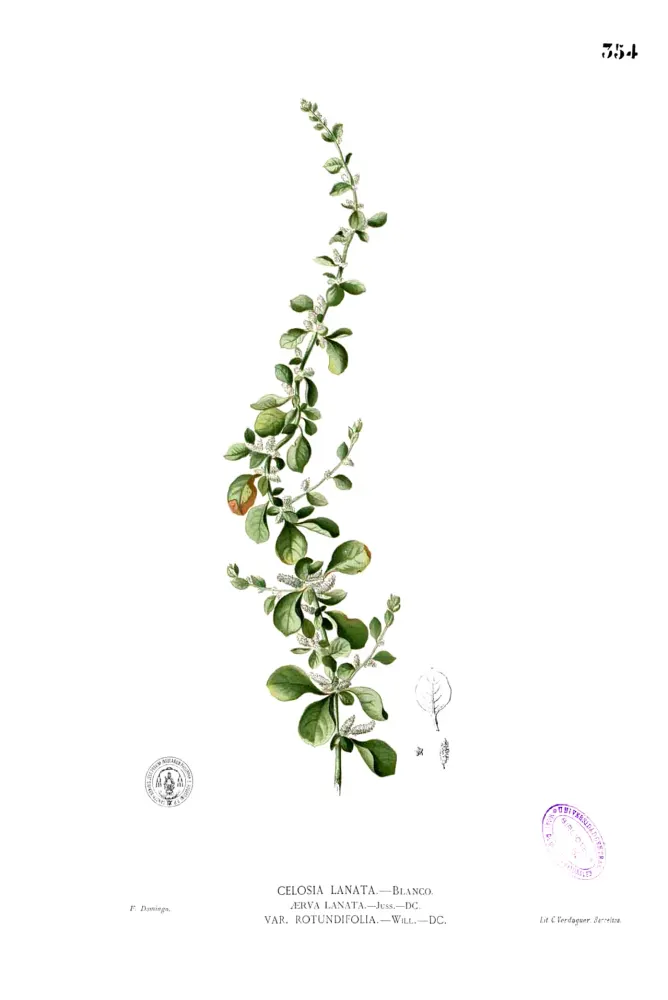
© Francisco Manuel Blanco (O.S.A.) · Public domain · Commons
Ouret lanata
CautionPolpala · (Aerva lanata)
Amaranth family (Amaranthaceae)
Description
Ouret lanata, the mountain knotgrass, is a woody, prostrate or succulent, perennial herb in the family Amaranthaceae, native to the tropics of Africa and Asia. It has been included as occurring in Australia by the US government, but it is not recognised as occurring in Australia by any Australian state herbarium or Plants of the World Online. The plant sometimes flowers in the first year.
CONTRAINDICATED during pregnancy
Aerva lanata is described as emmenagogue and with antifertility action in Ayurvedic and ethnobotanical literature — use contraindicated during pregnancy.
Critical drug interactions with:
Nephrotoxische Arzneimittel (Aminoglykoside, Ciclosporin, NSAR bei Risikopatienten, Cisplatin)
- TeaWhole plantInternalTraditional use
Classic Polpala infusion from Ayurvedic and Sri Lankan herbal practice — main use as diuretic and 'stone-breaker' (Pashanabheda) for urinary stones and gravel. Pilot studies at the University of Colombo (Gunatilake et al. 2012) confirm the diuretic action but advise short courses only.
Preparation & dosage
AYURVEDIC POLPALA TEA: Pour 250 ml boiling water over 3–5 g dried Aerva lanata herb (whole plant, finely cut), cover and steep 5–10 min, strain. 1–2 cups daily between meals; drink at least 2 L of water in addition to support the flushing effect. USE FOR NO LONGER THAN 1 WEEK — Ayurvedic tradition itself limits Polpala to short courses, and long-term high-dose intake caused structural changes in proximal renal tubules in a rat model. For diagnosed kidney stones, renal insufficiency or while on diabetes medication, always under medical supervision.
- Dry amount
- 3–5 g
- Doses per day
- 2×
- Max duration
- 1 weeks
⚠ Age restriction: ≥ 18 years — Adults only — lack of paediatric data and known renal action.
[#src_goyal_aerva_phytochem_2011] [#src_gunatilake_polpala_urinary_2012] [#src_wp_en_aerva_lanata]
- TeaRootInternalTraditional use
Folk root decoction — used in Rajasthan and Tamil Nadu for urinary stones, painful urination (strangury) and liver complaints. Stronger than the herb tea because of higher constituent density; same strict time limit applies.
Preparation & dosage
ROOT DECOCTION (classic 'Pashanabheda' preparation): Steep 3–6 g of dried, comminuted Aerva lanata root in 300 ml of cold water, bring slowly to the boil and simmer for 15–20 min, strain. 1–2 cups daily, freshly prepared and warm. Stronger diuretic and stone-loosening action than the herb tea — limit to one week, then pause at least 3 weeks. Always drink plenty of water alongside.
- Dry amount
- 3–6 g
- Doses per day
- 2×
- Max duration
- 1 weeks
⚠ Age restriction: ≥ 18 years — Adults only — no paediatric safety data.
[#src_goyal_aerva_phytochem_2011] [#src_ijpsdr_aerva_antiurolithiatic_2017]
- TeaWhole plantInternalFolk medicine
Traditional Polpala cough tea — recorded in Ayurveda and Siddha for cough, bronchitis and mild asthma. Mechanistically explainable through saponins and flavonoids (secretolytic, anti-inflammatory); not clinically standardised.
Preparation & dosage
FOLK COUGH TEA: Pour 250 ml boiling water over 2–4 g dried Polpala herb, cover and steep 10 min, strain. Sweeten with a little honey if desired. 2–3 cups daily for irritating cough, bronchitis or asthmatic complaints — recorded in Indian and Sri Lankan folk recipes. Not for more than a week without medical assessment.
- Dry amount
- 2–4 g
- Doses per day
- 3×
- Max duration
- 1 weeks
⚠ Age restriction: ≥ 18 years — Folk use — not established for children.
[#src_goyal_aerva_phytochem_2011] [#src_longdom_aerva_review]
- TeaRootInternalFolk medicine
Tribal/folk use in Rajasthan: root juice or infusion for liver cholestasis, jaundice and dyspepsia. Documented in ethnobotanical reviews (Goyal et al. 2011) without clinical evidence.
Preparation & dosage
ROOT INFUSION for jaundice (folk medicine of Rajasthan): Crush 2–4 g of dried root, pour 250 ml hot water over it, steep 10–15 min, strain. 1–2 cups daily for max. one week — traditionally used for liver congestion, mild jaundice (icterus) and digestive complaints. Manifest jaundice or hepatitis ALWAYS needs medical clarification — this use does not replace a medical diagnosis.
- Dry amount
- 2–4 g
- Doses per day
- 2×
- Max duration
- 1 weeks
⚠ Age restriction: ≥ 18 years — Folk use — adults only; supervise medically in liver disease.
- RawLeafInternalTraditional use
Nutritive use as wild green — young leaves cooked in stews or as spinach substitute in West Africa, India and Sri Lanka. Also a medicinal plant, so avoid excess.
Preparation & dosage
LEAF VEGETABLE: Harvest young leaves (tender, before flowering), wash thoroughly and prepare like spinach — in soups, curries, or lightly steamed with onion and garlic. Valued as wild vegetable in West Africa and South India — good iron, calcium and protein content (proximate analyses: ~22 % crude protein, high ash with phosphate and potassium). Occasional eating is uncritical; the same caution as for the medicinal tea applies if eaten daily in large quantities over a long period.
- CompressLeafExternalFolk medicine
Folk fresh-leaf compress for minor injuries and (traditionally) as snake-bite first aid — ethnobotanically documented but clinically unproven. Today usable at most as a makeshift for harmless skin irritation.
Preparation & dosage
FRESH LEAF PASTE: Lightly crush fresh Polpala leaves between fingers or in a mortar until plant sap appears, then apply directly to small wounds, insect bites or snake bites (as FIRST-AID emergency measure — a snake bite remains a medical emergency, contact 112/hospital immediately). Refresh 1–2× daily. Traditional use in African and South Indian tribal medicine; no clinical data. NOT for large open wounds — risk of soil-borne contamination.
Distribution in Europe
🪴 Grow at home
- ☀ Light
- full sun
- 💧 Water
- every few days
- 🌱 Soil
- Sandy soil with drainage
- 🪴 Pot
- 20 cm
- ⭐ Difficulty
- ★★☆ intermediate
- 🐾 Pets
- pet-safe
Tips:
- Loves warmth — bring indoors below 15 °C.
- Don't over-fertilise — grows even on poor soils.
- Use leaves and herb for tea.
Care tips are general indoor-gardening recommendations, not scientific sources.