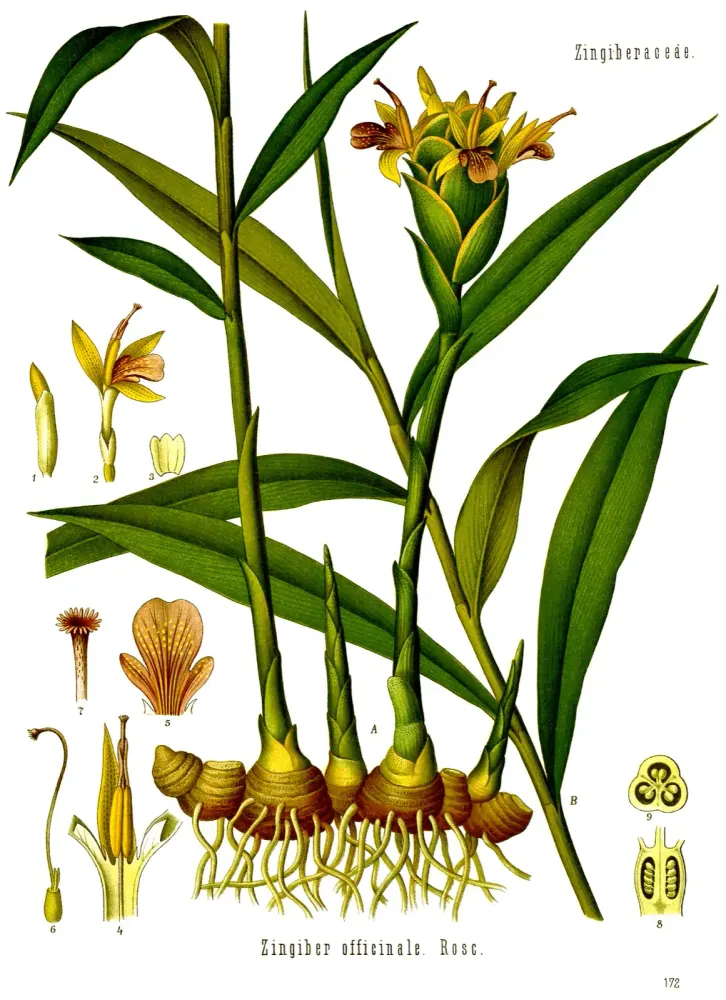
© Franz Eugen Köhler · Public domain · Commons
Ginger
CautionIngwer · (Zingiber officinale)
Ginger family (Zingiberaceae)
Description
Ginger is a flowering plant whose rhizome, ginger root or ginger, is widely used as a spice and a folk medicine. It is an herbaceous perennial that grows annual pseudostems about one meter tall, bearing narrow leaf blades. The inflorescences bear flowers having pale yellow petals with purple edges, and arise directly from the rhizome on separate shoots.
- TeaRhizomeInternalCommission E
Ginger infusion per Kommission E for dyspeptic complaints — bloating, flatulence, sluggish digestion. The pungent compounds (gingerols, shogaols) stimulate saliva, gastric secretion and biliary flow.
Preparation & dosage
INFUSION (Kommission E, dyspeptic complaints): Pour 250 ml boiling water over 2–4 g freshly grated or coarsely crushed dried ginger rhizome (Zingiberis rhizoma), cover, steep 10 min, strain. 2–3 cups daily, preferably with or after meals. Daily dose per Kommission E: 2–4 g dried rhizome. Indicated for mild dyspeptic complaints (bloating, flatulence, sluggish digestion, loss of appetite). Do not exceed 4 g dry drug per day. Fresh rhizome contains more gingerols; dried more shogaols (sharper taste).
- Dry amount
- 2–4 g
- Doses per day
- 3×
- Max duration
- 4 weeks
[#src_kommission_e_zingiber] [#src_ema_zingiber_rhizoma] [#src_escop_zingiber]
- RawRhizomeInternalEMA well-established
Ginger powder/extract for prevention of motion sickness (kinetosis) — EMA well-established use. Clinically documented activity against nausea and vomiting in travel sickness.
Preparation & dosage
STANDARDISED DRY EXTRACT / POWDER (EMA well-established use, motion sickness): Per EMA monograph well-established use: 250 mg dry extract (DER 5–20:1, ethanol 50–70 %) or 1–2 g rhizome powder in capsule/tablet form, 30–60 min before travel then every 4 hours as needed, max 4 g/day. Indication: prevention of nausea and vomiting in motion sickness (kinetosis). Efficacy clinically documented (several randomised studies). Not for children under 6. In pregnancy consult physician first (EMA: traditional use in pregnancy, not well-established there). Classified here as 'raw' (powder/capsule = direct intake of undiluted drug).
- Dry amount
- 1–2 g
- Doses per day
- 2×
- Max duration
- 8 weeks
[#src_ema_zingiber_rhizoma] [#src_escop_zingiber] [#src_ernst_pittler_1999]
- TinctureRhizomeInternalTraditional use
Traditional ginger tincture for nausea and digestive complaints — more concentrated than tea, convenient for travel.
Preparation & dosage
TINCTURE (DER 1:5 in 60–70 % ethanol): 1.5–3 ml (~30–60 drops) 3× daily, diluted in water or juice, preferably before or with meals. Traditional use for nausea, dyspeptic complaints, motion sickness and digestion support. Due to ethanol content: not for alcohol dependence, liver disease, epilepsy or pregnancy without medical advice.
- Liquid amount
- 1.5–3 ml
- Doses per day
- 3×
- Max duration
- 4 weeks
[#src_escop_zingiber] [#src_wichtl_teedrogen] [#src_ema_zingiber_rhizoma]
- TeaRhizomeInternalTraditional use
Low-dose ginger tea for pregnancy nausea — traditional use per EMA, only after medical advice.
Preparation & dosage
PREGNANCY NAUSEA (traditional use, EMA): Low dose: 0.5–1 g dried ginger rhizome in 200 ml boiling water, steep 10 min, strain, drink in small sips. Up to 3× daily. Per EMA monograph recognised as traditional herbal medicine for relief of nausea in pregnancy — BUT only after consulting a physician or midwife, as clinical safety data for the first trimester are limited. Keep dose at minimum necessary. Seek medical help immediately for severe vomiting (hyperemesis gravidarum).
- Dry amount
- 0.5–1 g
- Doses per day
- 3×
- Max duration
- 8 weeks
[#src_ema_zingiber_rhizoma] [#src_who_zingiber] [#src_escop_zingiber]
- CompressRhizomeExternalFolk medicine
Folk warming ginger compress for muscle pain, joint complaints and circulatory stimulation — external application of pungent compounds (gingerols) as counter-irritant and warming agent.
Preparation & dosage
WARMING COMPRESS (folk use): 30–50 g freshly grated or coarsely crushed ginger rhizome in 500 ml hot (not boiling) water, steep 10–15 min. Soak a cloth or flannel in the hot ginger liquid, wring out carefully (caution: very hot — burn risk), apply to affected area (joints, muscles, neck) until cloth cools, 10–20 min. Once daily. Folk use for rheumatic complaints, muscle pain, joint stiffness and to promote local circulation. DO NOT apply to broken, inflamed or irritated skin. Patch-test first — gingerols can cause skin irritation.
- Dry amount
- 30–50 g
- Doses per day
- 1×
- Max duration
- 3 weeks
[#src_pfaf_zingiber] [#src_wichtl_teedrogen] [#src_wp_de_zingiber]
- SpiceRhizomeInternalFolk medicine
Ginger rhizome as universal culinary and household spice — fresh, dried, candied, as syrup or pickle. One of the world's most widely used spices (origin South/Southeast Asia, today globally cultivated).
Preparation & dosage
CULINARY: Fresh rhizome: peel, grate, slice or press — for curries, soups, stir-fries, smoothies, dressings, marinades, chutneys. Dried rhizome: ground as spice powder for gingerbread, biscuits, chai blends, spice mixes (Garam Masala, Ras el-Hanout). Candied ginger: preserved in sugar, eaten as a sweet or remedy for travel nausea (chew directly). Ginger syrup: rhizome + sugar + water — versatile for drinks and desserts. Fresh ginger juice: pressed, for shots and dressings. Pickled ginger (Gari): Japanese sushi accompaniment. Ginger-honey mix: classic household remedy for cold symptoms, sore throat, nausea.
[#src_wp_de_zingiber] [#src_wp_en_zingiber] [#src_pfaf_zingiber]
- InhalationRhizomeExternalFolk medicine
Folk ginger steam inhalation for cold symptoms, cough and sinus congestion — mildly stimulating to mucous membranes, warming.
Preparation & dosage
INHALATION (folk use, cold symptoms): Simmer 20–30 g freshly grated ginger rhizome or 5–10 g dried powder in 1 litre boiling water for 3–5 min. Remove from heat, cool briefly (burn risk!). Drape towel over head and inhale steam for 5–10 min, eyes closed. Up to 2× daily. Folk use for cold symptoms, sinusitis, cough, mucus loosening. Gingerol vapours mildly stimulate mucous membranes and local circulation. NO hot liquid contact with skin — burn risk. Do not use for asthma without medical advice.
- Dry amount
- 20–30 g
- Doses per day
- 2×
- Max duration
- 2 weeks
- TeaRhizomeInternalTraditional use
Traditional warming ginger tea for cold symptoms, chills and mild joint complaints — diaphoretic and circulation-promoting, often with honey and lemon.
Preparation & dosage
WARMING INFUSION (traditional, Asia/Europe): 1–2 g dried ginger rhizome (slices or powder) in 200 ml boiling water, steep 10 min, strain. Optionally sweeten with honey and lemon juice. 2–3 hot cups daily. Traditional use in Asia and increasingly Europe for colds (diaphoretic), feeling of chills, poor circulation, mild joint complaints and to support febrile states (diaphoretic). Corresponds to traditional use in WHO monograph. Do not use for high fever without medical evaluation.
- Dry amount
- 1–2 g
- Doses per day
- 3×
- Max duration
- 3 weeks
[#src_who_zingiber] [#src_wichtl_teedrogen] [#src_escop_zingiber]