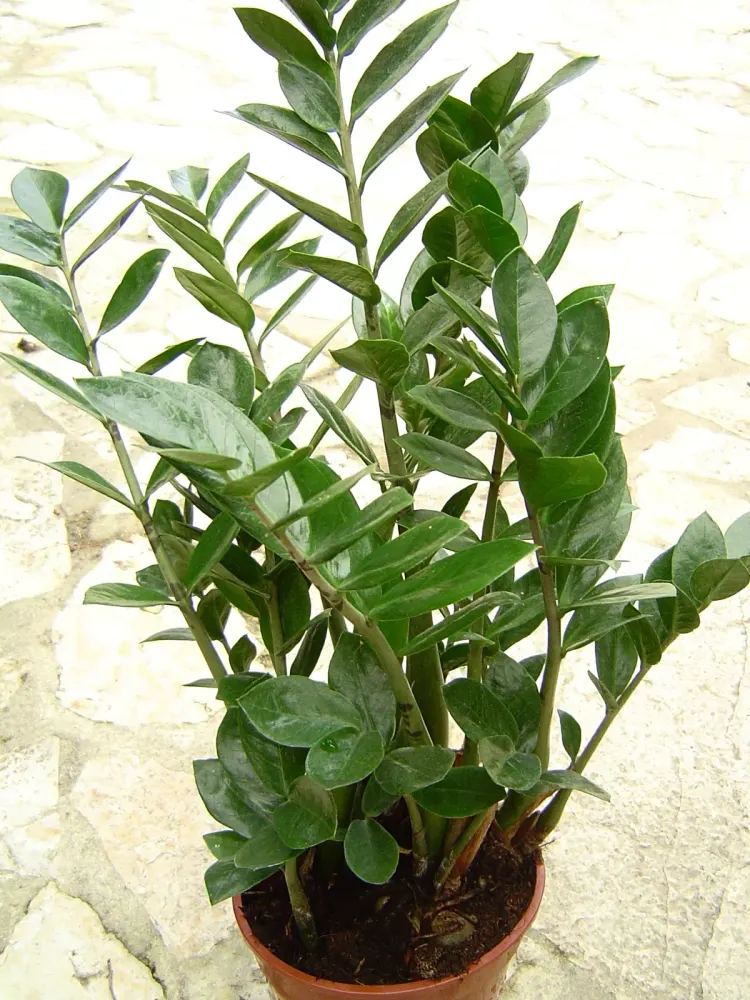
© User:WeFt · CC BY-SA 3.0 · Commons
Zamioculcas
Toxic🐾Zamioculcas zamiifolia · (Zamioculcas zamiifolia)
Arum family (Araceae)
Description
With its thick, glossy pinnate leaves, Zamioculcas zamiifolia — also known as the ZZ plant — ranks among the most undemanding houseplants, tolerating weeks of drought and shady spots without complaint. It stores water in fleshy rhizomes and contains, among other compounds, calcium oxalate raphides, saponins and starch. Clinical studies found the plant can help reduce formaldehyde, xylene and toluene levels in indoor air, and folk sources also credit it with reducing benzene. An important note for households with children and pets: all plant parts, especially rhizomes and leaves, contain irritating calcium oxalate needles. Sap contact can irritate skin, and ingestion may cause burning and swelling in the mouth, vomiting and diarrhoea. As a decorative plant it is safe under normal handling, but should be kept out of reach of children and pets — wash hands after repotting or pruning.
External use only!
This plant must NOT be taken internally. Use only as compress, salve, or bath.
As a living houseplant, Zamioculcas zamiifolia absorbs measurable amounts of formaldehyde, xylene, and toluene from indoor air according to Kim et al. (2014). The study tested 86 houseplant species in closed chambers. The ZZ plant showed particularly good tolerance to the test gases alongside a high elimination rate.
Preparation & dosage
Sources: [1]
As a complement to NASA data (Wolverton 1989), follow-up studies confirm the ability of the Araceae family to absorb volatile organic compounds (VOCs). The ZZ plant belongs to the same family as the top performers listed in the NASA study.
Preparation & dosage
Thanks to extreme drought tolerance owing to thickened rhizomes, the ZZ plant is ideal for beginners and travelling plant owners. It survives gaps of several weeks without watering and grows even under artificial light.
Preparation & dosage
⚠ External use only
TOXIC to dogs, cats, and humans. All plant parts — especially rhizomes and leaves — contain calcium oxalate raphides. Contact with plant sap causes skin and eye irritation; if ingested: burning and swelling in the mouth, vomiting, diarrhoea. Not hazardous as a houseplant under normal contact, but must be kept away from children and pets. Wash hands after handling.
No data on systemic human toxicity. Avoid contact with plant sap; no internal use.
No medicinal use. As a houseplant no systemic risk; avoid contact with plant sap nonetheless.
Place out of reach of small children — rhizomes and leaves toxic if ingested. If ingestion suspected, contact poison control immediately (UK: 111, US: 1-800-222-1222).
Contraindications
- Any internal use — strictly ornamental plant, no known folk medicine tradition.
Harvested part: whole plant (decorative)
- Time of day:
- Morning — division during spring repotting. Wear gloves due to calcium oxalate sap.
- Drying:
- Not applicable — rhizomes are only divided for propagation, not dried.
- Time of day:
- Any time — cut yellowed or damaged leaves at the base. Gloves recommended.
- Drying:
- No drying — leaves are not harvested or processed.
- Calcium oxalate raphidesOtherWhole plant
Needle-shaped calcium oxalate crystals (raphides) in idioblasts — particularly concentrated in rhizomes. Primary mechanism of contact and ingestion toxicity.
- SaponinsSaponinWhole plant
Steroidal saponins in leaves and rhizomes. Contribute to mucous membrane irritation and gastrointestinal effects upon ingestion.
- Starch (Amylum)PolysaccharideRhizome
High starch content in the thickened rhizomes — energy reservoir enabling extreme drought tolerance.
- Alkaloids (Araceae type, unspecified)AlkaloidWhole plant
Alkaloid compounds in minor amounts — typical for Araceae; specific compounds not fully characterised for Z. zamiifolia.
- Flavonoids (quercetin-type)FlavonoidLeaf
Flavonoids in the leaves — secondary plant compounds, no known medicinal significance.
- [1]MonographEfficiency of Volatile Formaldehyde Removal by Indoor Plants — Kim et al. (2014), HortScience, PMC4334964(accessed: 2026-05-24)
- [2]MonographInterior Landscape Plants for Indoor Air Pollution Abatement — Wolverton et al., NASA TM-101766 (1989)(accessed: 2026-05-24)
- [4]MonographRHS — Zamioculcas zamiifolia cultivation advice(accessed: 2026-05-24)
- [5]MonographCliniTox Giftpflanzen — Zamioculcas zamiifolia (hort. Lodd.) Engl.: sehr stark giftig +++ (Institut für Veterinärpharmakologie und -toxikologie, Universität Zürich)(accessed: 2026-08-10)
- [3]WikipediaZamioculcas zamiifolia (Wikipedia EN)(accessed: 2026-05-24)
Distribution in Europe
🪴 Grow at home
- ☀ Light
- low light
- 💧 Water
- sparse
- 🌱 Soil
- Cactus/succulent soil
- 🪴 Pot
- 20 cm
- ⭐ Difficulty
- ★☆☆ beginner
- 🐾 Pets
- toxic to pets
Tips:
- Stores water in rhizomes — watering every 3-4 weeks is enough.
- Tolerates almost any light.
- Grows slowly — don't worry if nothing happens for a while.
Care tips are general indoor-gardening recommendations, not scientific sources.