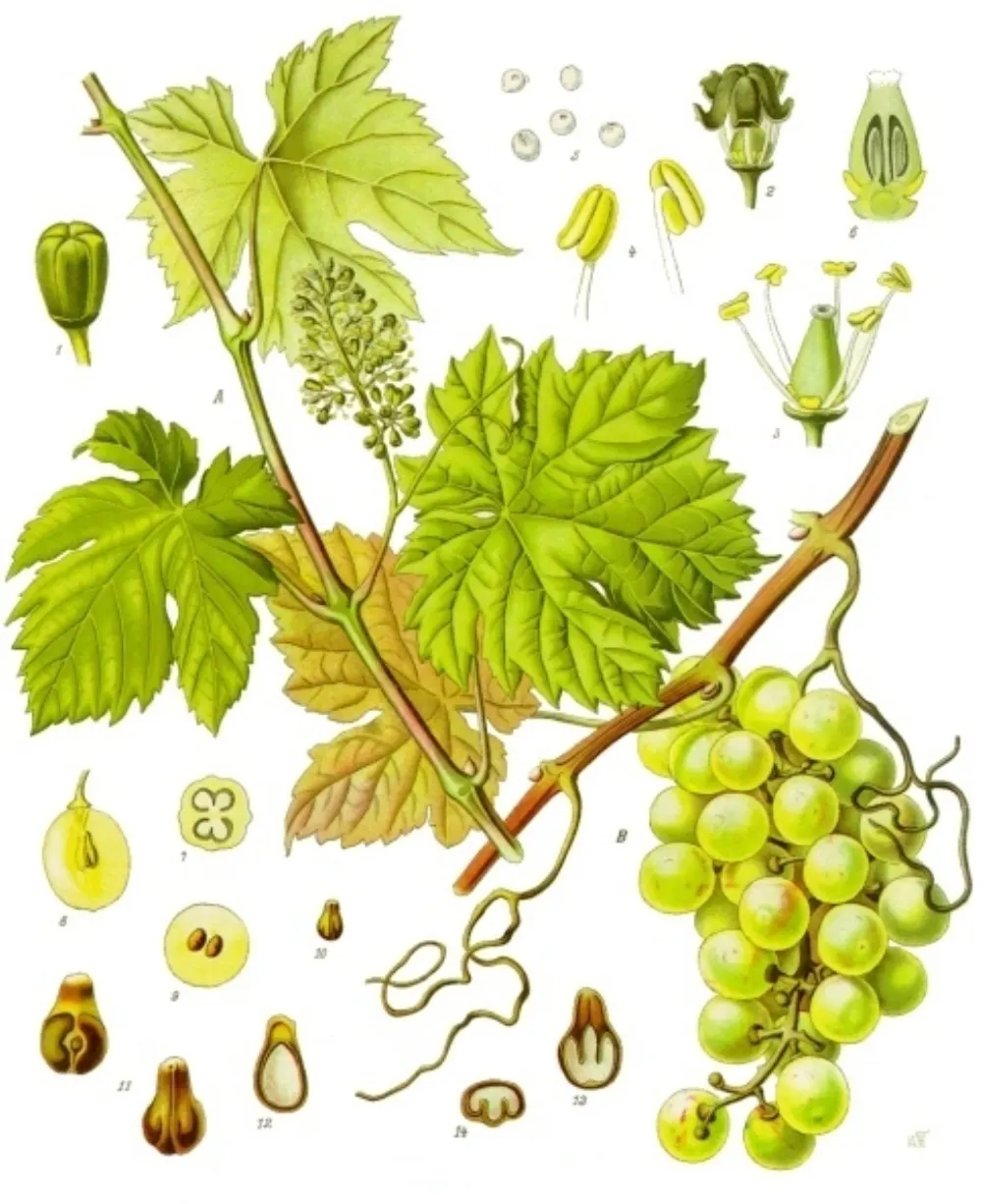
© Franz Eugen Köhler, Köhler's Medizinal-Pflanzen · Public domain · Commons
Grapevine (red vine)
🐾Weinrebe (Rote Weinrebe) · (Vitis vinifera)
Grape family (Vitaceae)
Description
The grapevine is a woody climbing plant (liana) that reaches 10-20 metres using tendrils. Its large, palmately 3- to 5-lobed leaves have a heart-shaped base and turn a vivid red in autumn - this 'red vine leaf' (Vitis viniferae folium) is the medicinally used plant part. Flowers appear from June to August, and the fruit (grapes) ripen into dark blue-violet, green or yellowish berries. While the grapes serve as food, only the red autumn leaf is used for venous complaints.
CONTRAINDICATED for children
According to the EMA, grapevine leaf medicines should only be used in adults; use in children and adolescents is not recommended.
- TinctureLeafInternalEMA well-established
Standardised red vine leaf extract is used for chronic venous insufficiency - for swollen, heavy and tired legs, a feeling of tension, pain and night-time calf cramps. The EMA classifies this use as 'well-established use'; the flavonoids and tannins improve capillary sealing and reduce oedema.
Preparation & dosage
- RawFruitInternalTraditional use
The grape is a popular food, supplying sugars, fruit acids and polyphenols; the skin contains resveratrol. Note: harmless for humans, but grapes and raisins are toxic to dogs (nephrotoxic).
Preparation & dosage
🤝 Permaculture Partners
In your garden, this plant acts as: