© Unknown (see Commons) · See Commons file page · Commons
Viscum album
Toxic🐾Mistel · (Viscum album)
Sandalwood family (Santalaceae)
Description
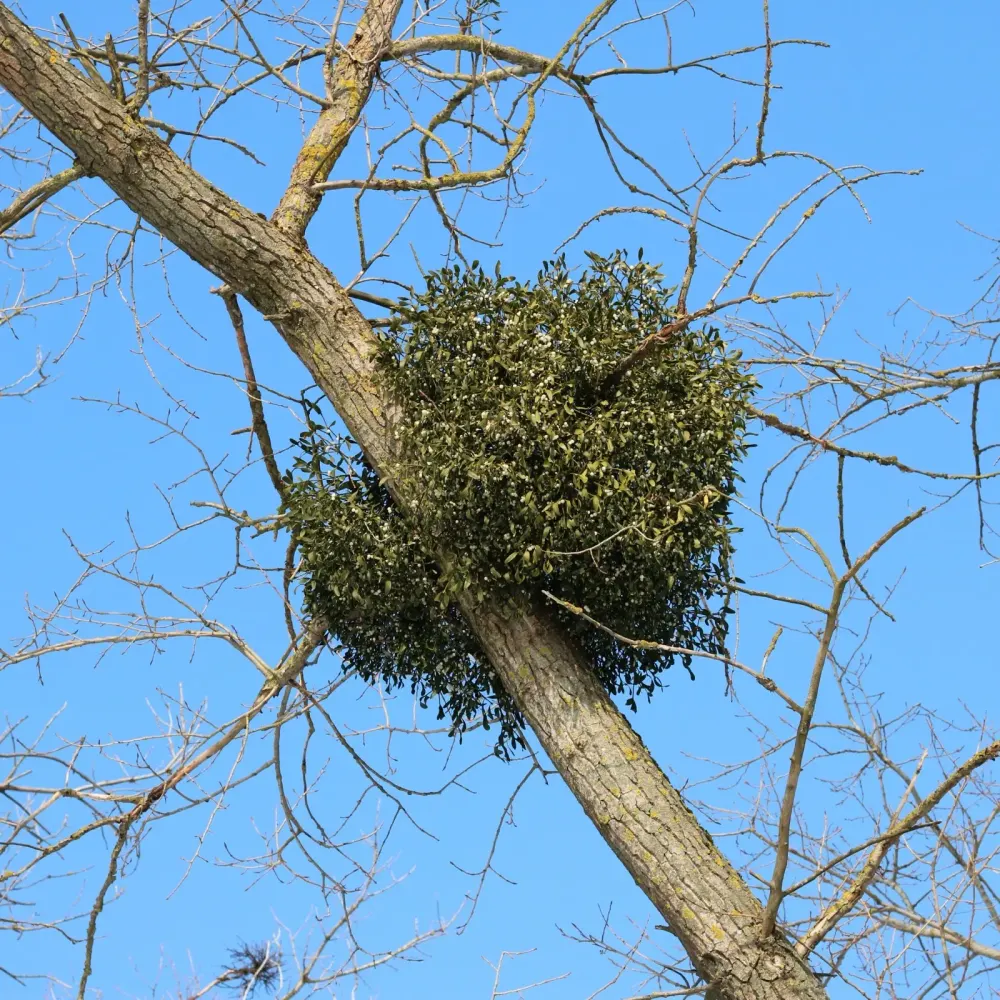
Viscum album is a species of mistletoe in the family Santalaceae, commonly called European mistletoe, common mistletoe, or simply mistletoe. It is native to Europe, as well as western and southern Asia. V.
CONTRAINDICATED during pregnancy
Contraindicated in pregnancy. Mistletoe lectins are highly active proteins; uterus-contracting effects have been described. Parenteral mistletoe products are also contraindicated in pregnancy.
CONTRAINDICATED during breastfeeding
Contraindicated during lactation. No sufficient safety data for mother and child; potential transfer of active proteins.
CONTRAINDICATED for children
Contraindicated in children. Even a few berries can cause poisoning. Keep plants out of reach of children; safely dispose of berries from Advent wreaths or Christmas decorations.
Critical drug interactions with:
Immunsuppressiva / Immunosuppressants
- CompressAerial partsExternalFolk medicine
Folk-medicinal use: cold compress of mistletoe-herb decoction on weeping skin rashes and eczema. Evidence weak, traditional household use — seek medical advice for extensive or unclear skin lesions.
Preparation & dosage
[#src_madaus_1938_viscum_album] [#src_heilkraeuter_mistel_viscum_album]
- BathAerial partsExternalFolk medicine
Folk-medicinal bath additive of mistletoe herb for relaxation and nervous tension. Tradition mainly in Swiss and southern German household medicine (e.g. Künzle); clinical evidence is lacking.
Preparation & dosage
[#src_heilkraeuter_mistel_viscum_album] [#src_madaus_1938_viscum_album]
Historical documentation only — do NOT use
These internal applications are historically documented. This plant is highly toxic — self-treatment can cause severe poisoning or death. For documentation only, explicitly NOT a recommendation.
- TeaAerial partsInternalTraditional use
Historical cold infusion of mistletoe herb (stems and leaves) for mild hypertension and circulatory complaints. Important: cold maceration only (8-12 h) — the cytotoxic lectins are heat-labile and a hot infusion inactivates them, but folk-medicinal constituents are also lost. Today this is of documentary interest only; therapeutic self-use is not recommended due to toxicological risks.
Preparation & dosage
Macerate 2.5-3.5 g of dried mistletoe herb in 150 ml of cold water for 8-12 hours, then strain. Use only under medical supervision — self-medication not recommended.
- Dry amount
- 2.5–3.5 g
- Doses per day
- 2×
- Max duration
- 4 weeks
[#src_kommission_e_1984_viscum_album] [#src_madaus_1938_viscum_album] [#src_who_monograph_2009_viscum_album]
- TinctureAerial partsInternalTraditional use
Historical low-dose ethanolic tincture of mistletoe herb for circulatory weakness. Because of the cytotoxic lectins and viscotoxins, home preparation and self-use are no longer recommended today — the therapeutic margin is narrow and only suitable for prescription by a physician.
Preparation & dosage
1:5 in 40-50% ethanol, 1-2 ml per dose, maximum 2 times daily. Only under medical supervision — home preparation not recommended.
- Liquid amount
- 1–2 ml
- Doses per day
- 2×
- Max duration
- 4 weeks
[#src_kommission_e_1984_viscum_album] [#src_madaus_1938_viscum_album]
- TinctureAerial partsInternalClinical trial
Note: this use is NOT a home-made tincture but a standardised parenteral (subcutaneously injected) finished medicinal product — Iscador®, Helixor®, abnobaVISCUM®. Used in anthroposophic and integrative oncology as complementary therapy to conventional cancer treatments (surgery, chemotherapy, radiotherapy). Studies show improvements in quality of life, sleep and tumour-associated fatigue; a confirmed life-prolonging effect is contested. The ESMO complementary-oncology guideline lists mistletoe as an option for improving quality of life. To be administered only by experienced physicians.
[#src_iscador_fachinfo_viscum_album] [#src_esmo_complementary_2024_viscum_album] [#src_who_monograph_2009_viscum_album]