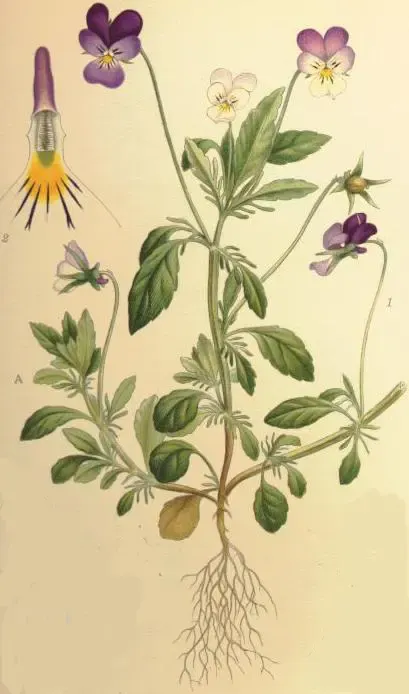
© Carl Axel Magnus Lindman · Public domain · Commons
Viola tricolor
CautionWildes Stiefmütterchen · (Viola tricolor)
Violet family (Violaceae)
Description
Viola tricolor is a common European wild flower, growing as an annual or short-lived perennial. The species is also known as wild pansy, Johnny Jump up, heartsease, heart's ease, heart's delight, tickle-my-fancy, Jack-jump-up-and-kiss-me, come-and-cuddle-me, three faces in a hood, love-in-idleness, and pink of my john.
- TeaAerial partsInternalTraditional use
Traditional internal herbal tea from flowering wild pansy herb for seborrhoeic skin disorders and cradle cap (infant seborrhoeic dermatitis) — listed as a traditional indication in the EMA monograph.
Preparation & dosage
INFUSION (internal, EMA traditional use): 1.5–3 g dried wild pansy herb (Violae tricoloris herba) in 150 ml boiling water, covered, steep 10 min, strain. Drink 3× daily. Traditionally used for seborrhoeic skin conditions and mild skin rashes (e.g. seborrhoeic dermatitis, cradle cap in children) as an accompanying internal treatment. Do not extend beyond 4 weeks without medical advice; consult a doctor if condition worsens or does not improve.
- Dry amount
- 1.5–3 g
- Doses per day
- 3×
- Max duration
- 4 weeks
[#src_ema_viola_tricolor] [#src_kommission_e_viola] [#src_escop_viola]
- BathAerial partsExternalTraditional use
External wash and compress with wild pansy infusion for seborrhoeic skin, cradle cap and mild rashes — traditional EMA indication for external use.
Preparation & dosage
EXTERNAL INFUSION / WASH: 5–10 g dried wild pansy herb in 1 litre boiling water, steep 15 min, strain and cool to body temperature. Apply as a wash, compress or partial bath to affected skin area, leave 10–15 min, 2–3× daily. Traditionally for seborrhoeic dermatitis, cradle cap, mild rashes and scaly itchy skin. For sensitive children's skin, halve concentration and patch-test first.
- Dry amount
- 5–10 g
- Doses per day
- 1×
- Max duration
- 4 weeks
[#src_ema_viola_tricolor] [#src_escop_viola] [#src_pfaf_viola_tricolor]
- CompressAerial partsExternalFolk medicine
Folk compress with wild pansy herb infusion for itching, mild skin inflammation and scaly eczema.
Preparation & dosage
COMPRESS: 3–5 g herb in 200 ml hot water, steep 10 min, strain. Soak a clean cloth in the cooled infusion, wring out well and apply to affected area (e.g. itchy skin, mild inflammation, minor abrasions). Leave 15–20 min, repeat up to 2× daily. Folk remedy for itching, mild skin inflammation, scaly eczema and minor wound care. Do not apply to open or infected wounds — seek medical attention.
- Dry amount
- 3–5 g
- Doses per day
- 2×
- Max duration
- 2 weeks
[#src_madaus_viola] [#src_pfaf_viola_tricolor] [#src_wp_de_viola]
- TeaAerial partsInternalFolk medicine
Folk cough and cold tea — mucilaginous, mildly diaphoretic, traditionally for catarrh of the upper respiratory tract.
Preparation & dosage
COUGH & COLD TEA: 1.5–2.5 g dried wild pansy herb in 200 ml boiling water, steep 10 min, strain. Drink 3× daily, sweetened with honey if desired. Folk use for catarrhal coughs, mild upper respiratory complaints, and as a mild diaphoretic for light fever. The mucilage content is thought to soothe irritant cough. Not a substitute for medical treatment of persistent or severe respiratory symptoms.
- Dry amount
- 1.5–2.5 g
- Doses per day
- 3×
- Max duration
- 2 weeks
- TeaAerial partsInternalFolk medicine
Traditional 'blood-purifying' tea for chronic skin conditions, eczema, gout and joint complaints — salicylate-containing, mildly diuretic; the concept of 'blood purification' has no modern medical equivalent.
Preparation & dosage
CLEANSING TEA (folk medicine): 1.5–3 g herb in 200 ml hot water, steep 10 min, strain. Drink 3× daily. In European folk medicine, wild pansy was used for centuries as a mild 'blood purifier' for skin conditions, chronic eczema, gout and arthritis — the salicylate content was believed to be mildly diuretic and metabolism-stimulating. The traditional notion of 'blood purification' has no modern medical equivalent; it denotes mild diuretic and metabolic support. Modern evidence is limited.
- Dry amount
- 1.5–3 g
- Doses per day
- 3×
- Max duration
- 4 weeks
- TinctureAerial partsInternalTraditional use
Traditional tincture for seborrhoeic skin conditions — suitable for internal and external use; contains ethanol, therefore not for children under 12.
Preparation & dosage
TINCTURE (1:5 in 25–40 % ethanol): 1–2 ml (~20–40 drops) 3× daily in water internally, or apply undiluted externally to affected skin (dilute 1:3 in water for sensitive skin). Traditionally for seborrhoeic skin conditions — mucilage is soothing, flavonoids are antioxidant, salicylates are mildly anti-inflammatory. Due to ethanol content, avoid in children under 12, pregnant women, or those with alcohol dependency.
- Liquid amount
- 1–2 ml
- Doses per day
- 3×
- Max duration
- 4 weeks
- SalveAerial partsExternalFolk medicine
Folk oil salve from wild pansy herb for dry scaly skin, eczema and minor wounds — soothing and emollient action from mucilage content.
Preparation & dosage
SALVE / MACERATE: Fresh or dried wild pansy herb (1 part herb) macerated in warmed olive or almond oil (5 parts oil) for 2–3 hours at approx. 50 °C in a water bath, strain and press well. For salve: melt approx. 5–10 g beeswax into 100 g oil extract, add a few drops of lavender oil if desired. Pour into dark jars, store cool (shelf life 3–6 months). Folk use for dry scaly skin, mild eczema, skin inflammation and minor wounds.
- RawFlowerInternalFolk medicine
Edible wild flowers — decorative and mildly aromatic; used in flower syrup, crystallised flowers, spring quark and as a salad topping.
Preparation & dosage
EDIBLE FLOWERS / SALAD: The colourful flowers of wild pansy (harvested before full maturity) are edible and used in natural cookery as salad decoration, in flower syrup (boil with sugar and water), crystallised with egg white and sugar as decoration, or fresh in spring quark and herb butter. Mildly aromatic, slightly sweet. Contain rutin and anthocyanins regarded as antioxidant co-constituents. Collect flowers only from unsprayed, unfertilised sites.