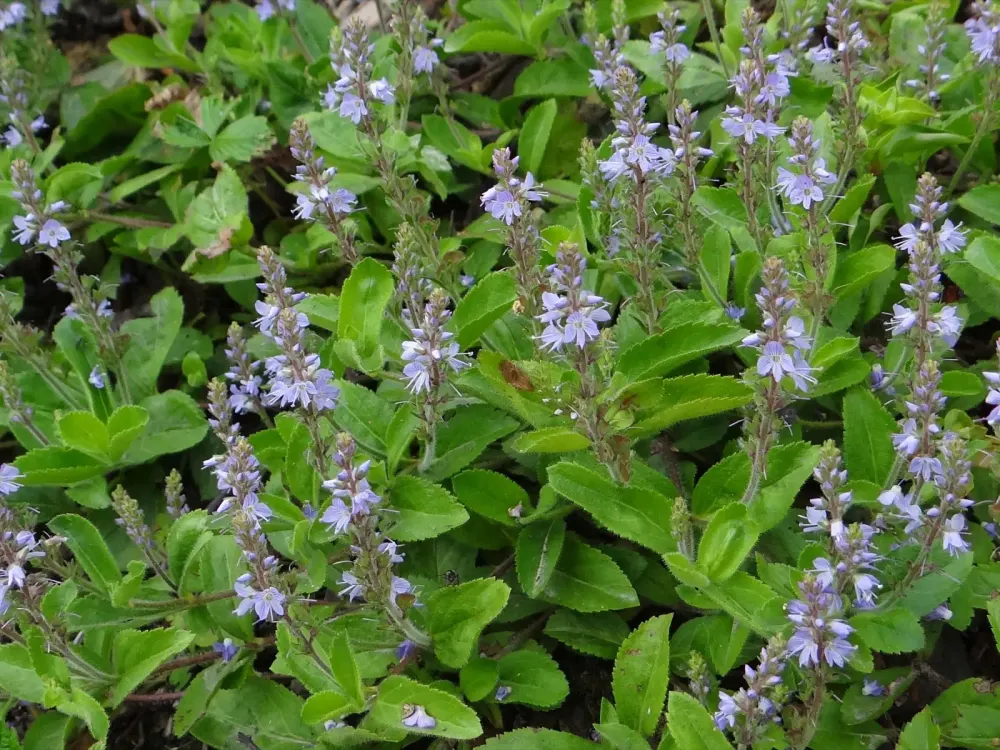
© Jerzy Opioła · CC BY-SA 4.0 · Commons
Veronica officinalis
Echter Ehrenpreis · (Veronica officinalis)
Plantain family (Plantaginaceae)
Description
Veronica officinalis, the heath speedwell, common gypsyweed, common speedwell, or Paul's betony, is a species of flowering plant in the plantain family Plantaginaceae. It is native to Europe and western Asia. It has been introduced to North America and is widely naturalised there.
- TeaAerial partsInternalFolk medicine
Infusion of the flowering aerial parts (1–2 g per cup, steep 10 min) for mild colds, coughs, and catarrh of the upper respiratory tract. Iridoid glycosides (aucubin, catalpol) have mild anti-inflammatory effects; saponins promote mucus liquefaction.
Preparation & dosage
- Dry amount
- 1–2 g
- Doses per day
- 3×
[#src_wp_de_veronica] [#src_pfaf_veronica] [#src_pmc6651156]
- GargleAerial partsExternalFolk medicine
Stronger infusion (2–3 g per 150 ml) as a gargle for mild inflammation of the oral mucosa and throat. Tannins and phenolic acids (chlorogenic acid, caffeic acid) are astringent and mildly antimicrobial.
Preparation & dosage
- CompressAerial partsExternalFolk medicine
Cooled infusion as a moist compress for skin irritations, eczema, minor wounds and abrasions. Traditionally used in Balkan folk medicine for skin ulcerations and snake bites. Astringent tannins and antioxidant flavonoids (luteolin, apigenin) support wound healing.
- TeaAerial partsInternalFolk medicine
Used in folk medicine for gout and rheumatism as a mild diuretic and anti-inflammatory. Aucubin and catalpol inhibit COX-2 and NF-κB in vitro, supporting traditional use for inflammatory joint complaints.
Preparation & dosage
- Dry amount
- 1–2 g
- Doses per day
- 3×
- TeaAerial partsInternalFolk medicine
Mildly diuretic effect of the aerial parts; used in folk medicine as supportive flushing therapy for urinary tract irritation. Listed in the 19th-century US Pharmacopoeia as a diaphoretic and mild expectorant.
Preparation & dosage
- Dry amount
- 1–2 g
- Doses per day
- 3×
- RawLeafInternalTraditional use
Historically drunk in France as a tea substitute ('thé d'Europe'); slightly bitter and astringent taste. Fresh leaves occasionally used in salads. Widely consumed as a daily beverage in 19th-century France and England.