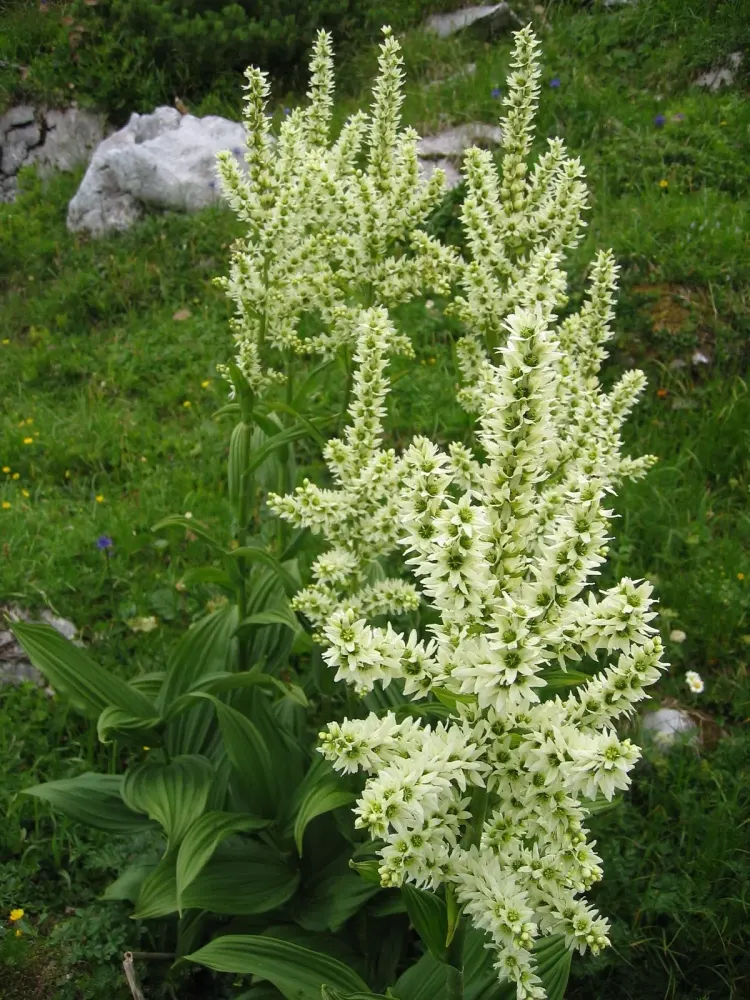
© User:Tigerente · CC BY 2.5 · Commons
Veratrum album
Toxic🐾Weißer Germer · (Veratrum album)
False-hellebore family (Melanthiaceae)
Description
Veratrum album, the false helleborine, white hellebore, European white hellebore, or white veratrum is a poisonous plant in the family Melanthiaceae. It is native to Europe and parts of western Asia.
🌿 Risk of confusion — read before wild-harvesting!
CRITICAL CONFUSION RISK: non-flowering white false-hellebore is repeatedly mistaken for yellow gentian (Gentiana lutea) when collecting roots for gentian schnapps — Veratrum has ALTERNATE leaves, Gentiana OPPOSITE. Confusion with wild garlic (Allium ursinum) is also documented. Fatal outcome possible 3–12 hours after ingestion.
External use only!
This plant must NOT be taken internally. Use only as compress, salve, or bath.
CONTRAINDICATED during pregnancy
Cyclopamine (abundant in Veratrum californicum, present in lower amounts in Veratrum album) is a classic Smoothened antagonist in the sonic hedgehog pathway and teratogenic: in 1957, Idaho (USA) lamb cyclopia (single-eye holoprosencephaly) was described following maternal consumption of corn lily (V. californicum). Protoveratrines are also embryotoxic and cardiotoxic. Any use during pregnancy is absolutely contraindicated.
CONTRAINDICATED during breastfeeding
Veratrum alkaloids can pass into breast milk and cause bradycardia, hypotension, and respiratory disturbances in the infant. Breastfeeding: strictly contraindicated.
CONTRAINDICATED for children
Children are extremely sensitive to Veratrum alkaloids; even centigram doses of root powder can be fatal. The narrow therapeutic index prohibits any paediatric use. In case of suspected ingestion, contact poison control immediately.
Critical drug interactions with:
Herzglykoside (Digoxin, Digitoxin) · Antihypertensiva (ACE-Hemmer, Betablocker, Calciumkanalblocker, Diuretika) · Antiarrhythmika (Klasse I — Chinidin, Lidocain; Klasse III — Amiodaron, Sotalol) · Hedgehog-Pathway-Inhibitoren (Vismodegib, Sonidegib)
- InhalationRhizomeExternalFolk medicine
Sneeze-powder (sternutatory): finely ground rhizome powder was blown into the nose from the 16th to 19th century to clear mucus, cure headaches, or revive the unconscious. Bock's 'Kreutterbuch' (1565) lists Veratrum album accordingly as sneeze-powder and for scabies. Discontinued today due to mucosal irritation and absorption-related poisoning risk.
Preparation & dosage
- SalveRhizomeExternalFolk medicine
Folk-medicinal external use against scabies, lice, and joint pain (Bock's 'Kreutterbuch' 1565, PFAF). Diluted extracts or salves act as strong local irritants (rubefacient). Modern assessment: dangerous due to transdermal alkaloid absorption through compromised skin.
Preparation & dosage
- RawRhizomeExternalFolk medicine
Insecticide: dried rhizome powder was traditionally used against pests and insects. Wikipedia EN documents brief use of Veratrum album extracts against the Colorado potato beetle (Leptinotarsa decemlineata). PFAF notes efficacy against caterpillars and mammals — replaced today by safer pesticides.
Preparation & dosage
Historical documentation only — do NOT use
These internal applications are historically documented. This plant is highly toxic — self-treatment can cause severe poisoning or death. For documentation only, explicitly NOT a recommendation.
- RawRhizomeInternalFolk medicine
Ancient use as emetic and purgative: in Hippocrates (c. 460–370 BC), the powdered rhizome of white false-hellebore was a 'common emetic'. Dioscorides described it as 'inducing vomiting and sneezing'. The substance was used to purge 'black bile' and to treat madness (Aëtius). Highly toxic — obsolete today, only of pharmacy-historical relevance.
Preparation & dosage
- RawRhizomeInternalFolk medicine
Anticyra myth: in ancient Greece the city of Anticyra (on the Gulf of Corinth) was famous for hellebore preparations against mental illness — the phrase 'naviga Anticyram' ('sail to Anticyra') was a taunt for the insane. Which Veratrum or Helleborus species was meant is debated among historians; Veratrum album was explicitly used as 'white hellebore' for this purpose.
Preparation & dosage
- TinctureRhizomeInternalFolk medicine
Antihypertensive research in the 1930s–1950s: Veratrum extracts (protoveratrines A and B) were clinically tested to lower blood pressure. The use was abandoned because of an extremely narrow therapeutic index (nausea, bradycardia, collapse already at therapeutic doses) and the availability of safer antihypertensives. A historical example of a pharmaceutical dead-end.
Preparation & dosage
- TinctureRhizomeInternalFolk medicine
Homoeopathic use: Veratrum album is applied in homoeopathy (D6–D30) for acute vomiting-diarrhoea with circulatory collapse, cold sweats, and exhaustion (Hahnemann's homoeopathic proving). Highly diluted stages contain no active alkaloid amounts. Home preparation from plant material is strictly prohibited.
Preparation & dosage
- TinctureRhizomeInternalClinical trial
Cyclopamine derivative vismodegib (Erivedge, FDA approval 2012-01-30) for advanced basal cell carcinoma — inhibitor of the hedgehog signalling pathway (Smoothened antagonist). IMPORTANT: vismodegib is a semi-synthetic small molecule pharmacologically derived from cyclopamine (originally isolated from Veratrum californicum). It is NOT a plant extract from Veratrum album. Listed here purely to illustrate the pharmacological significance of the cyclopamine line.
Preparation & dosage
[#src_wp_vismodegib_veratrum_album] [#src_wp_cyclopamine_veratrum_album]