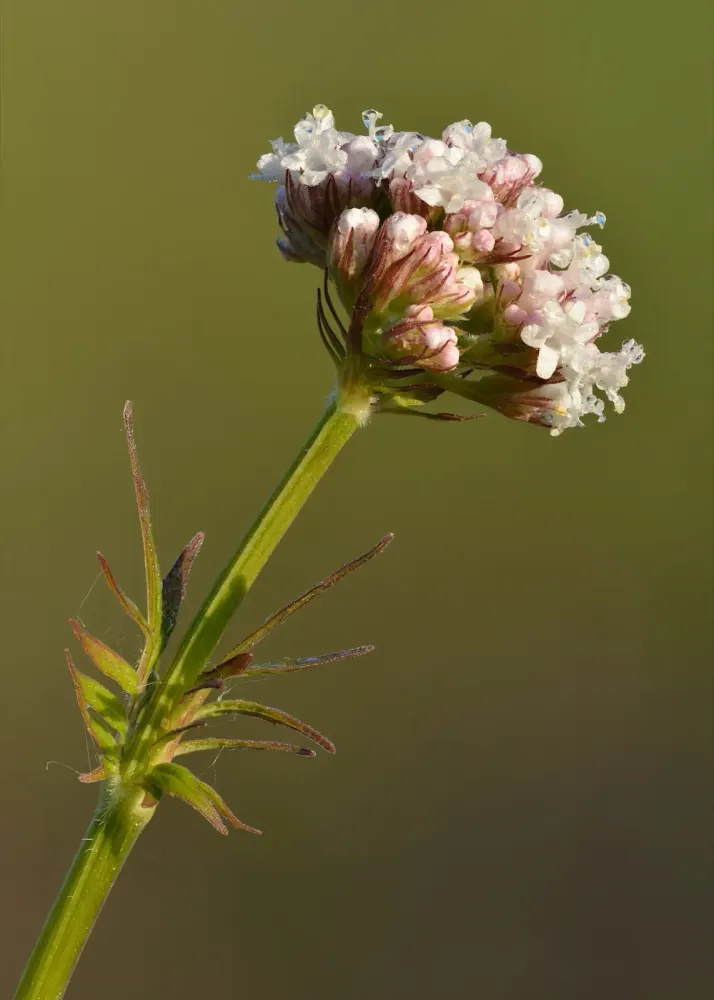
© Unknown (see Commons) · See Commons file page · Commons
Valerian (herb)
CautionEchter Baldrian · (Valeriana officinalis)
Honeysuckle family (Caprifoliaceae)
Description
Its unmistakable, ever-intensifying smell already reveals the active compound: isovaleric acid only forms as the root of this honeysuckle-family plant dries and ages, and is not a sign of poor quality. As a standardised dry extract, valerian holds EMA „well-established use“ status for relieving nervous tension and mild sleep disturbances – though only after two to four weeks of regular intake, since it lacks the acute knock-out effect of classical sleeping pills. The main active compounds are sesquiterpenic acids such as valerenic acid, which act at the GABA-A receptor, supported by flavonoids like 6-methylapigenin and lignans with a similar mechanism. Taken as tea, tincture or bath additive, the root has also traditionally eased nervous stomach complaints – an indication Germany's Kommission E rates positively too – and, blended with lemon balm and hops, serves as a calming evening tea. Valerian should never be stopped abruptly after prolonged use, can paradoxically cause restlessness in some people, and should not be combined with alcohol or sedatives.
Standardised valerian root dry extract for relief of mild nervous tension and sleeplessness — EMA main indication (well-established use).
Preparation & dosage
STANDARDISED DRY EXTRACT (EMA well-established use): Dry extract of Valerianae radix, DER 3–7.4:1, ethanol 40–70 % V/V. Approved daily dose: 400–600 mg, 1–3× daily (restlessness, nervous tension) or a single dose 30–60 min before bedtime (sleep-onset disorders). Onset of effect after 2–4 weeks of regular use. Do not combine with alcohol or sedatives. Continue if improved after 2 weeks; no improvement after 4 weeks: consult a doctor.
- Liquid amount
- 1–3 ml
- Doses per day
- 3×
- Max duration
- 4 weeks
⚠ Age restriction: ≥ 12 years — Per EMA: for children from 12 years (traditional use); insufficient data below 12 years.
Traditional infusion of valerian root for nervous restlessness and mild sleep disorders — classic folk medicine and EMA traditional use.
Preparation & dosage
INFUSION (EMA traditional use): 2–3 g comminuted valerian root in 150–250 ml boiling water, covered, steep 10–15 min, strain. For nervous tension: 2–3 cups daily between meals. For sleep: 1 cup 30–60 min before bedtime. NOTE: The characteristic smell (isovaleric acid) intensifies during steeping — unpleasant for some; taste can be softened with honey or lemon balm. Do not use longer than 4 weeks without medical advice.
- Dry amount
- 2–3 g
- Doses per day
- 3×
- Max duration
- 4 weeks
⚠ Age restriction: ≥ 12 years — Not for children under 12 years.
Alcoholic valerian root tincture — traditional alternative to tea with longer shelf life, suitable for adults without alcohol contraindication.
Preparation & dosage
TINCTURE (EMA traditional use, DER 1:8 in ethanol 60–70 % V/V): 4–8 ml (~80–160 drops) up to 3× daily, stirred into water or juice. For sleep: 1 dose 30–60 min before bedtime. Note ethanol content: contraindicated in liver disease, alcohol dependence or epilepsy. Do not combine with sedatives or alcohol. Traditional use — lower clinical evidence than standardised dry extract.
- Liquid amount
- 4–8 ml
- Doses per day
- 3×
- Max duration
- 4 weeks
⚠ Age restriction: ≥ 18 years — Due to ethanol content: adults only.
Relaxing full bath with valerian root extract — traditional external use for nervous exhaustion and sleep-onset difficulties.
Preparation & dosage
FULL BATH (EMA traditional use): 100–200 g comminuted valerian root in 2 l boiling water, steep covered 10 min, strain, add to bath water. Temperature 34–37 °C (thermoneutral, not too hot), duration 10–20 min. 1 bath daily. Contraindicated with open wounds, acute skin inflammations, cardiovascular disease or high fever. The characteristic valerian vapour may be intensified in the bath — rest afterwards. NO full bath for children under 12 years or with known hypersensitivity.
- Dry amount
- 100–200 g
- Doses per day
- 1×
- Max duration
- 4 weeks
Valerian tea for nervous gastric complaints and functional abdominal cramps — Kommission E positive monograph.
Preparation & dosage
CALMING TEA FOR NERVOUS GASTRIC COMPLAINTS (Kommission E): 2–3 g comminuted root in 200 ml boiling water, steep covered 10 min, strain. Drink 3× daily after meals. Kommission E and folk indication: nervous/functional gastric irritability, functional abdominal cramps, tension headaches. Acts via dampening central stress responses — not a direct spasmolytic on gut muscle like peppermint. Helpful as adjunct when GI complaints are clearly stress-related.
- Dry amount
- 2–3 g
- Doses per day
- 3×
- Max duration
- 4 weeks
Folk triple-herb evening tea (valerian + lemon balm + hops) — synergistic blend for mild sleep-onset issues and calming.
Preparation & dosage
VALERIAN BLEND TEA (folk medicine, Hildegard tradition): Blend 1–2 g valerian root with 1 g each lemon balm leaf and hop strobiles, steep in 200 ml hot water (~90 °C, not boiling) covered for 8 min, strain. 1 cup in the evening, optional afternoon cup. Traditional combination: synergistic use with lemon balm and hops has been documented in European folk medicine for centuries and recognised by EMA monographs as combined traditional use. Milder odour than pure valerian. Suitable for those who find pure valerian's smell unpleasant.
- Dry amount
- 1–2 g
- Doses per day
- 2×
- Max duration
- 3 weeks
External application of valerian tincture as liniment or compress for muscle tension and mild joint discomfort — purely folk-medicine.
Preparation & dosage
LINIMENT / COMPRESS (folk medicine): Apply 5–10 ml undiluted valerian tincture (1:5, ethanol 60 %) to a cloth and use as a wrap on tense muscles or aching joints, leave 20–30 min. Alternatively rub directly into the skin. Do not apply to open wounds or irritated skin. Folk external use for muscular tension and mild joint pain — no clinical evidence; historical sources (Madaus, Hildegard) document the tradition.
- Liquid amount
- 5–10 ml
- Doses per day
- 2×
- Max duration
- 3 weeks
IMPORTANT: Valerian causes paradoxical reactions (restlessness, agitation instead of calming) in some individuals — documented and more common at higher doses. Do not drive or operate machinery shortly after intake — possible impairment of reaction time, especially in first days and with concurrent alcohol. Do not stop abruptly after prolonged use — taper over 1–2 weeks. Not a classical pharmacological hypnotic: therapeutic effect develops after 2–4 weeks of continuous use, no acute action. Persistent sleep disorders require medical evaluation. The characteristic odour (isovaleric acid, a breakdown product of valerenic acid) intensifies after drying and storage — not a sign of quality loss. Prefer evening dosing; morning grogginess (hangover effect) possible at higher doses.
⏱ Max continuous use: 4 weeks
Per EMA not recommended in pregnancy or lactation — insufficient safety data. Earlier in vitro data showed uterotonic activity; clinical relevance at oral therapeutic doses unclear. Occasional culinary seasoning use (historical, rarely practised) is a different case but also not recommended.
Insufficient data on transfer of valerian constituents into breast milk. EMA recommends: do not use during lactation.
Standardised extracts and tincture not recommended for children under 12 years (EMA — insufficient data). EMA monograph allows traditional use from 12 years. No self-treatment with valerian in younger children — nervous complaints in children require medical assessment.
Drug interactions
Benzodiazepine und andere Sedativa/Hypnotika (Zolpidem, Zopiclon, Barbiturate)
Valerian extracts modulate GABA-A receptors and may additively enhance the sedative effect of benzodiazepines and hypnotics. Animal evidence; limited clinical data. Risk of excessive sedation, impaired reaction time, and respiratory depression at high doses. Avoid combination or use only under medical supervision.
Alkohol (Ethanol)
Valerian may potentiate the CNS-depressant effects of alcohol. Avoid concurrent use during therapy — driving ability and reaction time may be impaired.
CYP3A4- und CYP2D6-Substrate (z.B. bestimmte Antihistaminika, Antidepressiva, Statine)
In vitro studies show weak inhibition of CYP3A4 and CYP2D6 by valerian constituents (valerenic acid, valepotriates). Clinical relevance at therapeutic doses likely low, but consider with narrow-therapeutic-index drugs. Plasma-level monitoring recommended for affected co-medications.
Antikoagulantien / Thrombozytenaggregationshemmer (Warfarin, Phenprocoumon, ASS, Clopidogrel)
Case reports and in vitro data suggest weak platelet-aggregation inhibitory properties of isovaleric acid derivatives. Clinical significance at normal doses low, but caution and INR monitoring advised with anticoagulation therapy.
Contraindications
- Hypersensitivity to valerian (Valeriana officinalis) or other Valeriana species.
- Pregnancy and lactation (therapeutic doses) — do not use due to lack of safety data.
- Children under 12 years (standardised preparations) — insufficient data.
- Valerian tincture in alcohol dependence, severe liver disease or epilepsy — contraindicated due to ethanol content.
- Full bath contraindicated in: open wounds, acute skin inflammations or infections, decompensated heart failure, severe hypertension, high fever.
Harvested part: rhizome (autumn)
- Time of day:
- On dry autumn days — ideal timing is after the above-ground parts have died back (October–November), when the plant has fully stored its constituents (valerenic acid, valepotriates) in the rhizome. Harvest in the morning once dew has dried.
- Drying:
- Dig up roots and rhizome (two-year-old plants yield higher constituent content), wash thoroughly, remove fibrous rootlets and stem remnants, cut into 3–5 mm slices or sticks. Dry at max. 35–40 °C in a dehydrator or fan oven for 12–24 h until brittle. Do NOT dry at higher temperatures — valerenic acid and valepotriates are heat-labile. Fresh roots smell pleasantly spicy; the characteristic valerian odour (isovaleric acid) develops through enzymatic activity during drying and storage — this is normal and not a sign of poor quality. Smaller quantities can be air-dried on cloth in a well-ventilated shaded location in warm, dry weather.
- Storage:
- 24 months — Airtight in glass or tin containers, dark and dry, at room temperature. Valerenic acid content remains stable for up to 2 years with proper storage. Discard if rubbery or musty smell exceeds normal valerian odour. Pharmacopoeial quality: Ph.Eur. specifies min. 0.17 % valerenic acid.
- Time of day:
- In early spring, before the stem has grown strongly — the root still contains full nutrient and constituent stores from the previous year's vegetation period. Prefer early morning harvest.
- Drying:
- Alternative to autumn harvest: spring harvest of rhizome (March–April) also yields quality drug with good valerenic acid content, but must be collected before flower stalk develops. Processing same as autumn harvest. Spring harvest is suitable for one-year-old plants that have not yet flowered. NOTE: For pharmaceutical-grade quality, autumn harvest (two-year-old plants) is preferred (higher valepotriates and valerenic acid).
- Storage:
- 24 months — Same as autumn harvest: airtight, dark, dry. Process or dry spring roots promptly as higher moisture content increases mould risk.
- Valerensäure, Acetoxyvalerensäure, HydroxyvalerensäureSesquiterpeneContent: 0.3-0.8 %Root
Sesquiterpenic acids — lead compounds for quality standardisation (EMA: min. 0.17 % valerenic acid in dry extracts). Act at GABA-A receptor as partial agonists (modulate chloride ion channel) and inhibit GABA degradation by transaminase — centrally sedating without direct benzodiazepine binding. Primarily responsible for demonstrated sedative effect; also agonist at adenosine A1 receptors.
- Valepotriate (Valtrat, Isovaltrat, Didrovaltrat, Acevaltrat)OtherContent: 0.5-2.0 %Root
Iridoid monoterpenes (bicyclic structures) — characteristic of Valeriana species. Unstable: rapidly degraded to baldrinaldehyde derivatives on drying and in aqueous solution. Higher in fresh root and fresh tincture; dried medicinal herb contains few intact valepotriates. Potentially cytotoxic in vitro (alkylating) — prolonged exposure to fresh valepotriates not recommended. Degradation products (baldrinaldehyde) show independent sedative properties.
- Ätherisches Öl (Bornylacetat, Isovaleriansäure, Campher, beta-Bisabolol, Valeranon)Essential oilContent: 0.3-0.8 %Root
Characteristic essential oil — main components: bornyl acetate (fresh root, pleasant-spicy), isovaleric acid (degradation product, characteristic valerian odour develops on storage), camphor, valerianol, valeranone and further sesquiterpene alcohols. The volatile fraction contributes to effect, especially in baths and inhalations. Of secondary importance for standardised extract activity.
- Lignane (Pinoresinol, Lariciresinol, Isolariciresinol)OtherContent: 0.1-0.5 %Root
Hydroxycinnamic alcohol dimers (phenylpropanoids). Show in vitro sedative and anxiolytic properties via binding to GABA-A receptors (benzodiazepine binding site). Pinoresinol identified as pharmacologically active lead compound of this group; contributes synergistically to overall effect.
- Flavonoide (Linarin, Hesperidin, 6-Methylapigenin, Luteolin)FlavonoidContent: 0.1-0.3 %Root
Flavone glycosides and free flavones. 6-Methylapigenin identified in valerian, showing strong benzodiazepine receptor binding affinity in vitro — potentially significant for the anxiolytic component. Linarin shows weak sedative-hypnotic activity. Synergistic potentiation of GABA receptor complex together with valerenic acid.
- Alkaloid-Spuren (Actinidin, Chatinin, Valerianin, Valeranin)AlkaloidContent: < 0.1 %Root
Monoterpene alkaloids in trace amounts, characteristic for Valeriana species. Actinidin is the volatile alkaloid attracting cats (similar to nepetalactone from catnip). Pharmacologically irrelevant at therapeutic doses, but contribute to the overall bouquet of biological activity.
- Aminosäuren (GABA, Glutamin, Arginin, Tyrosin)OtherContent: 0.05-0.5 %Root
Free amino acids including GABA (gamma-aminobutyric acid) itself. However, exogenous GABA crosses the blood-brain barrier only to a limited extent — direct CNS action of valerian-GABA is questionable. Glutamine as GABA precursor may be indirectly relevant. Arginine and tyrosine as general nitrogen sources. Overall significance for sedative effect less than valerenic acid and lignans.
- Polysaccharide / Stärke / Gerbstoffe (Gerbsäuren, Kaffeesäure-Derivate)TanninContent: 3-8 %Root
Valerian root contains substantial starch (~20–30 %) and low-molecular tannins (caffeic acid derivatives, chlorogenic acid). Tannins cause the slightly astringent mouthfeel of valerian tea. Pharmacologically irrelevant for sedative action; but influence taste and GI tolerability. High starch content explains caloric density of the root (historically occasionally used as food in times of scarcity).
- [1]MonographEMA/HMPC/150848/2015 Corr.1 — European Union herbal monograph on Valeriana officinalis L., radix (Final, 2 February 2016)(accessed: 2026-05-21)
- [2]MonographESCOP Monographs — Valerianae radix (Valerian Root), 2nd edition incl. supplement 2009(accessed: 2026-05-21)
- [3]MonographKommission E — Baldrianwurzel (Valerianae radix), positive Monographie, BAnz Nr. 90, 1985 / BAnz Nr. 223, 1993 (Neubewertung)(accessed: 2026-05-21)
- [6]MonographPlants For A Future (PFAF) — Valeriana officinalis database entry(accessed: 2026-05-21)
- [4]BookWichtl, Max (Hrsg.) — Teedrogen und Phytopharmaka, 5. Auflage, Wissenschaftliche Verlagsgesellschaft Stuttgart, 2009 — Eintrag: Valerianae radix(accessed: 2026-05-21)
- [5]BookMadaus, Gerhard — Lehrbuch der biologischen Heilmittel, Band II: Valeriana officinalis, 1938 (Public Domain, Digitalisat Henriette's Herb)(accessed: 2026-05-21)