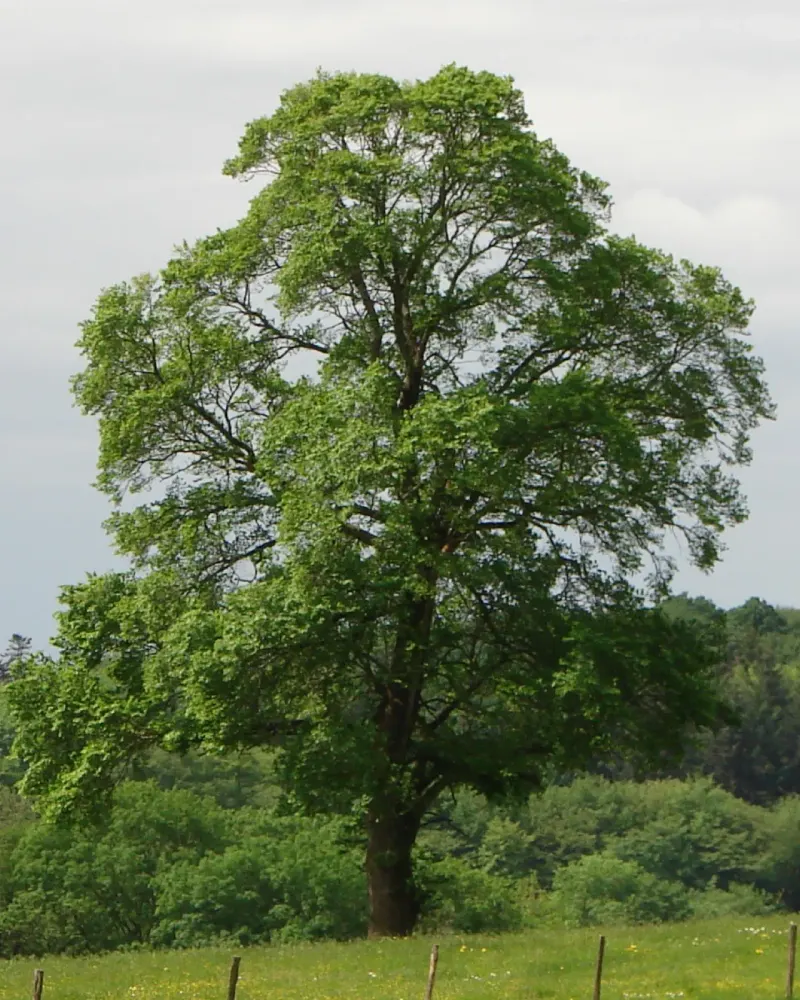
© Eric Collin. Original uploader was Ptelea at en.wikipedia · GFDL · Commons
Ulmus minor
Feldulme · (Ulmus minor)
Elm family (Ulmaceae)
Description
Ulmus minor Mill., the field elm, is by far the most polymorphic of the European species, although its taxonomy remains a matter of contention. Its natural range is predominantly south European, extending to Asia Minor and Iran; its northern outposts are the Baltic islands of Öland and Gotland, although it may have been introduced by humans. The tree's typical habitat is low-lying forest along the main rivers, growing in association with oak and ash, where it tolerates summer floods as well as droughts.
- TeaBarkInternalFolk medicine
A decoction of field elm bark was traditionally used in European folk medicine for diarrhoea and intestinal catarrh. Tannins (catechins, condensed tannins) act astringently on the intestinal mucosa; mucilage provides a demulcent, soothing effect. Henriette's Herbal (King's American Dispensatory) documents Ulmus campestris (a synonym for U. minor in older literature) as an astringent remedy for chronic intestinal complaints.
Preparation & dosage
Simmer 2–4 g dried, chopped field elm bark in 250 ml water for 15 minutes, strain. Up to 3 cups daily, not longer than 2 weeks without medical consultation.
- Dry amount
- 2–4 g
- Doses per day
- 3×
[#src_henriettes_ulmus] [#src_wiki_feldulme_de] [#src_pfaf_ulmus_procera]
- CompressBarkExternalFolk medicine
In folk medicine, an infusion or decoction of field elm bark was applied as a moist compress to skin eczema, inflamed areas, and poorly healing wounds. Tannin content acts astringently and mildly antiseptically; mucilage supports healing and soothes irritation. PFAF documents Ulmus procera (= U. minor cv.) for eczema and skin inflammation.
Preparation & dosage
Boil 20 g dried bark in 500 ml water for 15 minutes, strain, allow to cool. Soak a clean cloth and apply to affected areas; 2–3 times daily for 15–20 minutes.
[#src_pfaf_ulmus_procera] [#src_henriettes_ulmus] [#src_boudaoud_2016_ulmus_campestris]
- SalveBarkExternalFolk medicine
Bark powder or extract of field elm was processed into ointments and creams in folk medicine and applied externally for skin eczema, skin rashes, and wound care. Boudaoud-Ouahmed et al. (2016) demonstrated gastroprotective and antioxidant properties of U. campestris bark extract, attributed to polyphenolic compounds (tannins, catechins) that are also relevant for skin-protective effects.
Preparation & dosage
Prefer ready-made preparations. DIY: work fine bark powder into a neutral skin-care base (e.g. beeswax-oil ointment). Apply externally, not to deep open wounds.
[#src_boudaoud_2016_ulmus_campestris] [#src_pfaf_ulmus_procera]
- TinctureBarkInternalFolk medicine
Alcoholic tincture of field elm bark was used as an astringent for diarrhoea (internally) and as a soothing agent for skin eczema (externally, diluted). Tannins and phenolic acids of field elm bark show structural similarity to other Ulmus species; ethnobotanical data from the Caucasus (Paniagua-Zambrana et al. 2024/2025) document Ulmus minor for folk medicine applications in mountain regions.
Preparation & dosage
Bark tincture 1:5 (40–50 % ethanol): internally 20–40 drops up to 3 times daily; externally diluted (1:10 in water) as compress or wash. Not longer than 4 weeks without medical consultation.
- Doses per day
- 3×
- RawFlowerInternalFolk medicine
Ulmus procera (English elm = cultivar of U. minor) is known as Bach Flower No. 11 'Elm'. Edward Bach (1936) described this flower essence as a remedy for temporary overwhelm, sense of duty, and the feeling of being unable to cope — for normally capable people who experience temporary self-doubt. The essence is applied highly diluted in water or alcohol. No scientific evidence for efficacy beyond placebo exists.
Preparation & dosage
- RawLeafInternalFolk medicine
Young elm leaves and buds were used in European folk medicine and as emergency food. PFAF documents use of young leaves as a vegetable for Ulmus procera (= U. minor cv.). Ethnobotanical sources from mountain regions (Paniagua-Zambrana et al. 2025) document folk use of Ulmus leaves in Eastern Europe and the Caucasus.
Preparation & dosage
- TeaBarkInternalFolk medicine
In folk medicine, an infusion or mild decoction of field elm bark was also used for rheumatic complaints and 'blood purification'. Maud Grieve describes in 'A Modern Herbal' (1931) European elm bark (U. campestris = older name for U. minor) as antirheumatic. Boudaoud-Ouahmed et al. (2016) demonstrated hepatoprotective and antihypertensive properties of U. campestris bark extract — likely attributable to polyphenols.
Preparation & dosage
Steep 2–3 g dried bark in 200 ml hot water for 10 minutes (infusion) or simmer for 10 minutes (decoction). Strain, drink twice daily. Short-term use only.
- Dry amount
- 2–3 g
- Doses per day
- 2×
[#src_boudaoud_2016_ulmus_campestris] [#src_pfaf_ulmus_procera]