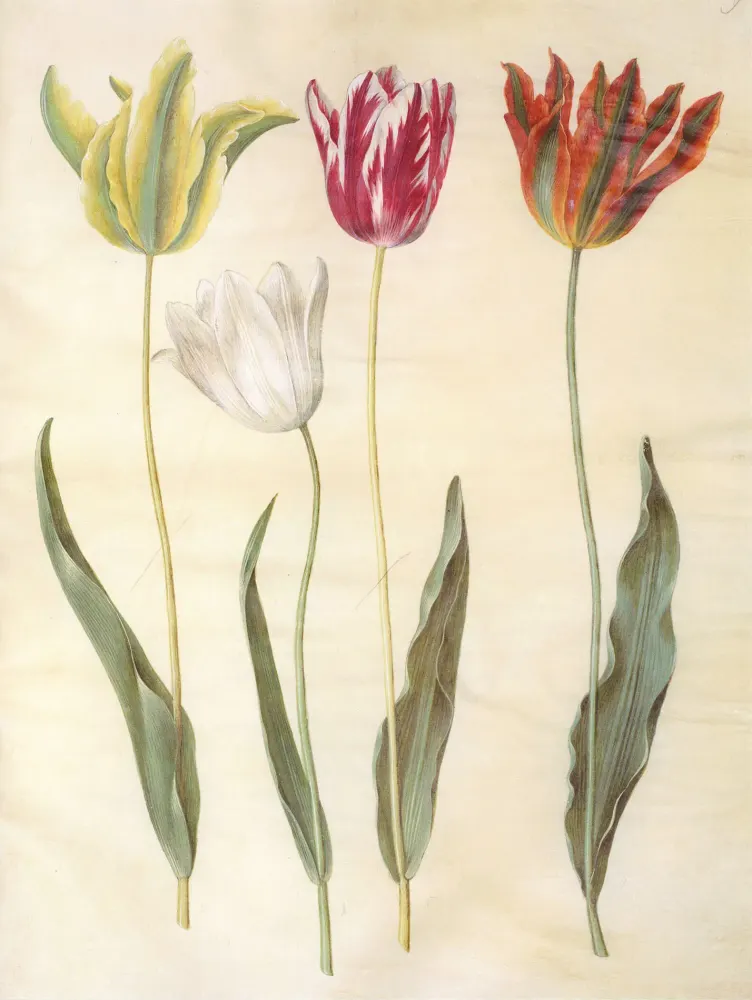
© Hans-Simon Holtzbecker · Public domain · Commons
Tulipa gesneriana
Toxic🐾Garten-Tulpe · (Tulipa gesneriana)
Lily family (Liliaceae)
Description
Tulipa gesneriana, the Didier's tulip or garden tulip, is a species of plant in the lily family, cultivated as an ornamental in many countries because of its large, showy flowers. This tall, late-blooming species has a single blooming flower and linear or broadly lanceolate leaves. This is a complex hybridized neo-species, and can also be called Tulipa × gesneriana.
🌿 Risk of confusion — read before wild-harvesting!
Confusion with edible onions has been described repeatedly.
External use only!
This plant must NOT be taken internally. Use only as compress, salve, or bath.
CONTRAINDICATED during pregnancy
No pharmacological application. Consumption of bulb or flower in pregnancy contraindicated due to gastroenteritis risk (electrolyte loss, dehydration, theoretical fetal impact via maternal hypovolaemia).
CONTRAINDICATED during breastfeeding
No pharmacological application. Tulipalin metabolites may theoretically pass into breast milk — data are entirely lacking. Consumption while breastfeeding is contraindicated.
CONTRAINDICATED for children
Children are particularly at risk because colourful tulip bulbs (stored in autumn) can easily be confused with edible onions and petals can be swallowed accidentally. Even small amounts can trigger severe gastrointestinal symptoms. Strictly store tulip bulbs out of reach of children.
- Rawuse.plant_part.bulbExternalFolk medicine
Classic dermatologically documented occupational risk 'tulip fingers' (Dutch 'tulpenvingers'): florists, bulb packers and horticultural workers with prolonged skin contact to tuliposide A during sorting and packing of tulip bulbs develop allergic contact dermatitis on fingertips, nail folds and palms. Clinical picture: dry, painful, fissured skin with scaling, sometimes paronychia and subungual hyperkeratosis. Mechanism: tuliposide A converts enzymatically to tulipalin A, an alpha-methylene-gamma-butyrolactone acting as a strong contact allergen. A standard patch-test allergen in occupational dermatology.
Preparation & dosage
[#src_wp_en_tulipa_gesneriana] [#src_wp_de_tulipa_gesneriana] [#src_hausarzt_tulipa_gesneriana]
- CompressFlowerExternalFolk medicine
Sporadically documented folk-medicinal use in rural regions of Anatolia (origin region of the garden tulip): crushed tulip flowers were locally applied to minor burns, insect stings and small skin irritations — a cooling, mechanical effect. No pharmacologically proven healing action. Because flowers also contain tuliposides, contact dermatitis is possible in sensitised individuals.
Preparation & dosage
[#src_wp_en_tulipa_gesneriana] [#src_pfaf_tulipa_gesneriana]
- RawFlowerExternalFolk medicine
In the Persian and Ottoman cultural sphere (16th-18th century) the tulip was primarily an ornamental and symbolic plant ('lale'); single herbals of that period mention an external use of the flowers as cooling poultice for skin irritations and small cuts. The documentation is vague and the use is regarded as purely historical today.
Preparation & dosage
[#src_wp_en_tulipa_gesneriana] [#src_pfaf_tulipa_gesneriana]
- Rawuse.plant_part.bulbExternalFolk medicine
Phytochemically documented antifungal property of tulipalin A and tulipalin B from tulip bulbs (especially against Botrytis cinerea, Fusarium spp. and some yeasts): the compounds act as part of the plant's chemical defence system against fungal infections of the bulb. There is no medical application in humans — data come from plant-pathology and agrochemical studies. Listed as a phytochemically interesting observation, not a therapeutic indication.
Preparation & dosage
[#src_wp_tulipalin_tulipa_gesneriana] [#src_wp_en_tulipa_gesneriana]
Historical documentation only — do NOT use
These internal applications are historically documented. This plant is highly toxic — self-treatment can cause severe poisoning or death. For documentation only, explicitly NOT a recommendation.
- Rawuse.plant_part.bulbInternalFolk medicine
Ethnobotanically documented emergency-food use of tulip bulbs during the Dutch Hunger Winter 1944/45 ('Hongerwinter'): after regular food supply collapsed in the occupied western Netherlands, authorities in The Hague and Amsterdam issued public instructions for eating tulip bulbs. The bulbs were peeled, the central sprout removed (it contains the highest tuliposide/tulipalin concentrations) and then boiled, roasted or ground as flour substitute. Flavour: bitter to soapy. Despite preparation, numerous gastroenteritis cases are documented. Today strictly historical — not a recommendation, as tulipalin A remains in residual amounts after any preparation.
Preparation & dosage
[#src_wp_hongerwinter_tulipa_gesneriana] [#src_wp_de_tulipa_gesneriana] [#src_rivm_tulipa_gesneriana]
- RawFlowerInternalFolk medicine
Petals of the garden tulip were occasionally used during the Dutch Hunger Winter 1944/45 too, but are less well documented than the bulbs. Today sometimes recommended in hobby-cook circles as an edible flower for decoration — not advisable because of tulipalin content, sensitised people can develop oral mucosal irritation.
Preparation & dosage
[#src_wp_hongerwinter_tulipa_gesneriana] [#src_wp_de_tulipa_gesneriana]