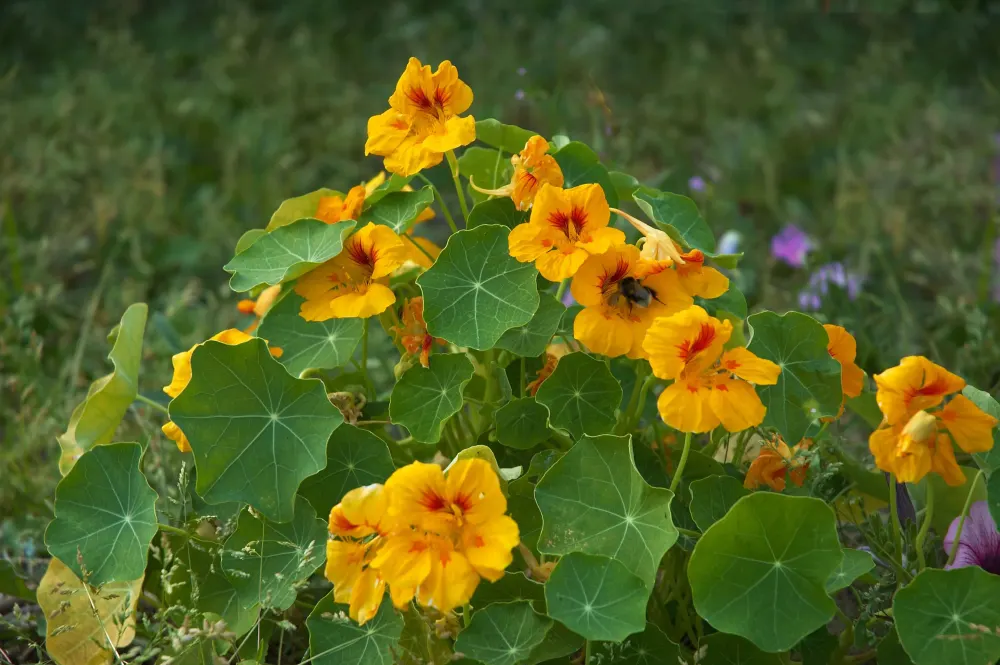
© Wouter Hagens · Public domain · Commons
Tropaeolum majus
CautionGroße Kapuzinerkresse · (Tropaeolum majus)
Nasturtium family (Tropaeolaceae)
Description
Tropaeolum majus, the garden nasturtium, nasturtium, Indian cress or monk's cress, is a species of flowering plant in the family Tropaeolaceae. An annual or a short-lived perennial with disc-shaped leaves and brilliant yellow, orange or red flowers, it is of cultivated, probably hybrid origin. It is not closely related to the genus Nasturtium.
- TeaAerial partsInternalTraditional use
Infusion of fresh or dried leaves and flowers for urinary tract infections. Benzyl isothiocyanate (BITC) derived from glucotropaeolin reaches therapeutically relevant concentrations in urine after oral intake and inhibits uropathogenic bacteria there.
Preparation & dosage
Pour 200 ml of boiling water over 2–3 g of dried leaves/flowers, steep covered for 10 minutes, strain. Drink 3 times daily.
- Dry amount
- 2–3 g
- Doses per day
- 3×
- Max duration
- 2 weeks
- TeaAerial partsInternalTraditional use
Tea from nasturtium herb (often combined with horseradish as in Angocin Anti-Infekt N) for acute respiratory tract infections. A clinical observational study shows effectiveness comparable to other phytopharmaceuticals for acute upper respiratory tract infections.
Preparation & dosage
Steep 2–4 g dried herb in 250 ml hot water for 10 minutes, strain.
- Dry amount
- 2–4 g
- Doses per day
- 3×
- TinctureAerial partsInternalTraditional use
Ethanolic tincture of fresh herb as a concentrated BITC source. Used in folk medicine for recurrent urinary tract infections. Volatile BITC is less stable in aqueous tea, so a tincture provides more consistent dosing.
Preparation & dosage
[#src_bitc_metabolites_2013] [#src_glucotropaeolin_bioavailability_2014]
- RawLeafInternalFolk medicine
Fresh leaves and flowers used as salad ingredient or garnish. Rich in vitamin C (approx. 130 mg/100 g), lutein, zeaxanthin, and glucotropaeolin. Plant source of antimicrobial sulfur compounds with a pleasantly spicy flavour.
[#src_wiki_en_tropaeolum] [#src_glucotropaeolin_biosynthesis_1996]
- CompressLeafExternalFolk medicine
Crushed fresh leaves applied as a poultice on minor wounds, skin blemishes, and insect stings. Local BITC release has antimicrobial and mildly anti-inflammatory effects. Folk medicinal use in Central Europe and South America.
- SalveAerial partsExternalFolk medicine
Oil macerate from flowers and leaves as a base for salves for skin problems. Traditionally used for acne, small abscesses, and poorly healing wounds.
Distribution in Europe
🪴 Grow at home
- ☀ Light
- full sun
- 💧 Water
- every few days
- 🌱 Soil
- Lean soil — otherwise only leaves, no flowers
- 🪴 Pot
- 25 cm
- ⭐ Difficulty
- ★☆☆ beginner
- 🐾 Pets
- pet-safe
Tips:
- Don't fertilise — too rich = many leaves, few flowers.
- Flowers and leaves peppery-spicy in salad.
- Self-seeding — seeds are caper substitute.
Care tips are general indoor-gardening recommendations, not scientific sources.
🤝 Permaculture Partners
In your garden, this plant acts as:
✨ Best symbiotic partners
- 🌿 Garlic Classic companion-planting partner.
- 🌿 Apium graveolens Classic companion-planting partner.
- 🌿 Calendula officinalis Classic companion-planting partner.
- 🌿 Cucumber Nasturtium deters cucumber pests.
- 🌿 Cucurbita pepo Nasturtium deters aphids and squash beetles.
- 🌿 Zucchini Nasturtium deters squash beetles.
- 🌿 Eruca sativa Classic companion-planting partner.
- 🌿 Matricaria chamomilla Classic companion-planting partner.
- 🌿 Parsley Classic companion-planting partner.
- 🌿 Rosemary Classic companion-planting partner.
- 🌿 Tomato Nasturtium pulls aphids away from tomato (trap plant).
- 🌿 Tagetes patula Both deter soil pests and are edible.
- 🌿 Thymus vulgaris Classic companion-planting partner.
- 🌿 Maize Nasturtium as aphid trap protects maize.
⚠️ Better not planted together
- 🥬 Fennel Fennel is strongly allelopathic and inhibits nearly all neighbours.
📦 Part of these planting sets:
Source: Gertrud Franck, Gesunder Garten durch Mischkultur (1980, eigene Kuration) | Helga und Margarete Langerhorst, Mein gesunder Naturgarten (eigene Kuration) | Klassische Mischkultur-Tradition (Three Sisters, Bauernregel)