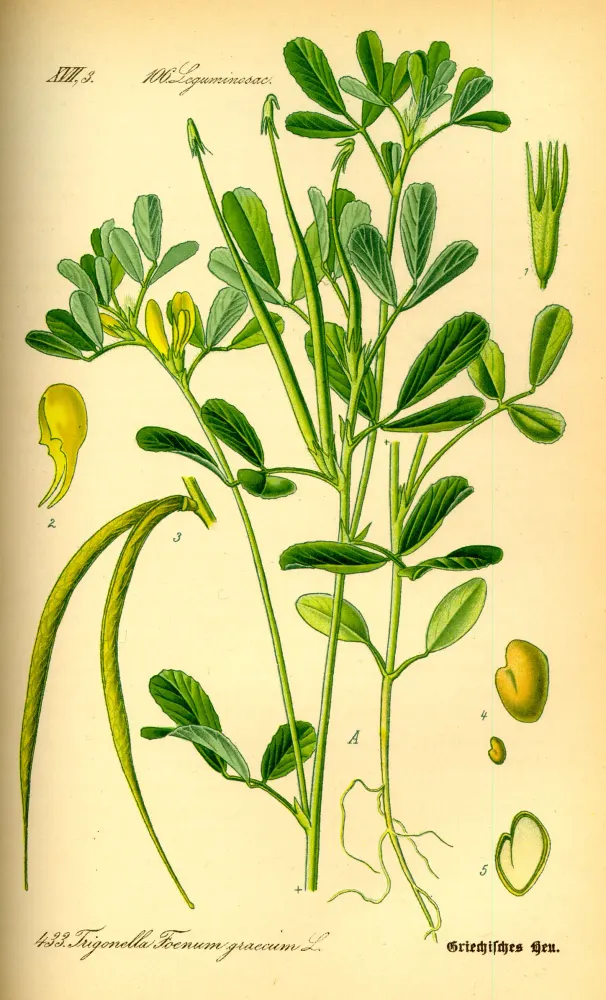
© Prof. Dr. Otto Wilhelm Thomé Flora von Deutschland, Österreich und der Schweiz 1885, Gera, Germany · Public domain · Commons
Fenugreek
CautionBockshornklee · (Trigonella foenum-graecum)
Legume family (Fabaceae)
Description
Fenugreek is an annual plant in the family Fabaceae, with leaves consisting of three small obovate to oblong leaflets. It is cultivated worldwide as a semiarid crop. Its leaves and seeds are common ingredients in dishes from the Indian subcontinent, and have been used as a culinary ingredient since ancient times.
CONTRAINDICATED during pregnancy
Contraindicated in therapeutic doses throughout pregnancy. Galactomannans and steroidal saponins (diosgenin) have documented uterotonic action in animal studies and traditional use — potential labour-stimulating effect. Culinary amounts (as spice) are considered safe, but therapeutic doses (tea, tincture, capsules) must be avoided.
- TeaSeedInternalCommission E
Kommission E positive (internal): fenugreek seed infusion for loss of appetite and mild digestive complaints — mucilage-rich drug with bitter and amaroid components.
Preparation & dosage
SEED INFUSION (Kommission E, internal use): 2–3 g coarsely ground or lightly crushed fenugreek seeds in 250 ml boiling water, covered, steep 10–15 min, strain. 3× daily, freshly prepared, before meals. Daily dose 6–9 g (Kommission E: 6 g/day internally). Indication: loss of appetite and supportive treatment of mild gastrointestinal complaints. Bitter, maple-syrup-like flavour (sotolon) — intense taste, soften with honey if desired. Limit to 4 weeks per Kommission E; consult doctor if complaints persist.
- Dry amount
- 2–3 g
- Doses per day
- 3×
- Max duration
- 4 weeks
[#src_kommission_e_trigonella] [#src_ema_hmpc_trigonella] [#src_escop_trigonella]
- CompressSeedExternalCommission E
Kommission E positive (external): fenugreek seed poultice as a warming compress for local inflammation — classic European folk medicine and Kommission E indication.
Preparation & dosage
SEED POULTICE / COMPRESS (Kommission E, external use): Mix 30–50 g fine fenugreek seed flour with hot water into a thick, smooth paste. Allow to cool to approx. 40–42 °C. Spread paste generously on clean linen or gauze, apply to the affected area (local inflammation, furuncles, abscesses in healing phase), cover with another cloth and leave on for 20–30 min. Repeat 2× daily. Do NOT apply to open wounds or sensitive/irritated skin. Clean skin thoroughly after use — fenugreek paste stains skin yellow and leaves characteristic sotolon scent.
- Dry amount
- 30–50 g
- Doses per day
- 2×
- Max duration
- 2 weeks
[#src_kommission_e_trigonella] [#src_ema_hmpc_trigonella] [#src_wichtl_trigonella]
- TinctureSeedInternalTraditional use
Traditional tincture as a bitter (amarum) for loss of appetite and digestive weakness — complementary alternative to the seed infusion form.
Preparation & dosage
TINCTURE (DER 1:5 in 40–60 % ethanol): 2–4 ml (~40–80 drops) 3× daily diluted in water, 15–30 min before meals. Traditional use as a bitter (amarum) to stimulate appetite and support digestion. Onset after 1–2 weeks of regular use. Consult doctor before use if liver disease, antidiabetics or anticoagulants are involved. Note ethanol content — not for alcohol dependence.
- Liquid amount
- 2–4 ml
- Doses per day
- 3×
- Max duration
- 4 weeks
[#src_escop_trigonella] [#src_ema_hmpc_trigonella] [#src_wichtl_trigonella]
- SpiceSeedInternalFolk medicine
Food and spice — seeds, sprouts and leaves established in Southern European, Arabic and South Asian cuisine since antiquity; WHO lists the nutritive use.
Preparation & dosage
SPICE / FOOD: Fenugreek seeds (whole or ground) used as a spice in numerous cuisines of southern Europe, the Middle East and South Asia — component of curry powder, ras el hanout, Ethiopian berbere. Toasting (dry, medium heat 1–2 min) reduces bitterness and develops nutty-caramel aroma. Seed sprouts used as a vitamin-rich side dish or salad addition. Leaves (fresh or dried, 'methi') as vegetable or herb in Indian and North African cuisine. WHO recommends 5–30 g seeds daily for dietary/nutritional use. Sotolon content may temporarily cause a maple-syrup-like body odour.
[#src_who_trigonella] [#src_pfaf_trigonella] [#src_wp_de_trigonella]
- TeaSeedInternalTraditional use
Mucilage-rich cold or warm infusion of fenugreek seeds as a demulcent (mucilaginosus) — traditional use for gastrointestinal irritation and metabolic support.
Preparation & dosage
MUCILAGE DECOCTION / COLD MACERATION (traditional use): 5–10 g coarsely ground fenugreek seeds in 250 ml cold water, leave to soak 3–5 h (mucilage extraction), or infuse in hot water covered for 15–20 min. Strain. 2× daily warm or cold. Cold maceration extracts the soothing mucilaginous galactomannans especially gently — preferred preparation for gastrointestinal irritation and IBS tendency. Traditionally also used for metabolic support and joint complaints.
- Dry amount
- 5–10 g
- Doses per day
- 2×
- Max duration
- 4 weeks
[#src_escop_trigonella] [#src_wichtl_trigonella] [#src_who_trigonella]
- RawSeedInternalFolk medicine
Soaked seeds and sprouts — folk nutritive use as digestive accompaniment with vitamins and enzymes.
Preparation & dosage
SOAKED SEEDS / SPROUTS (folk use, nutritive): soak 1–2 tbsp whole fenugreek seeds overnight in water, drain in the morning and eat raw, or sprout for 2–3 days (rinse daily). Soaked seeds are less bitter and more digestible than dry raw seeds. Sprouts are rich in vitamins (C, K, folate) and enzymes. Traditionally consumed in the Middle East and India as breakfast or yoghurt topping. Note: do not consume seeds in excessive quantities — high saponin concentration may cause flatulence and gastrointestinal irritation.
[#src_pfaf_trigonella] [#src_wp_en_trigonella] [#src_who_trigonella]
- TeaLeafInternalFolk medicine
Folk leaf infusion (methi tea) as a general tonic and digestive tea — rooted in North African and South Asian tradition.
Preparation & dosage
LEAF INFUSION (folk use, methi tea): 1–2 tsp dried fenugreek leaves ('methi') in 200 ml boiling water, covered, steep 7–10 min, strain. 2× daily warm. Folk use in North Africa and South Asia as a general tonic and digestive support. Leaves contain less galactomannan than seeds but are richer in flavonoids and vitamins. Milder in taste than seed preparations — less bitter, slightly herbal.
- Dry amount
- 1–2 g
- Doses per day
- 2×
- Max duration
- 3 weeks
[#src_pfaf_trigonella] [#src_wp_de_trigonella] [#src_who_trigonella]
- CompressLeafExternalFolk medicine
Folk leaf compress for mild skin inflammation and insect bites — North African and Arab folk medicine.
Preparation & dosage
LEAF COMPRESS (folk use, external): spread fresh or soaked dried fenugreek leaves on clean cloth, apply to affected skin area (mild inflammation, insect bites) for 15–20 min. Leaves contain flavonoids and mucilages with skin-soothing action. Traditional use in North African and Arab folk medicine. Consult a doctor if skin irritation worsens or signs of infection appear.
Distribution in Europe
🤝 Permaculture Partners
In your garden, this plant acts as:
✨ Best symbiotic partners
- 🌿 Cucurbita pepo Classic companion-planting partner.
- 🌿 Summer savory Classic companion-planting partner.
⚠️ Better not planted together
- 🥬 Garlic Classic companion-planting partner.
Source: Gertrud Franck, Gesunder Garten durch Mischkultur (1980, eigene Kuration) | Helga und Margarete Langerhorst, Mein gesunder Naturgarten (eigene Kuration)