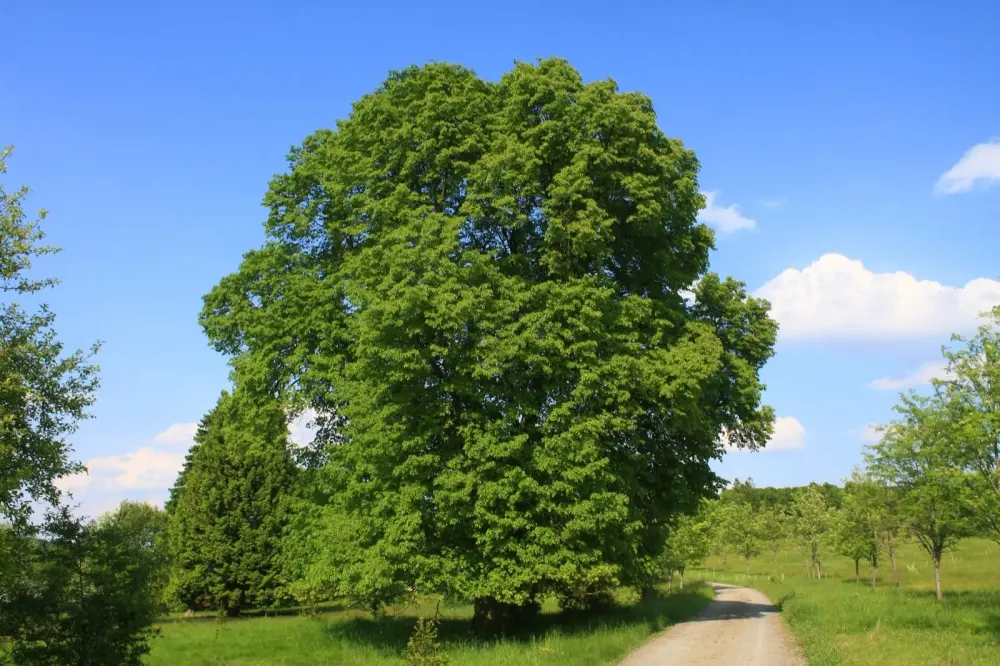
© Antiope05411 · CC BY-SA 3.0 · Commons
Tilia platyphyllos
Sommerlinde · (Tilia platyphyllos)
Mallow family (Malvaceae)
Description
Two to four weeks earlier than its sister species the small-leaved lime, this mallow-family tree opens its flowers, typically already in May – which is why the EMA monograph grants it equal status as a medicinal drug. The pale-yellow flowers make a classic diaphoretic tea for the onset of a cold, drunk as hot as possible; the effect comes from mucilage such as arabinogalactans and galactomannans, which soothe irritated throat mucosa, supported by flavonoids like tiliroside and rutin. A gargle made from the infusion further eases sore throat, while a warm full bath with the flowers – thanks to the honey-sweet essential oil containing farnesol – is traditionally used for nervous restlessness and sleep difficulties. The flowers are considered very well tolerated and established as tea from age four; in acute heart failure the sweating effect should only be used after medical consultation. An in-vitro finding on pancreatic lipase inhibition remains of unclear clinical relevance.
Traditional diaphoretic tea for the onset of a cold. T. platyphyllos flowers 2–4 weeks earlier than T. cordata and provides pharmacopoeially equivalent flowers. Mucilage and flavonoids soothe; sweating depends on hot liquid and body warmth.
Preparation & dosage
DIAPHORETIC TEA: 1.5–1.8 g + 150 ml boiling water, steep 5–10 min covered, strain. Drink as hot as possible, 2–4 cups/day, one before bed. Wrap warm afterwards. Up to ~6 g/day.
- Dry amount
- 1.5–1.8 g
- Doses per day
- 4×
- Max duration
- 1 weeks
⚠ Age restriction: ≥ 4 years — Per EMA from 4 years.
Soothing tea for dry irritative cough and throat irritation. T. platyphyllos shares the same pharmacological profile as T. cordata — EMA monograph covers both species.
Preparation & dosage
SOOTHING TEA: 1.5–1.8 g + 150 ml boiling water, steep 5–10 min covered. Drink warm in small sips 2–3× daily. Honey may enhance the soothing mucous film.
- Dry amount
- 1.5–1.8 g
- Doses per day
- 3×
- Max duration
- 1 weeks
⚠ Age restriction: ≥ 4 years — From 4 years.
Traditional relaxing bath for nervous restlessness and sleep difficulties. Essential oil components and flavonoids of T. platyphyllos act mildly calming through the skin.
Preparation & dosage
RELAXING BATH: 20–50 g + 1–2 L boiling water, steep 15 min, add to bath at 37 °C. 15–20 min ideally before bed. Pat dry and rest warm.
- Dry amount
- 20–50 g
- Doses per day
- 1×
- Max duration
- 2 weeks
⚠ Age restriction: ≥ 12 years — Full baths from 12 years.
Traditional tincture for nervous palpitations, mildly elevated blood pressure and anxiety. Tilia extracts show GABA-ergic activity and benzodiazepine receptor binding in vitro.
Preparation & dosage
TINCTURE (1:5 in 25% ethanol): 1–2 ml 3× daily diluted in a little water. Traditional for nervous palpitations and inner restlessness. Pharmacy preparation recommended.
- Liquid amount
- 1–2 ml
- Doses per day
- 3×
Folk use for stress-related stomach cramps and digestive complaints. Antispasmodic properties of flavonoids relax intestinal smooth muscle.
Preparation & dosage
AFTER-MEAL TEA: 1.5–2 g + 200 ml boiling water, steep 10 min. Drink warm after meals for stress-related digestive complaints.
- Dry amount
- 1.5–2 g
- Doses per day
- 2×
Folk gargle for sore throat and pharyngitis. Mucilage coats irritated mucosa protectively; tannins act mildly astringent.
Preparation & dosage
GARGLE: 2–3 g + 200 ml boiling water, steep 10 min, strain, cool to lukewarm. Gargle 1–2 min 2–3× daily for sore throat and pharyngitis — spit out afterwards.
- Dry amount
- 2–3 g
- Doses per day
- 3×
Large-leaved linden flowers considered very well tolerated. Beyond 1 week or high fever/dyspnoea: doctor. Diaphoretic tea not in acute cardiac insufficiency. Very old flowers reportedly develop narcotic properties — use freshly dried material only. Allergic reactions rarely possible. In-vitro pancreatic lipase inhibition noted — clinical relevance unknown.
⏱ Max continuous use: 1 weeks
Insufficient safety data. Not recommended as medicinal tea as a precaution.
Insufficient data on safety during lactation.
Per EMA tea from 4 years. Medical advice for persistent symptoms under 12. Full baths from 12 years.
Contraindications
- Hypersensitivity to linden flowers or other Tiliaceae.
- Children under 4 years (tea).
- Acute cardiac insufficiency: diaphoretic tea only with medical advice.
Harvested part: flowers
- Time of day:
- On sunny, dry mornings after dew has dried. T. platyphyllos flowers 2–4 weeks earlier than T. cordata — typically May to mid-June.
- Drying:
- Harvest whole flower clusters WITH tongue-shaped bracts — pharmacopoeial requirement. Harvest just after full bloom while flowers are pale yellow. Spread single-layer in shade, dry quickly at 25–35 °C. Never in direct sun.
- Storage:
- 12 months — Airtight, dark, dry — in glass or paper containers. Use within 12 months.
- Schleimstoffe (Arabinogalaktane, Galaktomannane)MucilageContent: ~10 %Flower
Acidic arabinogalactans and galactomannans. Form soothing protective film on mucosa. Primary active group for antitussive and demulcent effects.
- TilirosidFlavonoidFlower
Characteristic lead flavonoid of Tiliae flos. Kaempferol-3-O-[6''-p-coumaroyl]-glucoside. Antioxidant, mildly anti-inflammatory. Confirmed in T. platyphyllos flowers.
- Quercetin-Glykoside (Rutin, Hyperosid, Isoquercitrin)FlavonoidFlower
Antioxidant and vessel-stabilising. Contribute to antispasmodic and mildly anti-inflammatory effects.
- Kaempferol-Glykoside (Astragalin)FlavonoidFlower
Mildly antioxidant. Alongside tiliroside the second important kaempferol representative in linden flowers.
- Phenolsäuren (Chlorogensäure, p-Cumarsäure, Kaffeesäure)Phenolic acidFlower
Antioxidant. p-Coumaric acid discussed in connection with diaphoretic and antispasmodic effects.
- Ätherisches Öl (Farnesol, Citral, Eugenol, Limonene, Nerol, α-Pinen)Essential oilContent: 0,02–0,1 %Flower
Responsible for the characteristic honey-sweet linden scent. Mildly sedative and antiseptic.
- Kondensierte Gerbstoffe (Procyanidine)TanninContent: ~2 %Flower
Mildly astringent on mucosa. Mildly antimicrobial.
- [1]MonographEMA/HMPC/337066/2011 — European Union herbal monograph on Tilia cordata Miller, T. platyphyllos Scop., T. x vulgaris Heyne or their mixtures, flos (Final, 10 July 2012)(accessed: 2026-05-18)
- [5]MonographTilia: A Comprehensive Overview of Pharmaceutical Applications (PTcell, Ogbonna/Kelvas)(accessed: 2026-05-21)
- [4]BookPlants For A Future — Tilia platyphyllos(accessed: 2026-05-21)
- [2]WikipediaSommerlinde (Wikipedia DE)(accessed: 2026-05-21)
- [3]WikipediaTilia (Wikipedia EN)(accessed: 2026-05-21)