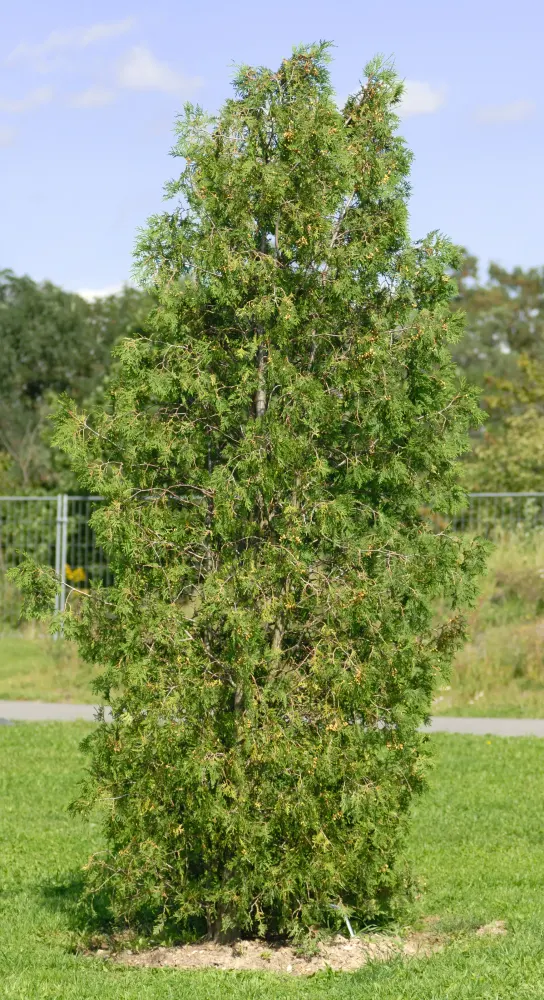
© André Karwath aka Aka · CC BY-SA 2.5 · Commons
Thuja occidentalis
Caution🐾Abendländischer Lebensbaum · (Thuja occidentalis)
Cypress family (Cupressaceae)
Description
Thuja occidentalis, also known as northern white-cedar, eastern white-cedar, or arborvitae, is an evergreen coniferous tree, in the cypress family Cupressaceae, which is native to eastern Canada and much of the north-central and northeastern United States. It is widely cultivated as an ornamental plant. It is not to be confused with Juniperus virginiana.
🌿 Risk of confusion — read before wild-harvesting!
TOXIC (thujone content) — essential oil, twigs, leaves, cones. The α/β-thujone content in the dried herb is ca. 7.6 mg/g (α:β ratio = 85:15), in the essential oil 1.4–4 % by mass. Thujone is a GABA-A antagonist and neurotoxic — overdose symptoms: gastrointestinal complaints, nausea, vomiting, hypersalivation, tachycardia, hypotension, lowered seizure threshold, generalised seizures, respiratory depression, in severe cases hepatic damage and death. Toxic oral thujone dose: ca. 30 mg/kg body weight. Skin contact with the essential oil or fresh plant sap can trigger allergic contact dermatitis. When trimming large amounts of hedge, wear gloves and respiratory protection. Internal self-use of the pure plant or essential oil is life-threatening. Esberitox® (finished product with a low-dose Thuja fraction, ca. 0.08 mg thujone/kg body weight at daily dose) is authorised in Germany and acceptable when following the package insert. On suspicion of poisoning: IMMEDIATELY call emergency services and poison control. There is NO EMA HMPC monograph for Thuja occidentalis as a single herb — all indications are folk-medicinal or homeopathic; clinical studies exist only for combination products.
CONTRAINDICATED during pregnancy
Thujone has documented uterotropic (emmenagogue/abortive) properties and crosses the placental barrier. Internal use and large-area external use in pregnancy strictly contraindicated — even low homeopathic potencies (D2–D6) of the mother tincture should be avoided. Esberitox® is not recommended in pregnancy.
CONTRAINDICATED during breastfeeding
Thujone passes into breast milk and can lower the infant's seizure threshold and cause sedation or agitation. Breastfeeding: internal use and Esberitox® contraindicated.
CONTRAINDICATED for children
Children under 12 are particularly sensitive to thujone — lower seizure threshold. Pure Thuja teas, tinctures or essential oil: no use under 12 years. Esberitox® N is authorised as a finished medicinal product from age 4 in reduced dose. Homeopathic preparations from D12 onward possible on medical prescription.
Critical drug interactions with:
Antiepileptika (Phenytoin, Carbamazepin, Valproat, Lamotrigin) · Immunsuppressiva (Ciclosporin, Tacrolimus, Methotrexat, Glukokortikoide hochdosiert, Biologika TNF-α-Blocker)
- TinctureLeafExternalTraditional use
Traditional external use of Thuja mother tincture (Thuja occidentalis Ø, ethanolic fresh-plant extract) for local treatment of common warts (Verrucae vulgares) and genital warts (Condylomata acuminata). Used in Western European phytotherapy and homeopathy since the 19th century (Hahnemann). Mechanism: antiviral (inhibition of viral replication, documented in vitro for HSV-1/2) plus a local cytotoxic component via thujone. No EMA HMPC monograph for the indication — therefore `traditional`.
Preparation & dosage
MOTHER TINCTURE (Thuja occidentalis Ø, 1:10 in 60–70 % ethanol, fresh young shoot tips): 1–2× daily one drop applied directly to the wart, protect surrounding skin with petroleum jelly. Treatment duration: until healing, typically 4–12 weeks. Not on mucous membranes, not over large areas. For genital warts only under medical supervision. Internal use of the mother tincture is not recommended due to thujone content.
⚠ Age restriction: ≥ 12 years — From 12 years old externally on small skin areas under supervision. No use in toddlers, pregnancy or breastfeeding.
[#src_naser_2005_thuja_occidentalis] [#src_wp_en_thuja_occidentalis] [#src_pfaf_thuja_occidentalis]
- TinctureLeafInternalClinical trial
Clinically documented exclusively as the combination product Esberitox® N (Schaper & Brümmer): Echinacea purpurea root + Baptisia tinctoria root + Thuja occidentalis shoot tips. Several randomised, double-blind, placebo-controlled studies (e.g. Henneicke-von Zepelin 1999, n=263) showed faster symptom relief in acute common cold versus placebo (P < 0.05). Adjunctive use alongside antibiotic therapy in bronchitis documented. Important: efficacy is primarily attributed to Echinacea/Baptisia polysaccharides — the Thuja component contributes immunomodulating glycoproteins. There is NO EMA HMPC monograph for Thuja occidentalis as a single herb; the `clinical_trial` evidence level refers to the combination product.
Preparation & dosage
FINISHED MEDICINAL PRODUCT: Esberitox® N (or Compact) — dose per package insert, typically adults 3× daily 3 tablets at first signs of cold. Limit use to 1–2 weeks. Do not self-prepare the Thuja component from the garden — thujone content is unpredictable. Over-the-counter pharmacy product.
⚠ Age restriction: ≥ 12 years — Esberitox® N from 4 years in reduced dosage; pure Thuja preparations internally not for children and adolescents.
[#src_henneicke_1999_thuja_occidentalis] [#src_naser_2005_thuja_occidentalis]
- TeaLeafInternalFolk medicine
Historical folk use as a scurvy cure: Jacques Cartier rescued his crew in the winter of 1535–1536 on the St. Lawrence River with the 'annedda' infusion of Thuja twigs and bark shown to him by the Stadaconan Iroquois ('Donnacona'). The high vitamin C content of the young shoot tips (seasonal up to ca. 50 mg/100 g) cured the scurvy symptoms within days. Today medically obsolete (vitamin C readily available) and not recommended as a routine tea due to thujone content.
Preparation & dosage
HISTORICAL: pour boiling water over young shoot tips, brief steep. Today NO recommendation as a vitamin C source — prolonged consumption carries a thujone seizure risk (see safety note). Purely documentary.
[#src_wp_en_thuja_occidentalis] [#src_naser_2005_thuja_occidentalis] [#src_pfaf_thuja_occidentalis]
- TinctureLeafInternalFolk medicine
Homeopathic use (Thuja occidentalis D6–C30) as a constitutional remedy for 'sycosis' according to Hahnemann — symbolically assigned indications: warts, skin growths, chronic rhinitis, post-vaccination complaints ('vaccine damage'), genital complaints. From D12 onward no pharmacologically active thujone amounts remain. Classical prescription by homeopathic physicians; no evidence-based efficacy beyond placebo demonstrated.
Preparation & dosage
Homeopathic potentization from D6 onward — no direct thujone effect. Use exclusively on medical or homeopathic prescription. Globules or drops, individual dosing.
[#src_wp_de_thuja_occidentalis] [#src_naser_2005_thuja_occidentalis]
- SalveLeafExternalFolk medicine
Traditional Indigenous and folk use of Thuja leaf pastes and salves in North America: Ojibwe, Algonquian and other First Nations used infusions and poultices of young twigs for rheumatism, swollen hands, joint pain, headaches and inflamed skin areas ('Nookomis Giizhik' — Grandmother Cedar). External use in liniment or salve format, typically with bear fat or lard. Today replaced by standardised topical antirheumatics; ethnobotanically documented.
Preparation & dosage
Chop fresh young shoot tips, infuse in warm fat or vegetable oil (e.g. olive oil) at 50–60 °C for ca. 30 minutes, strain — salve base. Apply thinly 1–2× daily, never on open wounds or in case of thujone sensitivity. Self-preparation only in small quantities — thujone content rises at higher temperatures.
[#src_wp_en_thuja_occidentalis] [#src_pfaf_thuja_occidentalis]
- InhalationLeafExternalFolk medicine
Folk fumigation and steam inhalation with Thuja shoot tips for colds, blocked nose and bronchitis — mechanism: secretolytic via the essential oil (monoterpenes, thujone fraction). In Ojibwe tradition ritual fumigation for cleansing and spiritual practice. Today not recommended due to thujone toxicity in prolonged use — even inhalation can be problematic for sensitive individuals or children.
Preparation & dosage
Pour boiling water over a small handful of fresh or dried shoot tips, inhale under a towel for 5–10 minutes — max. 1–2× daily, not in asthma, not in children under 12, not in pregnancy.
[#src_wp_en_thuja_occidentalis] [#src_pfaf_thuja_occidentalis]