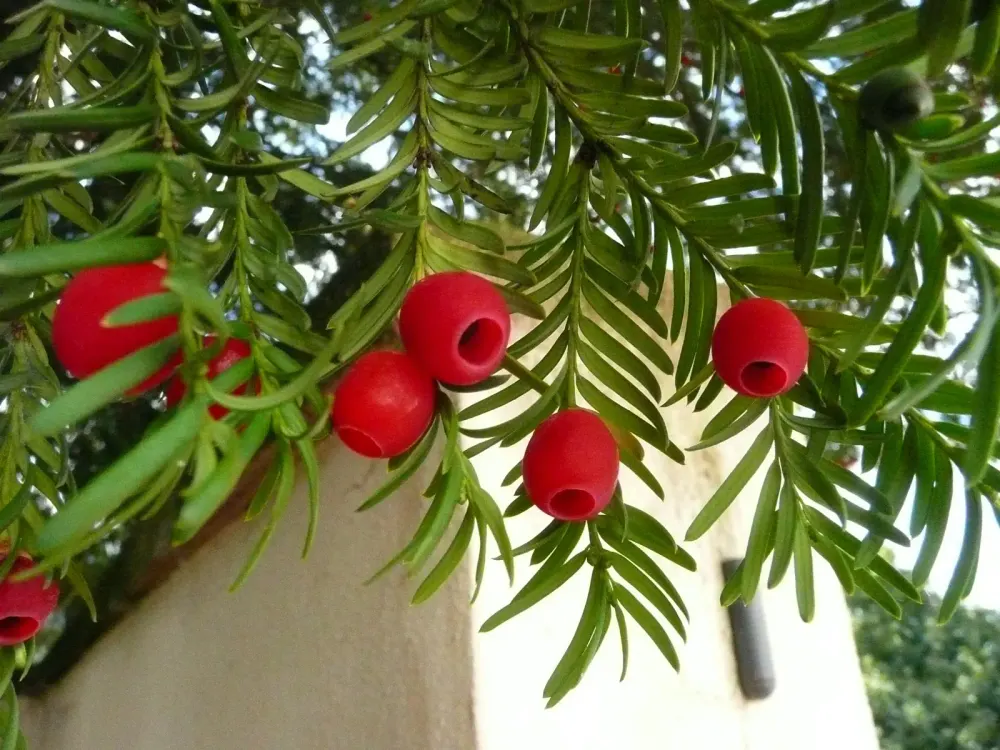
© 4028mdk09 · CC BY-SA 3.0 · Commons
Taxus baccata
Toxic🐾Europäische Eibe · (Taxus baccata)
Yew family (Taxaceae)
Description
Taxus baccata is an Old World species of evergreen tree in the family Taxaceae. It is the tree originally known as yew, though to distinguish it from related species it is sometimes called common yew, European yew, or, in North America, English yew. It is a woodland tree in its native range, including much of Eurasia and Northwest Africa.
🌿 Risk of confusion — read before wild-harvesting!
HIGHLY TOXIC — LIFE-THREATENING. Taxus baccata contains taxine A and B (cardiotoxic alkaloids) that can cause death even in small amounts. All plant parts except the red aril are toxic. Symptoms of poisoning: dizziness, vomiting, bradycardia, cardiac arrhythmia, cardiac arrest. NO self-application in any form. Paclitaxel as a medicine exclusively under oncological supervision. In case of poisoning: call emergency services (112) and poison control immediately.
CONTRAINDICATED during pregnancy
Taxine alkaloids are teratogenic and abortifacient. All plant applications during pregnancy are absolutely contraindicated. Even clinical paclitaxel is generally contraindicated in pregnancy.
CONTRAINDICATED during breastfeeding
Taxines may pass into breast milk. All plant applications during lactation are absolutely contraindicated.
CONTRAINDICATED for children
Particularly vulnerable: children are highly sensitive to taxine poisoning. Even a few needles or seeds can be fatal in children. Garden yew hedges represent a significant poisoning risk.
Critical drug interactions with:
Antiarrhythmika / Herzglykoside
- RawWhole plantExternalFolk medicine
The yew is considered one of the oldest culturally significant plants of Europe, carrying deep mythological meaning. As an evergreen, centuries-old tree it symbolises death and rebirth. Typical churchyard plant in Britain and Ireland — clearings around old churches harbour specimens up to 4,000 years old. No medicinal application; ethnobotanical documentation.
Preparation & dosage
Historical documentation only — do NOT use
These internal applications are historically documented. This plant is highly toxic — self-treatment can cause severe poisoning or death. For documentation only, explicitly NOT a recommendation.
- TinctureLeafInternalClinical trial
Paclitaxel (Taxol), semi-synthetically derived from 10-deacetylbaccatin III (from needles of Taxus baccata and T. brevifolia), is a clinically established cytotoxic drug for ovarian carcinoma, breast cancer, and NSCLC. The purified compound is not applied from the plant directly — this entry documents the pharmaceutical origin of the active substance. Self-treatment with yew preparations is strictly contraindicated.
Preparation & dosage
- TinctureLeafInternalFolk medicine
Homeopathic preparations from Taxus baccata (Taxus mother tincture, potencies) were used in the 19th century according to the homeopathic drug picture for conditions with bladder and kidney irritation as well as gout. No clinical efficacy demonstrated. To be distinguished from conventional paclitaxel.
Preparation & dosage
- RawFruitInternalFolk medicine
The red aril (fleshy cup) of the yew is the ONLY non-toxic part of the plant and was occasionally eaten by children. WARNING: The seed inside is highly toxic (taxines). In medieval folk medicine, minute amounts of yew berries were used for heart conditions — a practice that is today absolutely contraindicated and dangerous.
Preparation & dosage
- RawLeafInternalFolk medicine
WARNING — HIGHLY TOXIC. Historical records describe yew needles being used as an abortifacient and for self-poisoning (ancient Romans, Celtic warriors before capture). Lethal dose for adults: approx. 50–100 g needles. Taxine A and B inhibit cardiac calcium and sodium channels; death by cardiac arrest. No therapeutic benefit from self-application.
Preparation & dosage
[#src_taxus_poisoning_extracorporeal] [#src_taxus_toxine_1931]