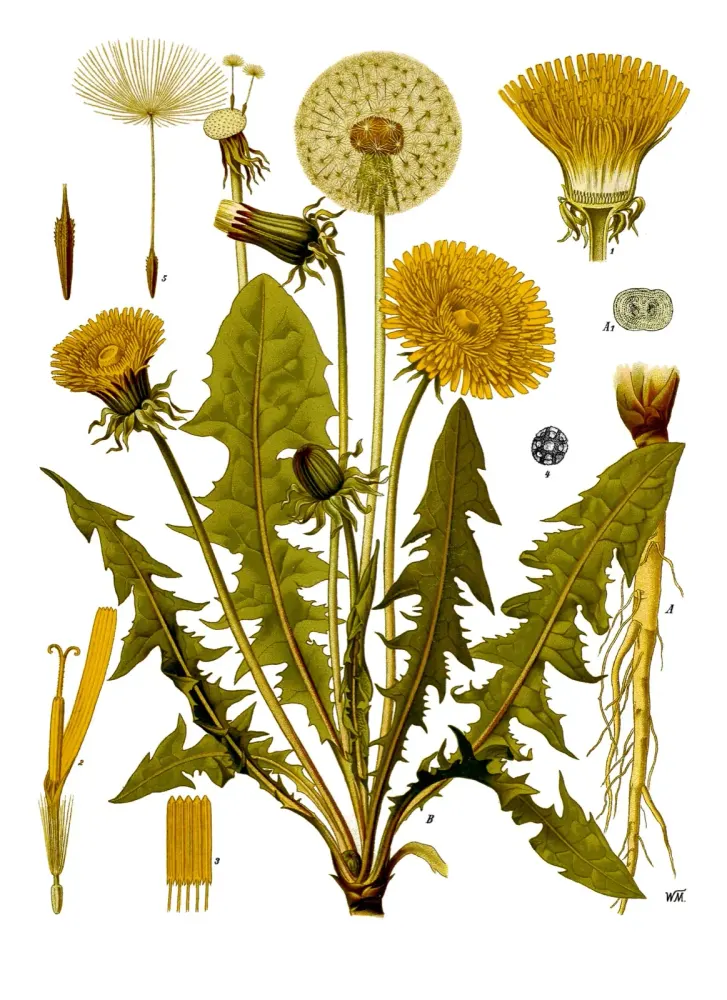
© Walther Otto Müller · Public domain · Commons
Taraxacum officinale
CautionGewöhnlicher Löwenzahn · (Taraxacum officinale)
Daisy family (Asteraceae)
Description
Taraxacum officinale, the dandelion or common dandelion, is a herbaceous perennial flowering plant in the daisy family, Asteraceae. The common dandelion is well-known for its yellow flower heads that turn into round balls of many silver-tufted fruit, which disperse in the wind. These balls are sometimes called "clocks" or "blowballs".
CONTRAINDICATED for children
Not for children under 12. Salad amounts OK.
- TeaRootInternalTraditional use
Classic bitter tea for digestive complaints.
Preparation & dosage
DECOCTION: 3–4 g + 150–250 ml cold water, boil and simmer 10–15 min. 3× daily before meals.
- Dry amount
- 3–4 g
- Doses per day
- 3×
- Max duration
- 2 weeks
⚠ Age restriction: ≥ 12 years — Per EMA from 12 years.
- TeaRootInternalTraditional use
Spring flushing cure.
Preparation & dosage
DECOCTION for urinary flushing: 3–4 g. Drink ≥ 2 L water/day.
- Dry amount
- 3–4 g
- Doses per day
- 3×
- Max duration
- 2 weeks
⚠ Age restriction: ≥ 12 years — From 12 years.
- TeaLeafInternalTraditional use
Leaf tea for urinary flushing — traditional spring cure.
Preparation & dosage
LEAF INFUSION: 4–10 g + 150–250 ml boiling water. 3× daily with ≥ 2 L water.
- Dry amount
- 4–10 g
- Doses per day
- 3×
- Max duration
- 2 weeks
⚠ Age restriction: ≥ 12 years — From 12 years.
- RawLeafInternalFolk medicine
Edible wild vegetable, traditional spring tonic.
Preparation & dosage
SPRING SALAD: Young leaves before flowering.
- Doses per day
- 1×
[#src_wp_de_taraxacum_officinale] [#src_wp_en_taraxacum_officinale]
- TinctureRootInternalTraditional use
Concentrated liquid extract as bitter drops.
Preparation & dosage
LIQUID EXTRACT: 90 drops 3× daily before meals in water.
- Liquid amount
- 1–3 ml
- Doses per day
- 3×
- Max duration
- 2 weeks
⚠ Age restriction: ≥ 18 years — Alcohol-containing tinctures not under 18.