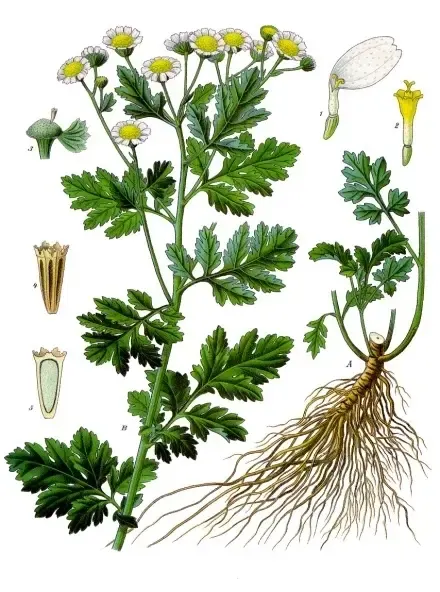
© Franz Eugen Köhler, Köhler's Medizinal-Pflanzen · Public domain · Commons
Tanacetum parthenium
CautionMutterkraut · (Tanacetum parthenium)
Daisy family (Asteraceae)
Description
Tanacetum parthenium, known as feverfew, is a flowering plant in the daisy family, Asteraceae. It may be grown as an ornament, and may be identified by its synonyms, Chrysanthemum parthenium and Pyrethrum parthenium. Having its origin in the Balkans region, it is now distributed worldwide.
CONTRAINDICATED during pregnancy
CONTRAINDICATED. Feverfew has documented emmenagogue and uterine-stimulating effects (parthenolide inhibits platelet aggregation and stimulates smooth muscle) — increased risk of miscarriage and premature labour. Per EMA, Kommission E, and ESCOP, do not use in pregnancy.
CONTRAINDICATED during breastfeeding
CONTRAINDICATED. Sesquiterpene lactones (especially parthenolide) may pass into breast milk and cause colic and irritability in infants. EMA and ESCOP recommend avoiding during lactation.
CONTRAINDICATED for children
Per EMA, not for children and adolescents under 18 — insufficient safety data. For children with migraine, always seek paediatric specialist advice.
- RawLeafInternalTraditional use
Traditional daily intake of fresh leaves for migraine prophylaxis — long-term use, rooted in English folk medicine; not for acute attack treatment.
Preparation & dosage
FRESH LEAVES (traditional long-term prophylaxis): 1–2 fresh feverfew leaves daily, consumed with bread, cottage cheese, or in a sandwich — do NOT chew plain, as fresh leaves contain high parthenolide that can irritate oral mucosa (mouth ulcers, swelling). Traditional use for migraine prophylaxis, well established in British folk medicine since the 18th century, recorded in the British Herbal Pharmacopoeia. Take daily for at least 4–6 weeks before assessing effect; clinical data show moderate benefit (Cochrane 2004: modest evidence for migraine prevention). After prolonged use, do NOT stop abruptly — taper gradually (see warnings: 'post-feverfew syndrome').
- Dry amount
- 1–2 g
- Doses per day
- 1×
- Max duration
- 16 weeks
⚠ Age restriction: ≥ 18 years — Adults only — insufficient data for children.
[#src_ema_tanacetum] [#src_cochrane_feverfew_2004] [#src_escop_tanacetum] [#src_wichtl_tanacetum]
- TinctureLeafInternalTraditional use
Feverfew tincture for traditional migraine prophylaxis (EMA Traditional Use) — gentler alternative to fresh leaf consumption.
Preparation & dosage
TINCTURE (pharmacopoeia quality, DER 1:5 in 25–45 % ethanol): 1–2 ml (~20–40 drops) 3× daily, diluted in water, preferably with meals. Parthenolide content: minimum 0.2 % relative to dried leaf. Tincture formulations avoid direct chewing of raw leaves and markedly reduce oral mucosa irritation risk. Long-term use (migraine prophylaxis) — effect not assessable before 4–6 weeks of regular intake. EMA Traditional Use Monograph (2016) covers this form. Do not stop abruptly after more than 8 weeks of use.
- Liquid amount
- 1–2 ml
- Doses per day
- 3×
- Max duration
- 16 weeks
⚠ Age restriction: ≥ 18 years — Adults only. Due to ethanol content, not suitable for alcohol dependence, liver disease, or epilepsy.
[#src_ema_tanacetum] [#src_escop_tanacetum] [#src_wichtl_tanacetum]
- TeaAerial partsInternalFolk medicine
Folk infusion for fever and headache and to promote menstruation — historically widespread, today scientifically supported only for migraine prophylaxis.
Preparation & dosage
INFUSION: 1–2 tsp (~1–2 g) dried feverfew herb (flowering aerial parts, pharmacopoeia grade) with 250 ml just-boiled water, covered, steep 10 min, strain. Up to 2 cups daily, preferably with meals (noticeably bitter — honey or peppermint may be added). Folk use for fever, headache, and promoting menstruation (emmenagogue effect — CONTRAINDICATED in pregnancy). The common name 'feverfew' reflects centuries of traditional use as a febrifuge, pre-dating the aspirin era. No clinical evidence for these specific indications beyond migraine prophylaxis.
- Dry amount
- 1–2 g
- Doses per day
- 2×
- Max duration
- 4 weeks
[#src_pfaf_tanacetum] [#src_wp_de_mutterkraut] [#src_madaus_1938_tanacetum]
- TinctureAerial partsInternalFolk medicine
Folk tincture for rheumatic complaints — Culpeper and British herbal tradition; efficacy not clinically established.
Preparation & dosage
TINCTURE for rheumatism/arthritis (folk use): 1–3 ml tincture (DER 1:5 in 40–50 % ethanol) 3× daily, diluted in water. Traditional use in British herbal medicine as an anti-inflammatory for rheumatic complaints and arthritis, mentioned in Culpeper's 'Complete Herbal' (1653) and the British Herbal Pharmacopoeia. No clinical evidence for this indication; parthenolide inhibits NF-κB pathway and prostaglandin synthesis in vitro but no controlled human trials exist for arthritis. Adjunctive measure only, not a substitute for medical treatment of inflammatory joint disease.
- Liquid amount
- 1–3 ml
- Doses per day
- 3×
- Max duration
- 6 weeks
[#src_pfaf_tanacetum] [#src_culpeper_1653] [#src_wp_en_feverfew]
- TeaFlowerInternalFolk medicine
Flower infusion as bitter tonic for digestion and to promote menstruation — emmenagogue effect; strictly contraindicated in pregnancy.
Preparation & dosage
FLOWER INFUSION (emmenagogue, digestive): 1–1.5 tsp dried feverfew flowers with 200 ml hot water (~90 °C), covered, steep 8 min, strain. 2× daily. Folk use as a bitter tonic for digestion (sesquiterpene lactones, especially parthenolide, stimulate bile secretion) and to support absent or scanty menstruation. CONTRAINDICATED in pregnancy — abortifacient effect documented. Do not use for more than 2 weeks without a break.
- Dry amount
- 1–1.5 g
- Doses per day
- 2×
- Max duration
- 2 weeks
[#src_pfaf_tanacetum] [#src_wp_de_mutterkraut] [#src_madaus_1938_tanacetum]
- CompressLeafExternalFolk medicine
Folk leaf compress for headache and joint pain — caution regarding contact dermatitis in Asteraceae-sensitised individuals.
Preparation & dosage
COMPRESS (external, folk use): Bruise or roughly chop a handful of fresh feverfew leaves, place on a clean linen or cotton cloth, and apply to the affected area (forehead for headache, aching joints) for 15–20 minutes. Caution: raw leaves can cause contact dermatitis — patch test recommended, especially with known Asteraceae allergy. Remove immediately if redness or burning occurs. Not clinically verified — purely folk tradition.
- TinctureLeafInternalCommission E
Standardised dry extract (positive Kommission E monograph, 1988) for migraine prophylaxis — not for acute treatment; parthenolide as marker compound.
Preparation & dosage
STANDARDISED EXTRACT / CAPSULES (Kommission E / EMA Traditional Use): Daily dose equivalent to 0.2–0.6 mg parthenolide from standardised dry extract or tincture. Commercial formulations typically 50–250 mg dried leaf extract per capsule/tablet, standardised to ≥ 0.2 % parthenolide. Take morning and evening with ample fluid and meals. For prophylaxis ONLY — not for acute migraine attack treatment. Effect not assessable before 4–6 weeks of regular intake. The positive Kommission E monograph (1988) and EMA Traditional Use assessment (2016) both target migraine prophylaxis. Cochrane review (2004, Diener et al.) describes modestly significant benefit over placebo — not gold-standard evidence.
- Liquid amount
- 0.5–2 ml
- Doses per day
- 2×
- Max duration
- 16 weeks
⚠ Age restriction: ≥ 18 years — Per EMA, adults only — no data for children/adolescents.
[#src_kommission_e_tanacetum] [#src_ema_tanacetum] [#src_cochrane_feverfew_2004] [#src_escop_tanacetum]
Distribution in Europe
🤝 Permaculture Partners
In your garden, this plant acts as:
✨ Best symbiotic partners
- 🌿 Garlic Classic companion-planting partner.
- 🌿 Matricaria chamomilla Classic companion-planting partner.
Source: Helga und Margarete Langerhorst, Mein gesunder Naturgarten (eigene Kuration)