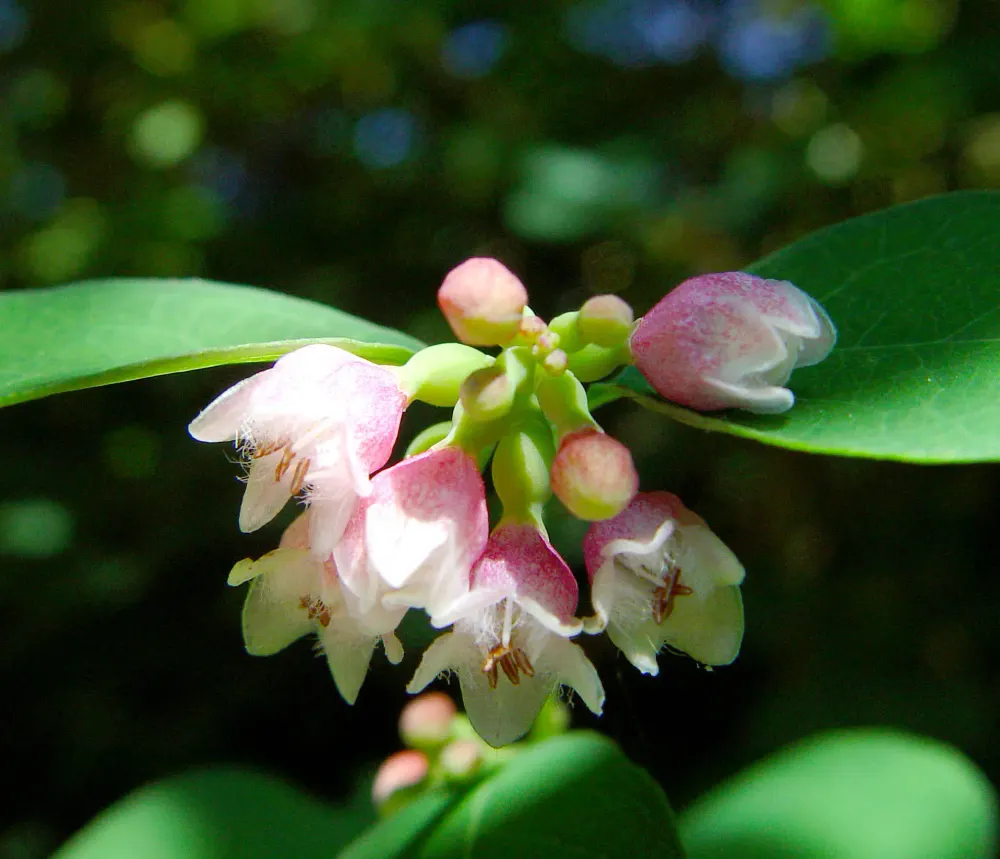
© No machine-readable author provided. ArtMechanic assumed (based on copyright claims). · CC BY-SA 3.0 · Commons
Symphoricarpos albus
Caution🐾Gewöhnliche Schneebeere · (Symphoricarpos albus)
Honeysuckle family (Caprifoliaceae)
Description
Symphoricarpos albus is a species of flowering plant in the honeysuckle family known by the common name common snowberry. Native to North America, it is browsed by some animals and planted for ornamental and ecological purposes, but is poisonous to humans.
🌿 Risk of confusion — read before wild-harvesting!
Fatal outcomes are not documented in modern toxicology; severity ranges from mild to moderate.
External use only!
This plant must NOT be taken internally. Use only as compress, salve, or bath.
CONTRAINDICATED during pregnancy
No medicinal use in pregnancy — the saponin- and glycoside-bearing berries can cause gastrointestinal irritation, and clinical safety data are entirely lacking. Wear gloves when handling crushed berries in the garden.
CONTRAINDICATED during breastfeeding
No use during lactation. Due to toxic constituents (saponins, symphoricarposide) and absent safety data, Symphoricarpos albus is not a medicinal plant for pregnant or breastfeeding women.
CONTRAINDICATED for children
Children must NEVER eat the berries — one of the most common playground and garden poisonings in Central Europe. Parents should educate small children about the white berries and supervise them in the garden. Contact poison control immediately if children ingest them; symptomatic treatment is usually sufficient. The traditional 'popping pea' game (crushing the berries) is harmless as long as no berries reach the mouth.
- RawWhole plantExternalTraditional use
Common snowberry is one of the most widely planted ornamental shrubs in Central Europe and has shaped park borders, hedges, cemetery plantings and especially railway embankments since the 19th century. Its conspicuous white, globular drupes often remain on the leafless shrub well into winter, decorating the bare landscape. The plant tolerates shade, drought, soil compaction, road salt and air pollution — traits that have made it a standard urban green-strip species.
[#src_wiki_de_symphoricarpos_albus] [#src_wiki_en_symphoricarpos_albus] [#src_pfaf_symphoricarpos_albus]
- RawWhole plantExternalTraditional use
As a densely suckering shrub, Symphoricarpos albus is excellent for free-growing privacy and windbreak hedges in wildlife gardens. The pink-white bell flowers from June to September provide bees, bumblebees and hoverflies with nectar over several months; the white berries are emergency winter food for many bird species (thrushes, blackbirds, fieldfares). Controversial in conservation terms, as the plant is regarded as an invasive neophyte in Central Europe and can suppress native ground flora in riparian woodlands.
[#src_wiki_de_symphoricarpos_albus] [#src_neobiota_bfn] [#src_pfaf_symphoricarpos_albus]
- RawFruitExternalFolk medicine
In the German-speaking world the shrub bears the folk name 'Knallerbse' or 'Knallerbsenstrauch' ('popping pea bush') because children would crush the ripe white berries on cobblestones or asphalt, where they burst with an audible pop. This children's game was widespread across Central Europe in the 19th and early 20th centuries and still shapes the cultural perception of the plant. Important: the berries were NOT eaten during the game — play was confined to crushing them, since the saponin-bearing fruit can cause symptoms if ingested.
[#src_wiki_de_symphoricarpos_albus] [#src_giz_bonn_snowberry]
- CompressFruitExternalFolk medicine
Indigenous peoples of the Pacific Northwest (Salish, Okanagan, Stl'atl'imx, Nlaka'pamux) historically used crushed berries and bark decoctions externally for skin rashes, cuts, sores and inflamed eyes. Application was as a poultice or wash. IMPORTANT: This ethnobotanical information serves cultural-historical documentation only — it must NOT be translated into modern self-medication. The saponin- and chelidonic-acid-bearing plant parts can cause irritation with prolonged skin contact; modern herbal practice has safer alternatives.
[#src_moerman_native_american] [#src_pfaf_symphoricarpos_albus]
- RawFruitInternalFolk medicine
Negative use (warning): The white berries of snowberry are among the most common causes of garden and playground poisonings in young children in Central Europe. Ingestion of a few berries causes nausea, vomiting, abdominal pain, diarrhoea and mild dizziness (saponin gastroenteritis). No fatalities are known from modern poisoning statistics; toxicity is mild to moderate. After ingestion by a child, contact the poison control centre — symptomatic treatment with adequate fluids is usually sufficient.
[#src_giz_bonn_snowberry] [#src_botanikus_schneebeere] [#src_aspca_snowberry]