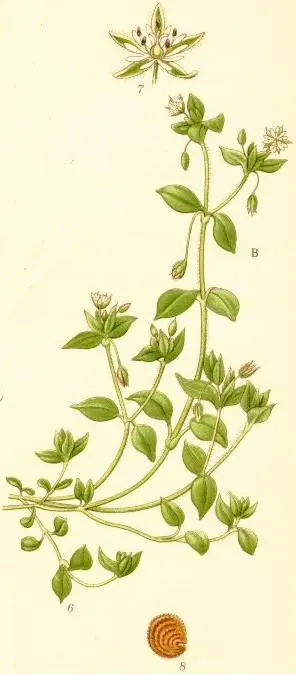
© Carl Axel Magnus Lindman (1856–1928) · Public domain · Commons
Common chickweed
CautionVogelmiere · (Stellaria media)
Pink family (Caryophyllaceae)
Description
Common chickweed is an annual, prostrate herb with round stems 3 to 40 cm long bearing a characteristic single line of hairs that alternates from side to side at each node. Its opposite, oval leaves are hairless, and the small white flowers have five deeply cleft petals that make them appear to have ten. In mild weather the plant flowers nearly year-round. The parts used are mainly the fresh aerial parts (herb), eaten raw as a wild vegetable and applied externally for skin conditions.
🌿 Risk of confusion — read before wild-harvesting!
Beware of confusion with the poisonous scarlet pimpernel (Lysimachia/Anagallis arvensis), which has a solid, angular stem and lacks chickweed's characteristic single line of hairs.
- RawAerial partsInternalTraditional use
Chickweed is a nutritious wild vegetable with a taste reminiscent of young raw corn; about 50 g of salad roughly covers an adult's daily vitamin C requirement.
Preparation & dosage
Add washed young fresh shoots raw to salads or briefly cook like spinach. Owing to the saponin content, do not eat very large amounts at once.
- SalveAerial partsExternalFolk medicine
The classic folk use: a cooling, soothing salve for itching, soreness and various skin complaints.
Preparation & dosage
Bruise the fresh herb and work it into unsalted lard (or a plant-based fat); apply as a cooling salve to itchy, irritated or inflamed skin.
- CompressAerial partsExternalFolk medicine
Fresh bruised leaves were traditionally used as a cooling, wound-soothing poultice.
Preparation & dosage
Crush the fresh herb and apply as a poultice to slow-healing wounds, minor ulcers or rheumatically painful areas; renew several times a day.
- TeaAerial partsInternalFolk medicine
Used in folk medicine as a tea for respiratory complaints and as a soothing (demulcent) remedy; not scientifically proven.
Preparation & dosage
Pour 250 ml of boiling water over 1 to 2 g of dried (or a handful of fresh) herb, steep covered for about 10 minutes, then strain.
- Dry amount
- 1–2 g
- Doses per day
- 3×
- Max duration
- 4 weeks
- TeaAerial partsInternalFolk medicine
Taken internally as a tea for rheumatism and joint pain; efficacy is not scientifically established.
Preparation & dosage
Prepare as the respiratory tea. Traditionally drunk for rheumatic complaints and joint pain, often alongside an external poultice.
- Dry amount
- 1–2 g
- Doses per day
- 3×
- Max duration
- 4 weeks
- TinctureAerial partsInternalFolk medicine
In the eclectic tradition a tincture was recommended for shifting, temporary rheumatic pains.
Preparation & dosage
Macerate the fresh herb in alcohol; take 2 to 4 ml of the finished tincture in a little water up to three times daily.
- Liquid amount
- 2–4 ml
- Doses per day
- 3×
- Max duration
- 4 weeks
- BathAerial partsExternalFolk medicine
Recorded as a skin-soothing bath for itching and skin irritation.
Preparation & dosage
Pour boiling water over a generous amount of fresh herb, steep, strain and add to the bath water; use as a full or partial bath for itchy or irritated skin.
🤝 Permaculture Partners
In your garden, this plant acts as: