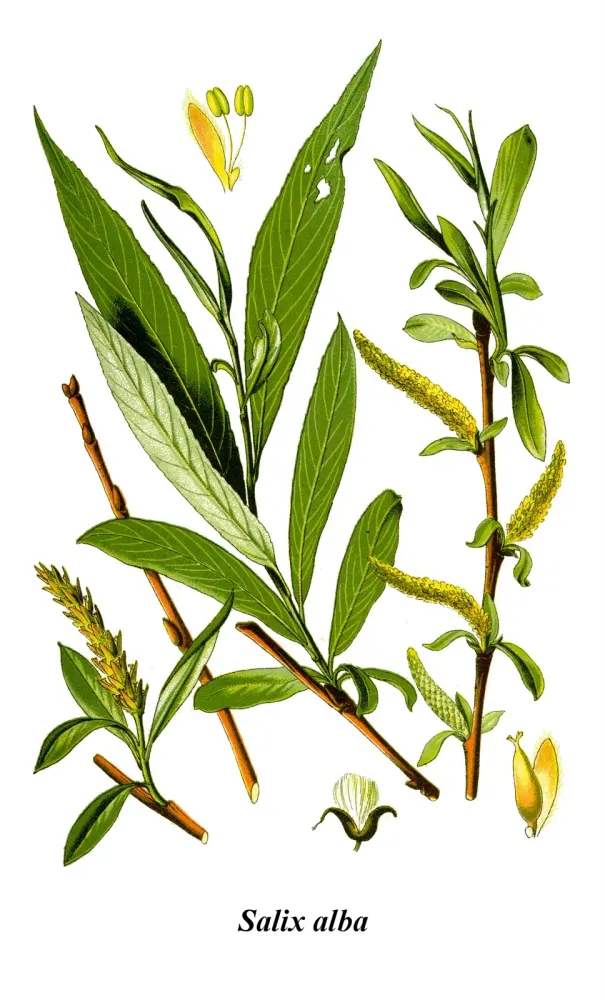
© Unknown (see Commons) · Public domain · Commons
Salix alba
CautionSilber-Weide · (Salix alba)
Willow family (Salicaceae)
Description
Salix alba, the white willow, is a species of willow native to Europe and western and Central Asia. The name derives from the white tone to the undersides of the leaves.
🌿 Risk of confusion — read before wild-harvesting!
SALICYLATE SENSITIVITY: Willow bark contains salicin (a salicylate precursor metabolised to salicylic acid). Cross-reactivity is possible with acetylsalicylic acid (aspirin) or other NSAIDs — AVOID willow bark if sensitive. REYE SYNDROME: Children and adolescents under 12 with viral infections (influenza, chickenpox) must not take salicylates — life-threatening risk. GASTROINTESTINAL: Take after meals if peptic ulcer, gastritis or NSAID-sensitive GI tract is known; discontinue and consult a doctor for severe stomach pain. DURATION: Short-term use; per EMA maximum 4 weeks without medical supervision. Chronic joint disease requires medical management. PAIN AS SIGNAL: Pain is a warning — identify the cause before prolonged symptomatic treatment.
CONTRAINDICATED during pregnancy
Willow bark is contraindicated in pregnancy, especially the third trimester: salicylates inhibit prostaglandin synthesis, may cause premature closure of the ductus arteriosus, delay labour and increase bleeding risk. EMA and ESCOP explicitly advise: do NOT use during pregnancy.
CONTRAINDICATED during breastfeeding
Salicylates pass into breast milk and may cause cumulative effects in infants. EMA and ESCOP advise: do NOT use during lactation.
CONTRAINDICATED for children
Children under 12: CONTRAINDICATED for fever associated with viral infections (Reye syndrome risk — life-threatening). Adolescents 12–18: medical supervision only, as Reye syndrome risk persists with viral infections. Fever in children always requires medical assessment.
Critical drug interactions with:
Antikoagulanzien / Thrombozytenaggregationshemmer (Warfarin, Phenprocoumon, Clopidogrel, ASS) · Nichtsteroidale Antirheumatika (Ibuprofen, Diclofenac, Naproxen) · Methotrexat (MTX)
- TeaBarkInternalCommission E
Decoction of willow bark (standardised to salicin) for low back pain, mild joint complaints and fever — positively assessed by Commission E; the EMA monograph lists the decoction as traditional use.
Preparation & dosage
DECOCTION (Commission E / EMA traditional use): 2–3 g of coarsely cut dried willow bark (Salix alba, S. purpurea or S. daphnoides) in 200–250 ml cold water, bring slowly to a boil, simmer 10–15 min, strain. Take 3× daily freshly prepared. Daily dose standardised to 60–120 mg total salicin. EMA indications: short-term relief of low back pain, mild joint pain and fever. Maximum 4 weeks without medical advice. Take after a meal if gastrointestinal sensitivity is known.
- Dry amount
- 2–3 g
- Doses per day
- 3×
- Max duration
- 4 weeks
⚠ Age restriction: ≥ 12 years — Not for children under 12 with fever (Reye syndrome risk, analogous to acetylsalicylic acid). Per EMA monograph: adults and adolescents from 12 years.
[#src_ema_salix_cortex] [#src_escop_salix_cortex] [#src_kommission_e_salix]
- TinctureBarkInternalCommission E
Willow bark tincture for rheumatic complaints, fever and headache — positive Kommission E assessment.
Preparation & dosage
TINCTURE (DER 1:5 in 25–40 % ethanol): 2–4 ml (~40–80 drops) 3× daily diluted in water. Daily dose corresponds to approx. 60–120 mg total salicin. Kommission E positive for fever, rheumatic complaints and headache. Tincture extracts phenolic glycosides slightly more efficiently than decoction. Maximum 4 weeks without medical supervision; avoid on empty stomach if gastric sensitivity known.
- Liquid amount
- 2–4 ml
- Doses per day
- 3×
- Max duration
- 4 weeks
⚠ Age restriction: ≥ 12 years — Not for children under 12 with fever (Reye syndrome risk). Due to ethanol content, avoid with alcohol dependence or liver disease.
[#src_kommission_e_salix] [#src_escop_salix_cortex] [#src_wichtl_teedrogen]
- TeaBarkInternalTraditional use
Traditional cold macerate of willow bark — folk alternative to decoction for mild fever and cold-related headache; gentler on the stomach.
Preparation & dosage
COLD INFUSION (traditional): 1–2 g coarsely cut willow bark in 200 ml cold water, macerate 8 hours, strain, warm to drinking temperature or drink cold. Some traditional sources prefer cold maceration as it extracts tannins more gently and is considered less stomach-irritating. 2× daily. Traditional use for mild cold-related fever and headache. Preferred over hot decoction for gastric sensitivity.
- Dry amount
- 1–2 g
- Doses per day
- 2×
- Max duration
- 2 weeks
[#src_wichtl_teedrogen] [#src_pfaf_salix_alba] [#src_wp_de_salix]
- BathBarkExternalFolk medicine
Willow bark bath for rheumatic complaints and muscle tension — external astringent and mildly anti-inflammatory folk remedy.
Preparation & dosage
BATH PREPARATION: 200–300 g dried willow bark in 3 litres cold water, bring to boil, simmer 20 min, strain. Add concentrate to bathwater (approx. 37–38 °C). Bathe 15–20 minutes. Folk use for rheumatic joint complaints, muscle tension and sweaty feet (astringent effect of tannins). External use avoids gastrointestinal issues. Dry and warm skin thoroughly after. Do not apply to open wounds or irritated skin.
- Dry amount
- 200–300 g
- Doses per day
- 1×
- Max duration
- 2 weeks
[#src_pfaf_salix_alba] [#src_madaus_salix] [#src_wp_de_salix]
- TinctureBarkExternalFolk medicine
External rubbing with willow bark tincture for local joint and muscle pain — folk use based on percutaneous salicin absorption and ethanol stimulation.
Preparation & dosage
RUBBING TINCTURE (external, undiluted or diluted 1:1): Apply 5–10 ml willow bark tincture (1:5 in 40–70 % ethanol) to affected joints or muscles and massage gently. Use 2× daily; wash after application. Folk external use for painful joints and muscles. Effect based on ethanol stimulation and mild percutaneous salicin absorption. Do not apply to open or irritated skin.
- Liquid amount
- 5–10 ml
- Doses per day
- 2×
- Max duration
- 4 weeks
- TeaLeafInternalFolk medicine
Folk medicinal leaf tea of white willow for mild colds and fever — weaker effect than bark decoction, rich in flavonoids and tannins.
Preparation & dosage
LEAF INFUSION: 1–2 tsp dried willow leaves in 200 ml boiling water, covered, steep 10 min, strain. 2× daily between meals. Lower salicin content than bark — milder effect. Folk use for mild colds and fever. Also contains flavonoids and tannins. Limit use to 2 weeks; prefer bark decoction if effect is insufficient.
- Dry amount
- 1–2 g
- Doses per day
- 2×
- Max duration
- 2 weeks
[#src_pfaf_salix_alba] [#src_madaus_salix] [#src_wp_de_salix]
- CompressBarkExternalFolk medicine
Willow bark decoction as compress for minor wounds, eczema and irritated skin — astringent and mildly anti-inflammatory folk medicine.
Preparation & dosage
COMPRESS: Boil 20–30 g willow bark in 500 ml water, simmer 15 min, cool, strain. Soak a clean linen cloth in the lukewarm decoction, wring out, apply to affected skin (poorly healing minor wounds, eczema, itchy skin). 2× daily, 15–20 minutes each time. Astringent tannins provide anti-inflammatory and contracting effect. If signs of infection or worsening: consult a doctor.
- Dry amount
- 20–30 g
- Doses per day
- 2×
- Max duration
- 2 weeks