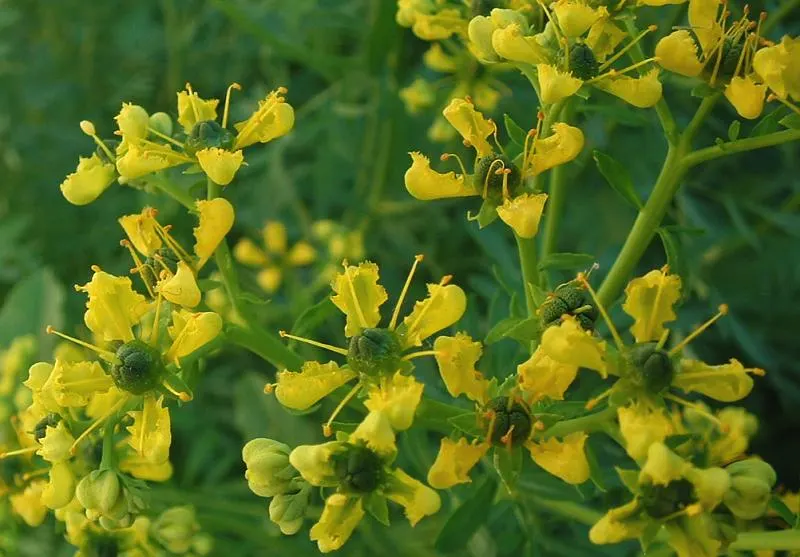
© Jeffdelonge (Wikimedia Commons) · CC BY-SA 3.0 · Commons
Common rue
Toxic🐾Weinraute · (Ruta graveolens)
Rue family (Rutaceae)
Description
Common rue is an evergreen Mediterranean subshrub usually growing 30–50 cm tall, rarely to 100 cm. Its blue-green, two- to three-times pinnate leaves give off a strong, pungent odour when bruised. Greenish-yellow flowers appear from June to November. For centuries it was an important medicinal, culinary and protective ('anti-witch') herb, but it is now regarded as toxic and phototoxic. Germany's Commission E rejected therapeutic use in 1989.
- CompressAerial partsExternalFolk medicine
Externally the plant was applied for joint pain, skin conditions and warts. Caution: skin contact combined with sunlight can cause severe blistering burns (phytophotodermatitis).
Historical documentation only — do NOT use
These internal applications are historically documented. This plant is highly toxic — self-treatment can cause severe poisoning or death. For documentation only, explicitly NOT a recommendation.
- TeaLeafInternalFolk medicine
Historically a leaf infusion was used for menstrual and digestive complaints. Internal use is now discouraged because of abortifacient effects, liver toxicity and poisoning risk – strictly forbidden in pregnancy.
- SpiceLeafInternalTraditional use
In Mediterranean cuisine tiny amounts of leaf were used as a strong, bitter seasoning. Traces only – larger amounts are toxic.